


Identification of candidate mediators of chemoresponse in breast cancer through therapy-driven selection of somatic variants
- PMID: 32734521
- PMCID: PMC7497675
- DOI: 10.1007/s10549-020-05836-7
Identification of candidate mediators of chemoresponse in breast cancer through therapy-driven selection of somatic variants
Abstract
Purpose: More than a third of primary breast cancer patients are treated with cytotoxic chemotherapy, typically without guidance from predictive markers. Increased use of neoadjuvant chemotherapy provides opportunities for identification of molecules associated with treatment response, by comparing matched tumour samples before and after therapy. Our hypothesis was that somatic variants of increased prevalence after therapy promote resistance, while variants with reduced prevalence cause sensitivity.
Methods: We performed systematic analyses of matched pairs of cancer exomes from primary oestrogen receptor-positive/HER2-negative breast cancers (n = 6) treated with neoadjuvant epirubicin/cyclophosphamide. We identified candidate genes as mediators of chemotherapy response by consistent subclonal changes in somatic variant prevalence through therapy, predicted variant impact on gene function, and enrichment of specific functional pathways. Influence of candidate genes on breast cancer outcome was tested using publicly available breast cancer expression data (n = 1903).
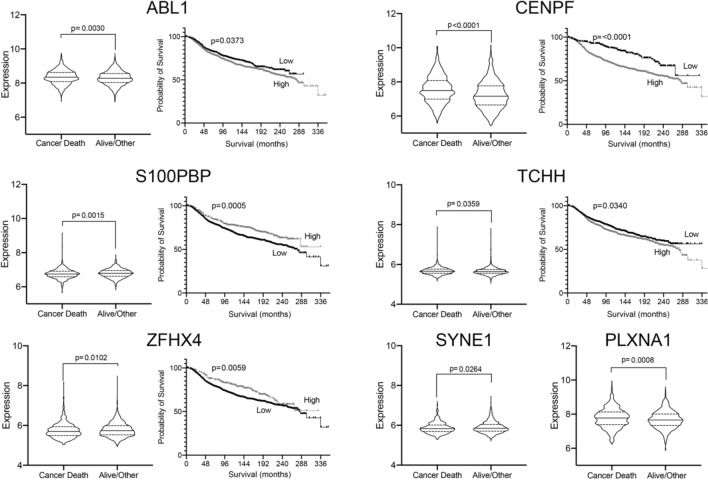
Results: We identified 14 genes as the strongest candidate mediators of chemoresponse: TCHH, MUC17, ARAP2, FLG2, ABL1, CENPF, COL6A3, DMBT1, ITGA7, PLXNA1, S100PBP, SYNE1, ZFHX4, and CACNA1C. Genes contained somatic variants showing prevalence changes in up to 4 patients, with up to 3 being predicted as damaging. Genes coding for extra-cellular matrix components or related signalling pathways were significantly over-represented among variants showing prevalence changes. Expression of 5 genes (TCHH, ABL1, CENPF, S100PBP, and ZFHX4) was significantly associated with patient survival.
Conclusions: Genomic analysis of paired pre- and post-therapy samples resulting from neoadjuvant therapy provides a powerful method for identification of mediators of response. Genes we identified should be assessed as predictive markers or targets in chemo-sensitization.
Keywords: Chemoresistance; Exome sequencing; Sensitization; Somatic variants.
Conflict of interest statement
All authors declare that they have no conflicts of interest.
Figures
References
-
- Li Z, Gao X, Peng X, May Chen MJ, Li Z, Wei B, Wen X, Wei B, Dong Y, Bu Z, Wu A, Wu Q, Tang L, Li Z, Liu Y, Zhang L, Jia S, Zhang L, Shan F, Zhang J, Wu X, Ji X, Ji K, Wu X, Shi J, Xing X, Wu J, Lv G, Shen L, Ji X, Liang H, Ji J. Multi-omics characterization of molecular features of gastric cancer correlated with response to neoadjuvant chemotherapy. Sci Adv. 2020;6(9):4211. doi: 10.1126/sciadv.aay4211. - DOI - PMC - PubMed
MeSH terms
Substances
Grants and funding
LinkOut - more resources
Full Text Sources
Medical
Research Materials
Miscellaneous
