


Associations between abdominal obesity indices and diabetic complications: Chinese visceral adiposity index and neck circumference
- PMID: 32736628
- PMCID: PMC7395356
- DOI: 10.1186/s12933-020-01095-4
Associations between abdominal obesity indices and diabetic complications: Chinese visceral adiposity index and neck circumference
Abstract
Background and aims: Obesity, especially abdominal obesity, has been considered a risk factor for diabetic complications. Many abdominal obesity indices have been established, including neck circumference (NC), waist-to-hip ratio (WHR), lipid accumulation product (LAP), visceral adiposity index (VAI) and the Chinese visceral adiposity index (CVAI). However, studies investigating the associations between these indices and diabetic complications are limited. The objective of this study was to investigate the associations of the abdominal obesity indices with cardiovascular and cerebrovascular disease (CVD), diabetic kidney disease (DKD) and diabetic retinopathy (DR).
Methods: A total of 4658 diabetic participants were enrolled from seven communities in Shanghai, China, in 2018. Participants completed questionnaires and underwent blood pressure, glucose, lipid profile, and urine albumin/creatinine ratio measurements; fundus photographs; and anthropometric parameters, including height, weight, waist circumference (WC), NC and hip circumference (HC).
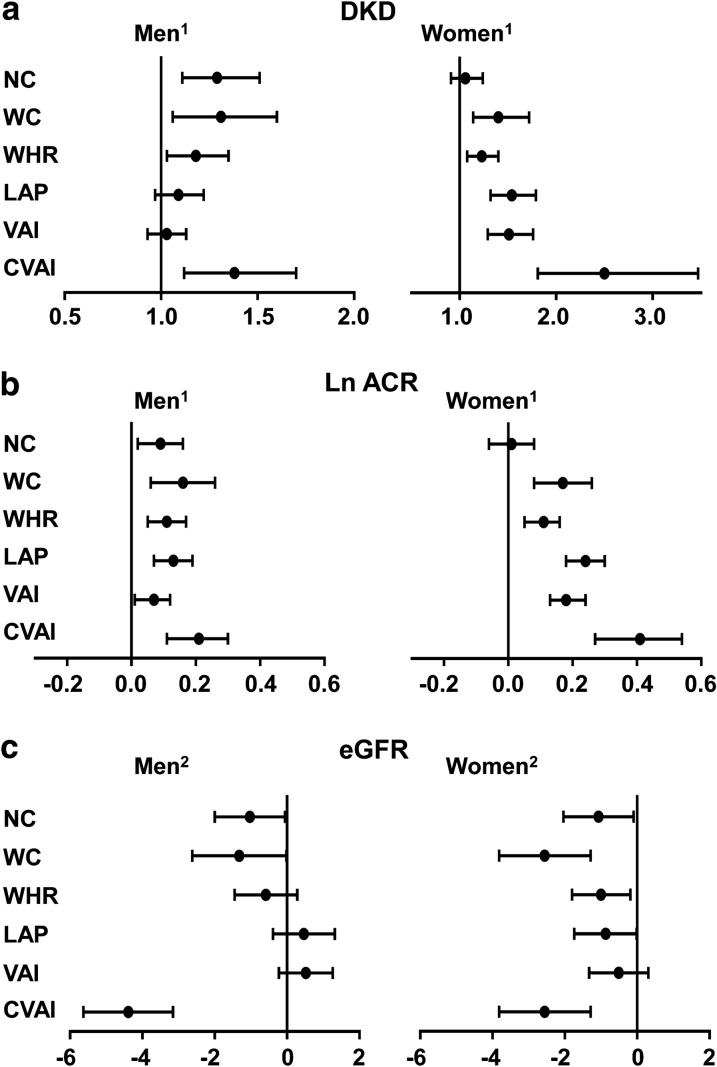
Results: In men, a one standard deviation (SD) increase in CVAI level was significantly associated with a greater prevalence of CVD (OR 1.35; 95% CI 1.13, 1.62) and DKD (OR 1.38; 95% CI 1.12, 1.70) (both P < 0.05). In women, a one SD increase in CVAI level was significantly associated with a greater prevalence of CVD (OR 1.32; 95% CI 1.04, 1.69) and DKD (OR 2.50; 95% CI 1.81, 3.47) (both P < 0.05). A one SD increase in NC was significantly associated with a greater prevalence of CCA plaque in both men (OR 1.26; 95% CI 1.10, 1.44) and women (OR 1.20; 95% CI 1.07, 1.35). These associations were all adjusted for potential confounding factors.
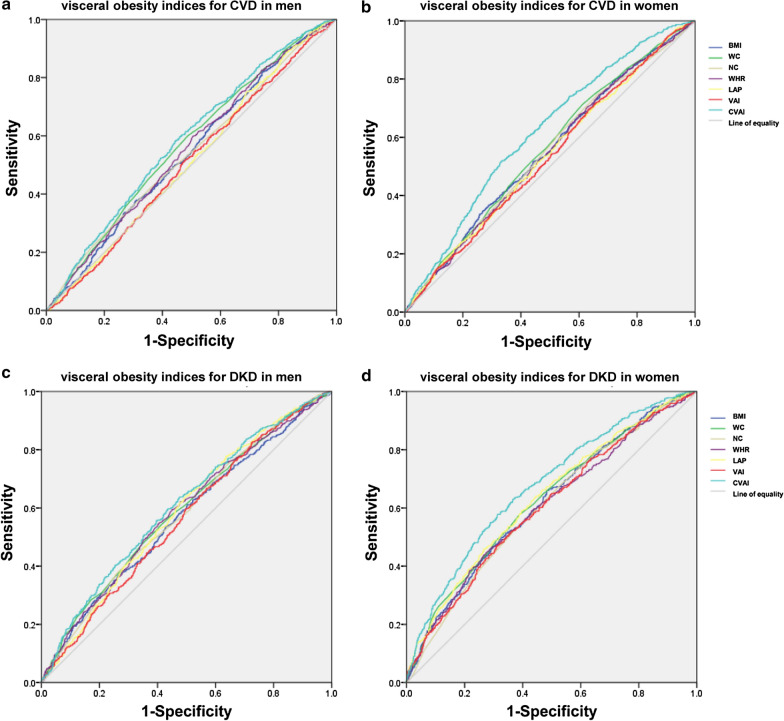
Conclusions: CVAI was most strongly associated with the prevalence of CVD and DKD among the abdominal obesity indices, and NC was unique associated with the prevalence of CCA plaque in Chinese adults with diabetes. Trial registration ChiCTR1800017573, www.chictr.org.cn . Registered 04 August 2018.
Keywords: Abdominal obesity; Cardiovascular and cerebrovascular disease; Chinese visceral adiposity index; Diabetic complications; Diabetic kidney disease; Neck circumference.
Conflict of interest statement
The authors declare that they have no competing or financial interests regarding the submitted work.
Figures


References
-
- Chooi YC, Ding C, Magkos F. The epidemiology of obesity. Metab Clin Exp. 2019;92:6–10. - PubMed
-
- Garvey WT, Garber AJ, Mechanick JI, Bray GA, Dagogo-Jack S, Einhorn D, Grunberger G, Handelsman Y, Hennekens CH, Hurley DL, et al. American association of clinical endocrinologists and american college of endocrinology position statement on the 2014 advanced framework for a new diagnosis of obesity as a chronic disease. Endocr Pract. 2014;20(9):977–989. - PMC - PubMed
-
- Man RE, Sabanayagam C, Chiang PP, Li LJ, Noonan JE, Wang JJ, Wong TY, Cheung GC, Tan GS, Lamoureux EL. Differential association of generalized and abdominal obesity with diabetic retinopathy in Asian patients with type 2 diabetes. JAMA Ophthalmol. 2016;134(3):251–257. - PubMed
-
- Lee SW, Son JY, Kim JM, Hwang SS, Han JS, Heo NJ. Body fat distribution is more predictive of all-cause mortality than overall adiposity. Diabetes Obes Metab. 2018;20(1):141–147. - PubMed
Publication types
MeSH terms
Associated data
LinkOut - more resources
Full Text Sources
Medical
Research Materials
