. 2020 Sep 2;10(9):2999-3008.
doi: 10.1534/g3.120.401545.

Genome-Wide Screen for Context-Dependent Tumor Suppressors Identified Using in Vivo Models for Neoplasia in Drosophila

Affiliations

Genome-Wide Screen for Context-Dependent Tumor Suppressors Identified Using in Vivo Models for Neoplasia in Drosophila

Casper Groth et al. G3 (Bethesda). .

Abstract

Genetic approaches in Drosophila have successfully identified many genes involved in regulation of growth control as well as genetic interactions relevant to the initiation and progression of cancer in vivo Here, we report on large-scale RNAi-based screens to identify potential tumor suppressor genes that interact with known cancer-drivers: the Epidermal Growth Factor Receptor and the Hippo pathway transcriptional cofactor Yorkie. These screens were designed to identify genes whose depletion drove tissue expressing EGFR or Yki from a state of benign overgrowth into neoplastic transformation in vivo We also report on an independent screen aimed to identify genes whose depletion suppressed formation of neoplastic tumors in an existing EGFR-dependent neoplasia model. Many of the positives identified here are known to be functional in growth control pathways. We also find a number of novel connections to Yki and EGFR driven tissue growth, mostly unique to one of the two. Thus, resources provided here would be useful to all researchers who study negative regulators of growth during development and cancer in the context of activated EGFR and/or Yki and positive regulators of growth in the context of activated EGFR. Resources reported here are available freely for anyone to use.

Keywords: Drosophila; EGFR; Hippo pathway; Neoplasia; Tumorigenesis.


Figures

Figure 1
Figure 1
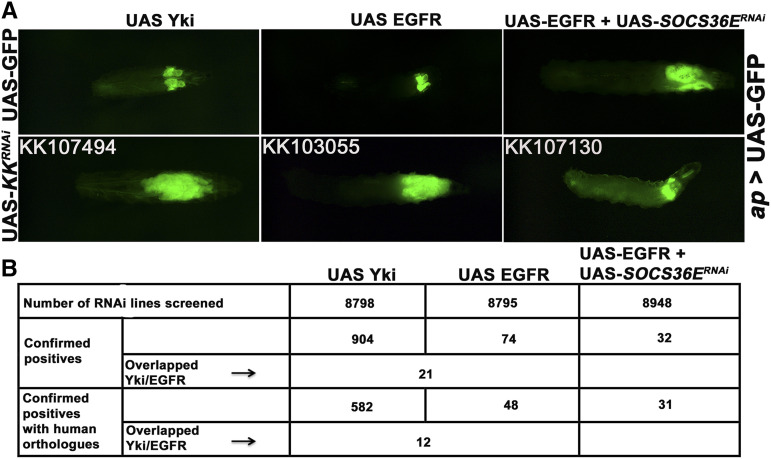
tumor formation/suppression visualized in intact larvae (A) Larvae co-expressed UAS-GFP with the indicated transgenes to permit visualization of the imaginal discs in the intact animal. All samples carried the ap-Gal4 driver and UAS-GFP. In addition, they carried either a second copy of UAS-GFP or one of the following: UAS-Yki, UAS-EGFR or UAS-EGFR+UAS-SOCS36ERNAi. (B) Table summarizing the number of RNAi lines screened and identified in the three large-scale screens (represents those many number of interacting genes).
Figure 2
Figure 2
Summary of pathway enrichment analysis of fly genes identify in the in vivo screens reported here. (A, C, E) The results of the pathway and gene set enrichment analysis are shown as graphical interaction maps. Each node represents a significantly enriched term or pathway from the GO, KEGG, Reactome and Panther databases (Table S3). Color-coding indicates functionally related groups of terms. Lines indicate genes shared among different terms. (B, D, F) show the individual genes associated with functionally enriched cluster. (A, B) UAS-EGFR screen (C, D) UAS-Yki screen (E, F) UAS-EGFR+UAS-SOCS36ERNAi screen
Figure 3
Figure 3
STRING interactome analysis of potential interactors of EGFR and YKi in Drosophila. STRING analysis was performed with confidence score of 0.7 and MCL clustering value of 2. (A) STRING Interactome of 73 fly genes identified as potential negative regulators in the context of over expression of EGFR. 17 out of those formed molecular clusters (with PPI enrichment value of 0.000482), largest being a cluster of 6 genes, all of which are constitutes of Fat/Hippo pathway (shown in red; FDR-1.39E-5). (B) STRING Interactome of 888 genes of identified as potential negative regulators in the context of over expression of Yki. 228 of those formed a single cluster with PPI enrichment value 1.4E-06. Components of Fat/Hippo pathway (red: FDR-0.00076) and Autophagy genes (blue: FDR-0.0241) are enriched in this cluster. (C) STRING Interactome of 32 fly genes identified as potential oncogenes in the context of SOCS suppression. 27 out of those formed molecular clusters (with PPI enrichment value of 0.0122), largest being a cluster of 14 genes. A smaller cluster comprising of EGFR and DrK were enriched in Dorso-ventral axis formation (shown in purple: FDR-0.0089).
Figure 4
Figure 4
Summary of pathway enrichment analysis of human orthologs (A, C, E) The results of the pathway and gene set enrichment analysis are shown as enrichment maps. Each node represents a significantly enriched term or pathway from the GO, KEGG, Reactome and PANTHER, NCI, MsigDB, BIOCARTA databases (Table S3). Color-coding indicates functionally related groups of terms. Lines indicate genes shared among different terms. (B, D, F) show the individual genes associated with functionally enriched cluster. (A, B) UAS-EGFR screen (C, D) UAS-Yki screen (E, F) UAS-EGFR+UAS-SOCS36ERNAi screen.

References

    1. Alexandrov L. B., Nik-Zainal S., Wedge D. C., Aparicio S. A. J. R., Behjati S. et al. , 2013. Signatures of mutational processes in human cancer. Nature 500: 415–421. 10.1038/nature12477 - DOI - PMC - PubMed
    1. Andrejeva D., Kugler J. M., Nguyen H. T., Malmendal A., Holm M. L. et al. , 2018. Metabolic control of PPAR activity by aldehyde dehydrogenase regulates invasive cell behavior and predicts survival in hepatocellular and renal clear cell carcinoma 11 Medical and Health Sciences 1112 Oncology and Carcinogenesis. BMC Cancer 18: 1–15. - PMC - PubMed
    1. Aragona M., Panciera T., Manfrin A., Giulitti S., Michielin F. et al. , 2013. A mechanical checkpoint controls multicellular growth through YAP/TAZ regulation by actin-processing factors. Cell 154: 1047–1059. 10.1016/j.cell.2013.07.042 - DOI - PubMed
    1. Ashburner M., Ball C. A., Blake J. A., Botstein D., Butler H. et al. , 2000. Gene Ontology: tool for the unification of biology. Nat. Genet. 25: 25–29. - PMC - PubMed
    1. Brumby A. M., Goulding K. R., Schlosser T., Loi S., Galea R. et al. , 2011. Identification of novel Ras-cooperating oncogenes in Drosophila melanogaster: A RhoGEF/Rho-family/JNK pathway is a central driver of tumorigenesis. Genetics 188: 105–125. 10.1534/genetics.111.127910 - DOI - PMC - PubMed

Publication types

LinkOut - more resources