


Factors Contributing to the Rising National Cost of Glucose-Lowering Medicines for Diabetes During 2005-2007 and 2015-2017
- PMID: 32737138
- PMCID: PMC7510041
- DOI: 10.2337/dc19-2273
Factors Contributing to the Rising National Cost of Glucose-Lowering Medicines for Diabetes During 2005-2007 and 2015-2017
Abstract
Objective: We examined changes in glucose-lowering medication spending and quantified the magnitude of factors that are contributing to these changes.
Research design and methods: Using the Medical Expenditure Panel Survey, we estimated the change in spending on glucose-lowering medications during 2005-2007 and 2015-2017 among adults aged ≥18 years with diabetes. We decomposed the increase in total spending by medication groups: for insulin, by human and analog; and for noninsulin, by metformin, older, newer, and combination medications. For each group, we quantified the contributions by the number of users and cost-per-user. Costs were in 2017 U.S. dollars.
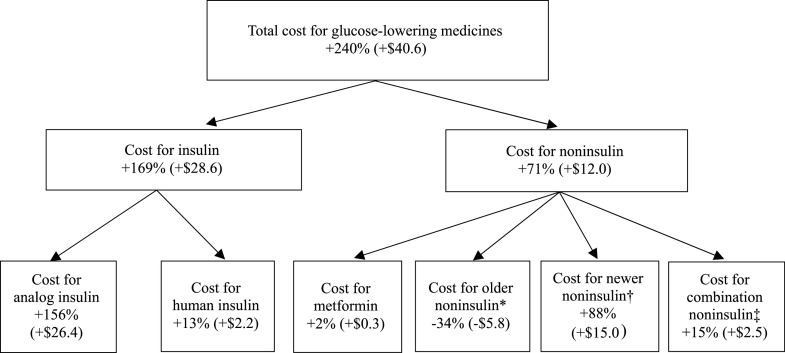
Results: National spending on glucose-lowering medications increased by $40.6 billion (240%), of which insulin and noninsulin medications contributed $28.6 billion (169%) and $12.0 billion (71%), respectively. For insulin, the increase was mainly associated with higher expenditures from analogs (156%). For noninsulin, the increase was a net effect of higher cost for newer medications (+88%) and decreased cost for older medications (-34%). Most of the increase in insulin spending came from the increase in cost-per-user. However, the increase in the number of users contributed more than cost-per-user in the rise of most noninsulin groups.
Conclusions: The increase in national spending on glucose-lowering medications during the past decade was mostly associated with the increased costs for insulin, analogs in particular, and newer noninsulin medicines, and cost-per-user had a larger effect than the number of users. Understanding the factors contributing to the increase helps identify ways to curb the growth in costs.
© 2020 by the American Diabetes Association.
Figures
Comment in
-
The High Cost of Diabetes Drugs: Disparate Impact on the Most Vulnerable Patients.Diabetes Care. 2020 Oct;43(10):2330-2332. doi: 10.2337/dci20-0039. Diabetes Care. 2020. PMID: 32958616 Free PMC article. No abstract available.
References
Publication types
MeSH terms
Substances
Associated data
LinkOut - more resources
Full Text Sources
Medical
Miscellaneous
