


Higher satisfaction after total knee arthroplasty using restricted inverse kinematic alignment compared to adjusted mechanical alignment
- PMID: 32737528
- PMCID: PMC8866329
- DOI: 10.1007/s00167-020-06165-4
Higher satisfaction after total knee arthroplasty using restricted inverse kinematic alignment compared to adjusted mechanical alignment
Abstract
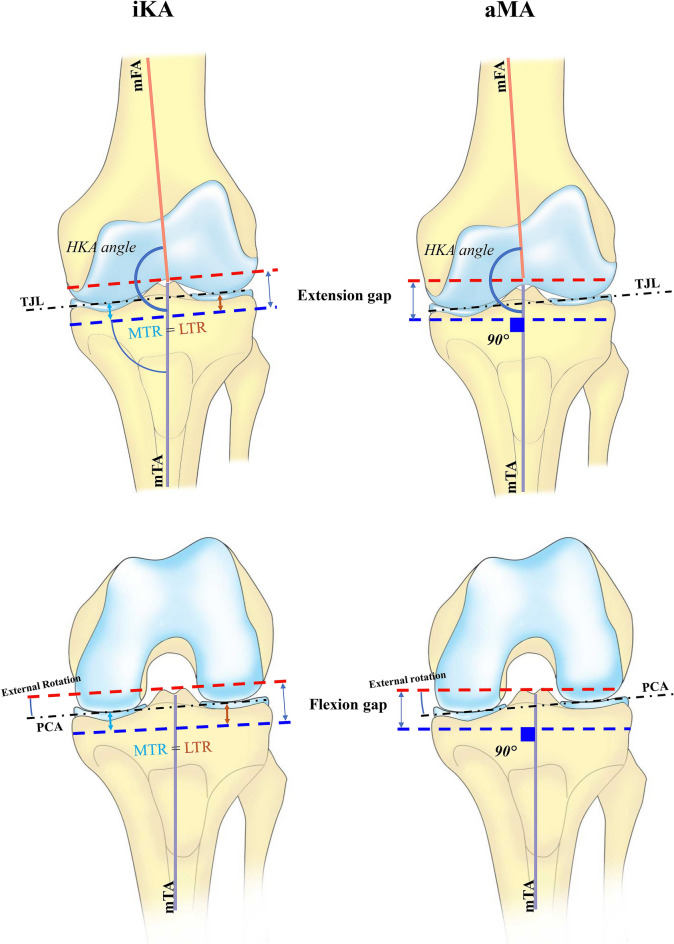
Purpose: Various alignment philosophies for total knee arthroplasty (TKA) have been described, all striving to achieve excellent long-term implant survival and good functional outcomes. In recent years, in search of higher functionality and patient satisfaction, a shift towards more tailored and patient-specific alignment is seen. The purpose of this study was to describe a restricted 'inverse kinematic alignment' (iKA) technique, and to compare clinical outcomes of patients that underwent robotic-assisted TKA performed by restricted iKA vs. adjusted mechanical alignment (aMA).
Methods: The authors reviewed the records of a consecutive series of patients that received robotic-assisted TKA with restricted iKA (n = 40) and with aMA (n = 40). Oxford Knee Score (OKS) and satisfaction on a visual analogue scale (VAS) were collected at a follow-up of 12 months. Clinical outcomes were assessed according to patient acceptable symptom state (PASS) thresholds, and uni- and multivariable linear regression analyses were performed to determine associations of OKS and satisfaction with six variables (age, sex, body mass index (BMI), preoperative hip-knee-ankle (HKA) angle, preoperative OKS, alignment technique).
Results: The restricted iKA and aMA techniques yielded comparable outcome scores (p = 0.069), with OKS, respectively, 44.6 ± 3.5 and 42.2 ± 6.3. VAS Satisfaction was better (p = 0.012) with restricted iKA (9.2 ± 0.8) compared to aMA (8.5 ± 1.3). The number of patients that achieved OKS and satisfaction PASS thresholds was significantly higher (p = 0.049 and p = 0.003, respectively) using restricted iKA (98% and 80%) compared to aMA (85% and 48%). Knees with preoperative varus deformity, achieved significantly (p = 0.025) better OKS using restricted iKA (45.4 ± 2.0) compared to aMA (41.4 ± 6.8). Multivariable analyses confirmed better OKS (β = 3.1; p = 0.007) and satisfaction (β = 0.73; p = 0.005) with restricted iKA.
Conclusions: The results of this study suggest that restricted iKA and aMA grant comparable clinical outcomes at 12-month follow-up, though a greater proportion of knees operated by restricted iKA achieved the PASS thresholds for OKS and satisfaction. Notably. in knees with preoperative varus deformity, restricted iKA yielded significantly better OKS and satisfaction than aMA.
Level of evidence: Level III, comparative study.
Keywords: Arthroplasty; Inverse kinematic alignment; Knee replacement; Patient satisfaction; Patient-reported outcomes; Patient-specific alignment; Robotic surgical procedures.
© 2020. The Author(s).
Conflict of interest statement
The authors declare that they have no competing interests.
Figures

References
-
- Beck EC, Nwachukwu BU, Mehta N, Jan K, Okoroha KR, Rasio J, Nho SJ. Defining meaningful functional improvement on the visual analog scale for satisfaction at 2 years after hip arthroscopy for femoroacetabular impingement syndrome. Arthroscopy. 2020;36(3):734–742.e732. doi: 10.1016/j.arthro.2019.09.028. - DOI - PubMed
-
- Cicchetti D. Guidelines, criteria, and rules of thumb for evaluating normed and standardized assessment instruments in psychology. Psychol Assess. 1994;6(4):284–290. doi: 10.1037/1040-3590.6.4.284. - DOI
MeSH terms
LinkOut - more resources
Full Text Sources
Other Literature Sources
Medical
Research Materials
