


Tracheostomy, ventilatory wean, and decannulation in COVID-19 patients
- PMID: 32740720
- PMCID: PMC7395208
- DOI: 10.1007/s00405-020-06187-1
Tracheostomy, ventilatory wean, and decannulation in COVID-19 patients
Abstract
Purpose: COVID-19 patients requiring mechanical ventilation can overwhelm existing bed capacity. We aimed to better understand the factors that influence the trajectory of tracheostomy care in this population to facilitate capacity planning and improve outcomes.
Methods: We conducted an observational cohort study of patients in a high-volume centre in the worst-affected region of the UK including all patients that underwent tracheostomy for COVID-19 pneumonitis ventilatory wean from 1st March 2020 to 10th May 2020. The primary outcome was time from insertion to decannulation. The analysis utilised Cox regression to account for patients that are still progressing through their tracheostomy pathway.
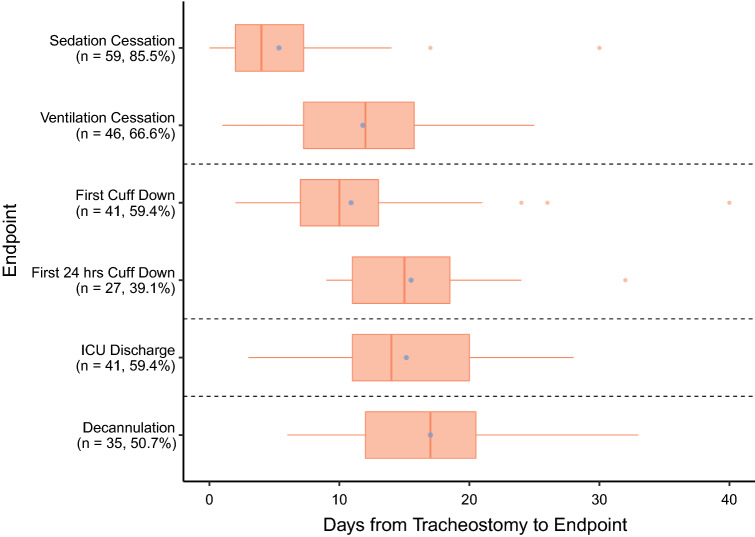
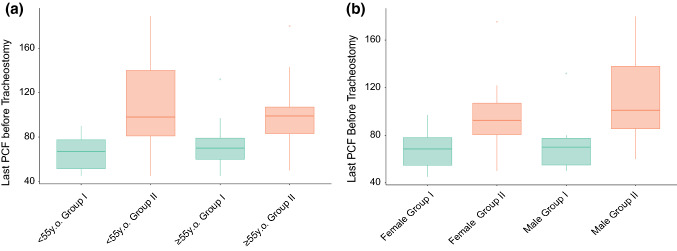
Results: At the point of analysis, a median 21 days (IQR 15-28) post-tracheostomy and 39 days (IQR 32-45) post-intubation, 35/69 (57.4%) patients had been decannulated a median of 17 days (IQR 12-20.5) post-insertion. The overall median age was 55 (IQR 48-61) with a male-to-female ratio of 2:1. In Cox regression analysis, FiO2 at tracheostomy ≥ 0.4 (HR 1.80; 95% CI 0.89-3.60; p = 0.048) and last pre-tracheostomy peak cough flow (HR 2.27; 95% CI 1.78-4.45; p = 0.001) were independent variables associated with prolonged time to decannulation.
Conclusion: Higher FiO2 at tracheostomy and higher pre-tracheostomy peak cough flow are associated with increased delay in COVID-19 tracheostomy patient decannulation. These finding comprise the most comprehensive report of COVID-19 tracheostomy decannulation to date and will assist service planning for future peaks of this pandemic.
Keywords: COVID-19; Decannulation; Peak cough flow; SARS-CoV-2; Tracheostomy; Tracheotomy.
Conflict of interest statement
The authors declare that they have no conflict of interest.
Figures
References
-
- Wu Z, McGoogan JM. Characteristics of and important lessons from the coronavirus disease 2019 (COVID-19) outbreak in china: summary of a report of 72314 cases from the chinese center for disease control and prevention. JAMA—J Am Med Assoc. 2020;323:1239–1242. doi: 10.1001/jama.2020.2648. - DOI - PubMed
Publication types
MeSH terms
LinkOut - more resources
Full Text Sources
Medical
Miscellaneous
