


Physical activity, obesity and sedentary behavior in cancer etiology: epidemiologic evidence and biologic mechanisms
- PMID: 32741068
- PMCID: PMC7931121
- DOI: 10.1002/1878-0261.12772
Physical activity, obesity and sedentary behavior in cancer etiology: epidemiologic evidence and biologic mechanisms
Abstract
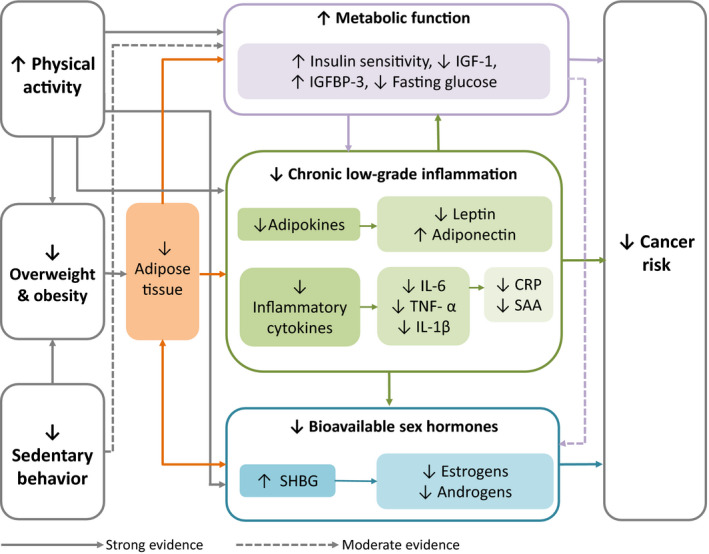
An estimated 30-40% of cancers can be prevented through changes in modifiable lifestyle and environmental risk factors known to be associated with cancer incidence. Despite this knowledge, there remains limited awareness that these associations exist. The purpose of this review article was to summarize the epidemiologic evidence concerning the contribution of physical activity, sedentary behavior, and obesity to cancer etiology and to provide an overview of the biologic mechanisms that may be operative between these factors and cancer incidence. Strong and consistent evidence exists that higher levels of physical activity reduce the risk of six different cancer sites (bladder, breast, colon, endometrial, esophageal adenocarcinoma, gastric cardia), whereas moderate evidence inversely associates physical activity with lung, ovarian, pancreatic and renal cancer, and limited evidence inversely correlates physical activity with prostate cancer. Sedentary behavior, independent of physical activity, has been shown to increase the risk of colon, endometrial, and lung cancers. Obesity is an established risk factor for 13 different cancer sites (endometrial, postmenopausal breast, colorectal, esophageal, renal/kidneys, meningioma, pancreatic, gastric cardia, liver, multiple myeloma, ovarian, gallbladder, and thyroid). The main biologic mechanisms whereby physical activity, sedentary behavior, and obesity are related to cancer incidence include an effect on endogenous sex steroids and metabolic hormones, insulin sensitivity, and chronic inflammation. Several emerging pathways related to oxidative stress, DNA methylation, telomere length, immune function, and gut microbiome are presented. Key recommendations for future research in both the epidemiology and biology of the associations between physical activity, sedentary behavior, obesity, and cancer risk are also provided.
Keywords: chronic inflammation; hormone; metabolism; obesity; physical activity; sedentary behavior.
© 2020 The Authors. Published by FEBS Press and John Wiley & Sons Ltd.
Conflict of interest statement
The authors declare no conflict of interest.
Figures
References
-
- Kulhánová I, Znaor A, Shield KD, Arnold M, Vignat J, Charafeddine M, Fadhil I, Fouad H, Al‐Omari A, Al‐Zahrani AS et al. (2020) Proportion of cancers attributable to major lifestyle and environmental risk factors in the Eastern Mediterranean region. Int J Cancer 146, 646–656. - PubMed
-
- Poirier AE, Ruan Y, Volesky KD, King WD, O'Sullivan DE, Gogna P, Walter SD, Villeneuve PJ, Friedenreich CM & Brenner DR (2019) The current and future burden of cancer attributable to modifiable risk factors in Canada: summary of results. Prev Med 122, 140–147. - PubMed
-
- Ding D, Lawson KD, Kolbe‐Alexander TL, Finkelstein EA, Katzmarzyk PT, van Mechelen W & Pratt M (2016) The economic burden of physical inactivity: a global analysis of major non‐communicable diseases. Lancet 388, 1311–1324. - PubMed
