Discrepancies in the Prevalence of Known Frailty Scales: Korean Frailty and Aging Cohort Study
- PMID: 32743263
- PMCID: PMC7387589
- DOI: 10.4235/agmr.2018.22.3.137
Discrepancies in the Prevalence of Known Frailty Scales: Korean Frailty and Aging Cohort Study
Erratum in
-
Erratum: Discrepancies in the Prevalence of Known Frailty Scales: Korean Frailty and Aging Cohort Study.Ann Geriatr Med Res. 2018 Dec;22(4):208. doi: 10.4235/agmr.18.0049. Epub 2018 Dec 31. Ann Geriatr Med Res. 2018. PMID: 32743276 Free PMC article.
Abstract
Background: The identification of frailty is considered an effective means of enhancing healthy aging. The definition of frailty affects its prevalence and associated institutionalization and mortality. This study aimed to identify the prevalence of frailty among community-dwelling older Korean adults according to different frailty scales.
Methods: This cross-sectional study based on the Korean Frailty and Aging Cohort Study represents a population of 1,318 people aged 70 years and older. Discrepancies in the prevalence of frailty were evaluated among six validated assessment tools. Multivariate logistic regression analysis was used to evaluate the prevalence of frailty according to its predictors (age, sex, and socioeconomic status).
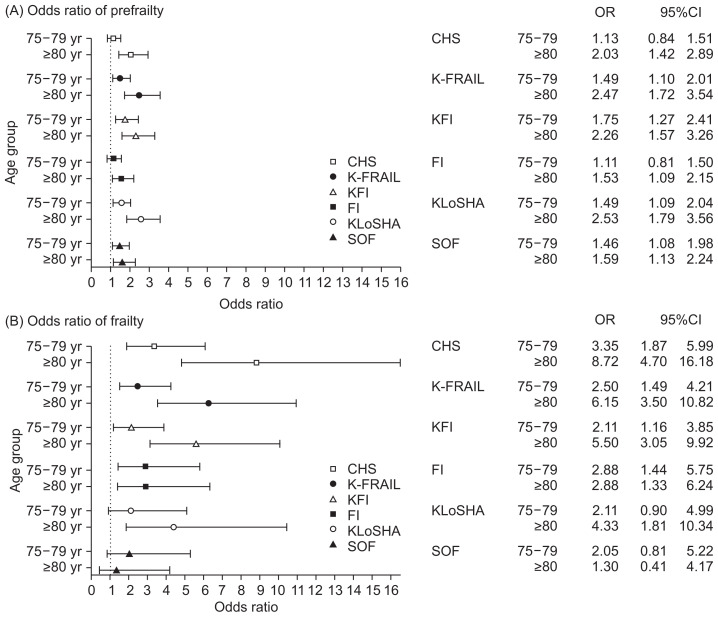
Results: The mean age of the participants was 76.1 (standard deviation, 3.9) years, and females comprised 51.0%. The prevalence of frailty varied from 2.5% to 12.4% using the Study of Osteoporotic Fracture frailty index and the Korean version of the Fatigue, Resistance, Ambulation, Illnesses, and Loss of Weight scale, respectively. The prevalence of frailty was higher among women and frailty rates increased with age on all scales. The risks of prefrailty and frailty were increased among participants with a low education level after adjusting for age, sex, residence, and income level.
Conclusion: In this study, the prevalence of frailty was found to vary depending on the scale used. Efforts aimed at screening and providing intervention for frailty and frail adults at risk, respectively, are needed to improve health outcomes considering the characteristics of each frailty scale and the determined prevalence.
Keywords: Frailty; Frailty scale; Korean Frailty and Aging Cohort Study; Older; Prevalence.
Copyright © 2018 by The Korean Geriatric Society.
Conflict of interest statement
The researchers claim no conflicts of interest.
Figures
References
-
- Korean Statistical Information Service . Population projections for Korea: 2010–2060 (Based on the 2010 Census) Daejoen (Korea): Korean Statistical Information Service; 2012.
-
- Jung HW, Kim KI. Multimorbidity in older adults. J Korean Geriatr Soc. 2014;18:65–71. doi: 10.4235/jkgs.2014.18.2.65. - DOI
LinkOut - more resources
Full Text Sources