Measuring Frailty in Health Care Databases for Clinical Care and Research
- PMID: 32743326
- PMCID: PMC7370795
- DOI: 10.4235/agmr.20.0002
Measuring Frailty in Health Care Databases for Clinical Care and Research
Abstract
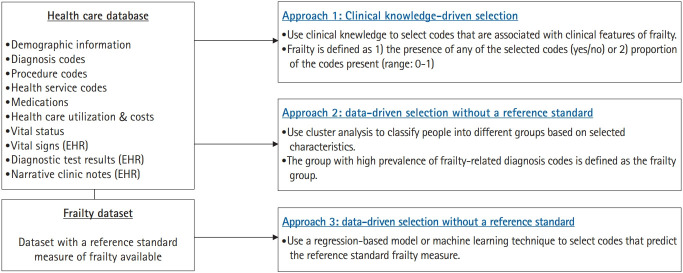
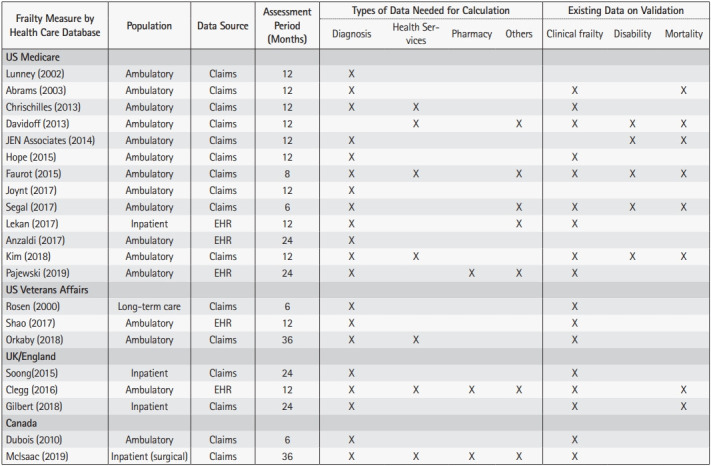
Considering the increasing burden and serious consequences of frailty in aging populations, there is increasing interest in measuring frailty in health care databases for clinical care and research. This review synthesizes the latest research on the development and application of 21 frailty measures for health care databases. Frailty measures varied widely in terms of target population (16 ambulatory, 1 long-term care, and 4 inpatient), data source (16 claims-based and 5 electronic health records [EHR]-based measures), assessment period (6 months to 36 months), data types (diagnosis codes required for 17 measures, health service codes for 7 measures, pharmacy data for 4 measures, and other information for 9 measures), and outcomes for validation (clinical frailty for 7 measures, disability for 7 measures, and mortality for 16 measures). These frailty measures may be useful to facilitate frailty screening in clinical care and quantify frailty for large database research in which clinical assessment is not feasible.
Keywords: Electronic health records; Frailty; Healthcare administrative claims.
Copyright © 2020 Korean Geriatrics Society.
Conflict of interest statement
CONFLICT OF INTEREST The author provides paid consultative services to Alosa Health, a nonprofit educational organization with no relationship to any drug or device manufacturers.
Figures
References
-
- Collard RM, Boter H, Schoevers RA, Oude Voshaar RC. Prevalence of frailty in community-dwelling older persons: a systematic review. J Am Geriatr Soc. 2012;60:1487–92. - PubMed
-
- Kojima G. Prevalence of frailty in nursing homes: a systematic review and meta-analysis. J Am Med Dir Assoc. 2015;16:940–5. - PubMed
-
- Hajek A, Bock JO, Saum KU, Matschinger H, Brenner H, Holleczek B, et al. Frailty and healthcare costs-longitudinal results of a prospective cohort study. Age Ageing. 2018;47:233–41. - PubMed
Publication types
Grants and funding
LinkOut - more resources
Full Text Sources