


Intraindividual double burden of overweight and micronutrient deficiencies or anemia among preschool children
- PMID: 32743648
- PMCID: PMC7396269
- DOI: 10.1093/ajcn/nqaa101
Intraindividual double burden of overweight and micronutrient deficiencies or anemia among preschool children
Abstract
Background: Child overweight prevalence is increasing globally, but micronutrient deficiencies persist.
Objectives: We aimed to 1) describe the prevalence and distribution of intraindividual double burden of malnutrition (DBM), defined as coexistence of overweight or obesity (OWOB) and either micronutrient deficiencies or anemia, among preschool children; 2) assess the independence of DBM components, e.g., whether the prevalence of DBM is greater than what would be expected by chance; and 3) identify predictors of intraindividual DBM, to guide intervention targeting.
Methods: We analyzed data from 24 population-based surveys from the Biomarkers Reflecting Inflammation and Nutritional Determinants of Anemia project (separately by survey; n = 226 to n = 7166). We defined intraindividual DBM as coexisting OWOB and ≥1 micronutrient deficiency [e.g., Micronutrient Deficiency Index (MDI) > 0; DBM-MDI] or anemia (DBM-Anemia). We assessed independence of DBM components with the Rao-Scott chi-square test and examined predictors of DBM and its components with logistic regression.
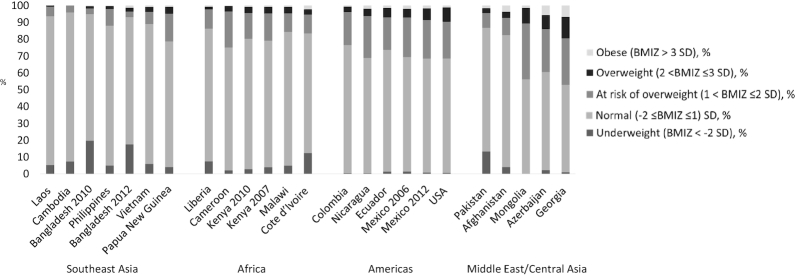
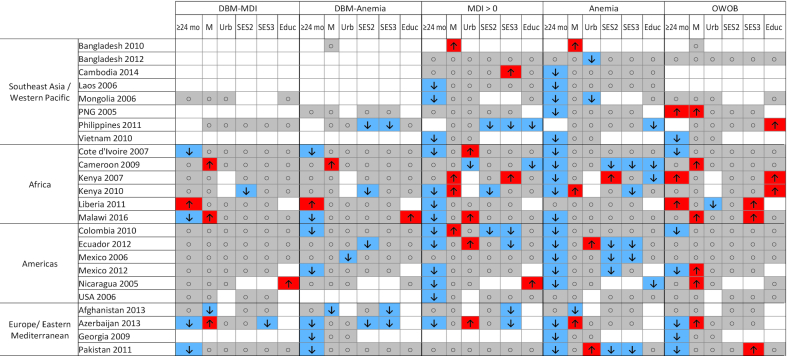
Results: DBM prevalence ranged from 0% to 9.7% (median: 2.5%, DBM-MDI; 1.4%, DBM-Anemia), reflecting a lower prevalence of OWOB (range: 0%-19.5%) than of micronutrient deficiencies and anemia, which exceeded 20% in most surveys. OWOB was generally not significantly associated with micronutrient deficiencies or anemia. In more than half of surveys, children 6-23 mo of age, compared with ≥24 mo, had greater adjusted odds of DBM-Anemia, anemia, and micronutrient deficiencies. Child sex and household socioeconomic status, urban location, and caregiver education did not consistently predict DBM or its components.
Conclusions: Intraindividual DBM among preschool children was low but might increase as child OWOB increases. The analysis does not support the hypothesis that DBM components cluster within individuals, suggesting that population-level DBM may be addressed by programs to reduce DBM components without targeting individuals with DBM.
Keywords: anemia; double burden of malnutrition; micronutrients; overweight/obesity; preschool children.
Copyright © The Author(s) on behalf of the American Society for Nutrition 2020.
Figures
References
-
- de Onis M, Blössner M, Borhi E. Global prevalence and trends of overweight and obesity among preschool children. Am J Clin Nutr. 2010;92(5):1257–64. - PubMed
-
- UNICEF, WHO, World Bank Levels and trends in child malnutrition: UNICEF – WHO – World Bank Group joint child malnutrition estimates. Washington (DC): UNICEF; New York: WHO; Geneva: World Bank; 2015.
-
- Nader PR, O'Brien M, Houts R, Bradley R, Belsky J, Crosnoe R, Friedman S, Mei Z, Susman EJ; National Institute of Child Health and Human Development Early Child Care Research Network . Identifying risk for obesity in early childhood. Pediatrics. 2006;118(3):e594–601. - PubMed
