


Recurrence after pituitary surgery in adult Cushing's disease: a systematic review on diagnosis and treatment
- PMID: 32743767
- PMCID: PMC7396205
- DOI: 10.1007/s12020-020-02432-z
Recurrence after pituitary surgery in adult Cushing's disease: a systematic review on diagnosis and treatment
Abstract
Purpose: Recurrence after pituitary surgery in Cushing's disease (CD) is a common problem ranging from 5% (minimum) to 50% (maximum) after initially successful surgery, respectively. In this review, we give an overview of the current literature regarding prevalence, diagnosis, and therapeutic options of recurrent CD.
Methods: We systematically screened the literature regarding recurrent and persistent Cushing's disease using the MESH term Cushing's disease and recurrence. Of 717 results in PubMed, all manuscripts in English and German published between 1980 and April 2020 were screened. Case reports, comments, publications focusing on pediatric CD or CD in veterinary disciplines or studies with very small sample size (patient number < 10) were excluded. Also, papers on CD in pregnancy were not included in this review.
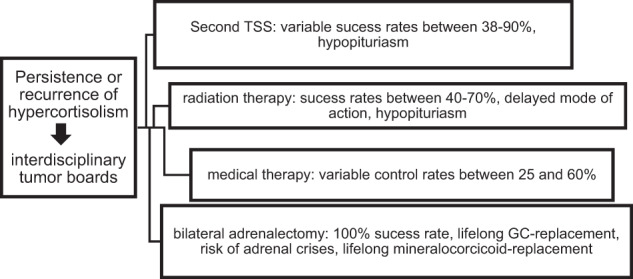
Results and conclusions: Because of the high incidence of recurrence in CD, annual clinical and biochemical follow-up is paramount. 50% of recurrences occur during the first 50 months after first surgery. In case of recurrence, treatment options include second surgery, pituitary radiation, targeted medical therapy to control hypercortisolism, and bilateral adrenalectomy. Success rates of all these treatment options vary between 25 (some of the medical therapy) and 100% (bilateral adrenalectomy). All treatment options have specific advantages, limitations, and side effects. Therefore, treatment decisions have to be individualized according to the specific needs of the patient.
Keywords: Adrenostatic therapy; Cushing’s syndrome; Hypercortisolism; Pituitary adenoma.
Conflict of interest statement
The authors declare that they have no conflict of interest.
Figures
References
-
- Petersenn S, Beckers A, Ferone D, van der Lely A, Bollerslev J, Boscaro M, Brue T, Bruzzi P, Casanueva FF, Chanson P, Colao A, Reincke M, Stalla G, Tsagarakis S. Therapy of endocrine disease: outcomes in patients with Cushing’s disease undergoing transsphenoidal surgery: systematic review assessing criteria used to define remission and recurrence. Eur J Endocrinol. 2015;172(6):R227–R239. doi: 10.1530/eje-14-0883. - DOI - PubMed
-
- Esposito F, Dusick JR, Cohan P, Moftakhar P, McArthur D, Wang C, Swerdloff RS, Kelly DF. Clinical review: early morning cortisol levels as a predictor of remission after transsphenoidal surgery for Cushing’s disease. J. Clin. Endocrinol. Metab. 2006;91(1):7–13. doi: 10.1210/jc.2005-1204. - DOI - PubMed
Publication types
MeSH terms
LinkOut - more resources
Full Text Sources
Miscellaneous
