. 2020 Dec;25(12):937-949.
doi: 10.1111/nep.13764. Epub 2020 Aug 20.

Alport syndrome: Proteomic analysis identifies early molecular pathway alterations in Col4a3 knock out mice

Affiliations

Alport syndrome: Proteomic analysis identifies early molecular pathway alterations in Col4a3 knock out mice

Orthodoxia Nicolaou et al. Nephrology (Carlton). 2020 Dec.

Abstract

Aim: Alport syndrome (AS) is the second most common hereditary kidney disease caused by mutations in collagen IV genes. Patients present with microhaematuria that progressively leads to proteinuria and end stage renal disease. Currently, no specific treatment exists for AS. Using mass spectrometry based proteomics, we aimed to detect early alterations in molecular pathways implicated in AS before the stage of overt proteinuria, which could be amenable to therapeutic intervention.

Methods: Kidneys were harvested from male Col4a3-/- knock out and sex and age-matched Col4a3+/+ wild-type mice at 4 weeks of age. Purified peptides were separated by liquid chromatography and analysed by high resolution mass spectrometry. The Cytoscape bioinformatics tool was used for function enrichment and pathway analysis. PPARα expression levels were evaluated by immunofluorescence and immunoblotting.

Results: Proteomic analysis identified 415 significantly differentially expressed proteins, which were mainly involved in metabolic and cellular processes, the extracellular matrix, binding and catalytic activity. Pathway enrichment analysis revealed among others, downregulation of the proteasome and PPAR pathways. PPARα protein expression levels were observed to be downregulated in Alport mice, supporting further the results of the discovery proteomics.

Conclusion: This study provides additional evidence that alterations in proteins which participate in cellular metabolism and mitochondrial homeostasis in kidney cells are early events in the development of chronic kidney disease in AS. Of note is the dysregulation of the PPAR pathway, which is amenable to therapeutic intervention and provides a new potential target for therapy in AS.

Keywords: Alport syndrome; Col4a3 knockout mice; PPARα; mass spectrometry; proteomics.


Conflict of interest statement

The authors declare no potential conflict of interest.

Figures
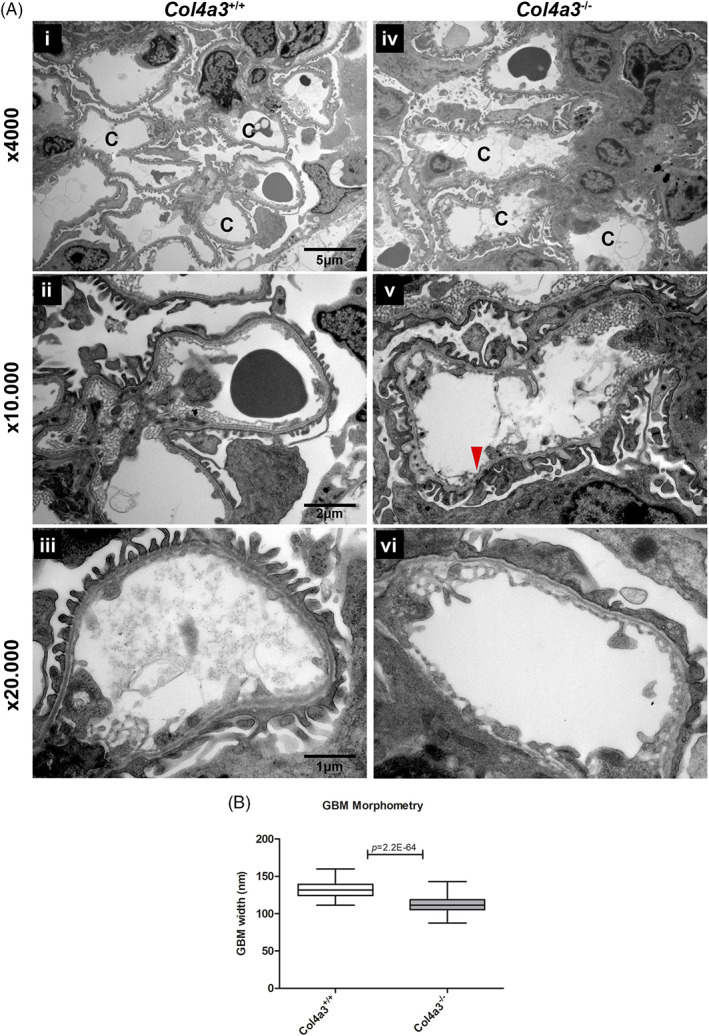
FIGURE 1
FIGURE 1
Electron microscopy and GBM measurements of 4 week mice. A, Electron micrographs of mouse kidneys Col4a3 −/− Alport (n = 4) and Col4a3 +/+ wild type mice (n = 4) at 4 weeks, at three different magnifications x4000, x10.000 and x20.000. (i) Wild type mice showing normal glomerular capillaries (C). (iiiii) Wild type mice showing uniform thickness of glomerular basement membranes with regular inner and outer contours. (iv) Alport mice showing normal glomerular capillaries (C). (v) Alport mice showing focal thinning (arrow heads) and focal areas with multi‐laminated segments (arrows) of GBM. (vi) Alport mice showing uniform thickness of glomerular capillaries with regular inner and outer contours. B, Box and whisker plots showing GBM width of Col4a3 −/− Alport (n = 4) and Col4a3 +/+ wild type mice (n = 4). Significant reduction in the GBM thickness (16%) was observed in Col4a3 −/− Alport mice when compared to the Col4a3 +/+ wild type mice. Col4a3 +/+ wild type mice show an average thickness of 133.3 nm with SD: 10.2 (total measurements: 122). Col4a3 −/− Alport shows an average thickness of 112.2 nm with SD: 10.2 (total measurements: 176). Statistical analysis was performed by a Student's t‐test with equal variances
FIGURE 2
FIGURE 2
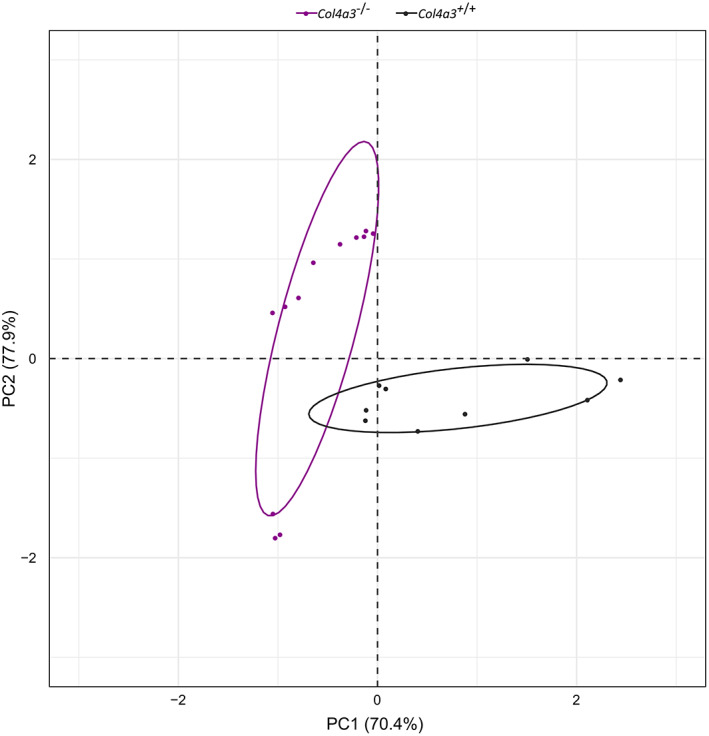
PCA analysis. PCA score plot of protein expression patterns of all proteins with P‐value ≤.05, showing a clear separation of Col4a3 −/− Alport mice (grey dots) and Col4a3 +/+ wild type mice (violet dots) into two distinct clusters. Statistical analysis was performed by one‐way ANOVA test using the Progenesis QI for proteomics software, while PCA analysis was carried out by the R statistics software version R 3.5.3 (R Core Team, 2019)
FIGURE 3
FIGURE 3
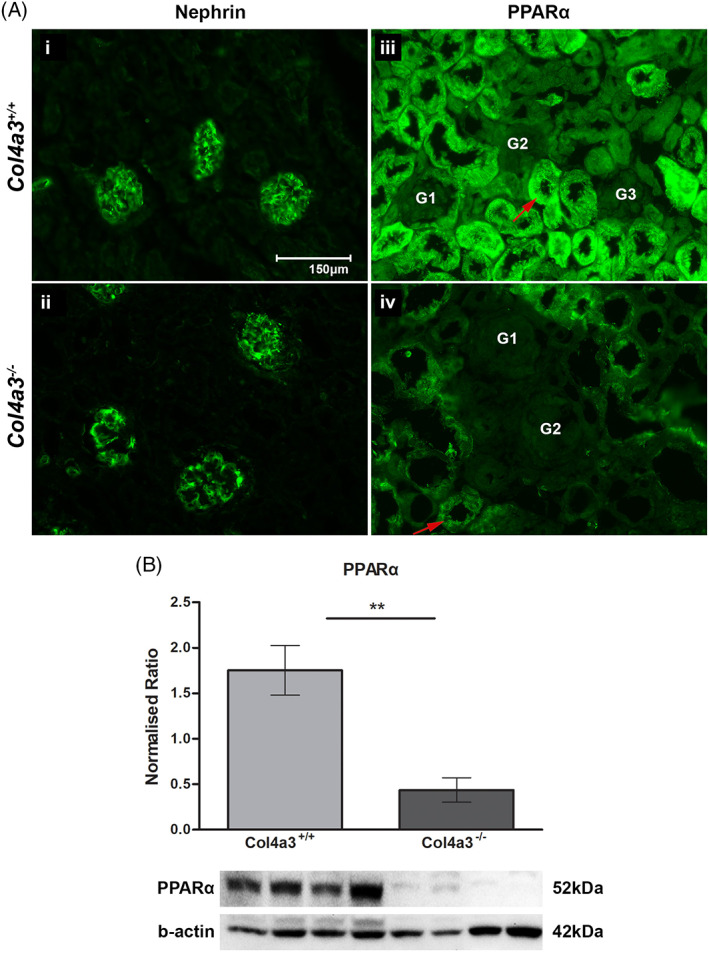
Expression of PPARα protein in mouse renal tissues. A, Representative images of immunofluorescence staining for Nephrin and PPARα proteins in renal tissues of Col4a3 −/− Alport mice and Col4a3 +/+ wild type mice at 4 weeks. (i, ii) No difference was observed in the expression levels of Nephrin protein between the two groups. In addition, Nephrin was observed to be solely expressed in the glomeruli. (iiiiv) PPARα protein was found to be downregulated in Col4a3 −/− Alport mice (iv) compared to Col4a3 +/+ wild type mice (iii). PPARα protein was found to be predominantly expressed in proximal renal tubules (arrows). n = 4/group, Scale bar = 150 μm. B, Relative quantification of PPARα via immunoblotting. Significant decrease of PPARα expression levels was observed in Col4a3 −/− Alport mice when compared to the Col4a3 +/+ wild type mice. n = 4/group, the data are presented as mean (SD). Statistical analysis was performed using a paired Student's t test. *P < 0.05, **P < 0.01, ***P < 0.001. PPARα, Peroxisome Proliferator Activated Receptor α

References

    1. Kashtan C. Alport syndrome and thin basement membrane nephropathy Comprehensive Pediatric Nephrology. Elsevier Inc.; 2008:229‐237.
    1. Gross O, Kashtan CE, Rheault MN, et al. Advances and unmet needs in genetic, basic and clinical science in Alport syndrome: report from the 2015 international workshop on Alport Syndrome. Nephrol Dial Transplant. 2017;32:916‐924. - PMC - PubMed
    1. Gross O, Licht C, Anders HJ, et al. Early angiotensin‐converting enzyme inhibition in Alport syndrome delays renal failure and improves life expectancy. Kidney Int. 2012;81:494‐501. - PubMed
    1. Kashtan CE, Ding J, Gregory M, et al. Clinical practice recommendations for the treatment of Alport syndrome: a statement of the Alport Syndrome research collaborative. Pediatr Nephrol. 2013;28:5‐11. - PMC - PubMed
    1. Gross O, Friede T, Hilgers R, Gorlitz A, Gavenis K, Ahmed R, Durr U. Safety and efficacy of the ACE‐inhibitor Ramipril in Alport Syndrome: the double‐blind, randomized, placebo‐controlled, multicenter phase III EARLY PRO‐TECT Alport trial in pediatric patients. ISRN Pediatr 2012;2012:436046. - PMC - PubMed