


Qualitative analysis of cognitive and social congruence in peer-assisted learning - The perspectives of medical students, student tutors and lecturers
- PMID: 32744892
- PMCID: PMC7482745
- DOI: 10.1080/10872981.2020.1801306
Qualitative analysis of cognitive and social congruence in peer-assisted learning - The perspectives of medical students, student tutors and lecturers
Abstract
Background: The teaching of students by peers, so-called peer-assisted learning, is effective based on cognitive and social congruence among students and student tutors. This study aims to investigate cognitive and social congruence by analysing the perspectives of students, student tutors and lecturers in order to receive a better understanding of these concepts and to improve the teaching in tutorials as well as the relationship among students and student tutors.
Methods: Cognitive and social congruence were assessed by conducting semi-structured interviews. An interview guide about teaching and relationship in tutorials was based on previous findings of Schmidt & Moust (1995) and Lockspeiser et al. (2008). The interviews were analysed inductively by using qualitative content analysis.
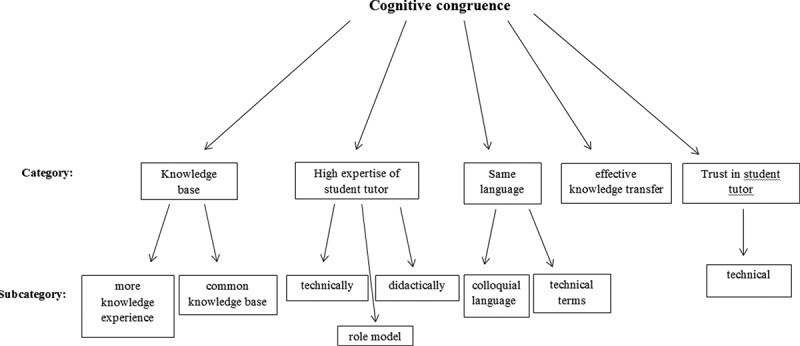
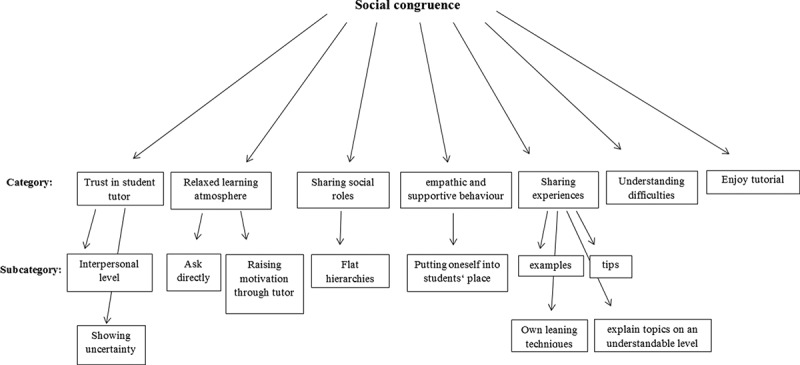
Results: Twenty-nine participants were interviewed. The following categories were found for cognitive congruence: knowledge base, high expertise by student tutors, same language and effective knowledge transfer. Social congruence was represented by relaxed learning atmosphere, sharing social roles, empathic and supportive behaviour of student tutors, sharing experiences, understanding difficulties and enjoying tutorial.
Conclusion: Cognitive and social congruence may be displayed on the practical behavioural level. Trust in student tutor could be found in both concepts on different levels. The qualitative results provide a deeper insight by indicating that the student tutors may play a 'mediator' role for the relationship between students and lectures.
Keywords: Cognitive congruence; lecturers; medical students; peer-assisted learning; social congruence; student tutors.
Conflict of interest statement
The authors declare no conflict of interest.
Figures
Comment in
-
Qualitative analysis of cognitive and social congruence in peer-assisted learning from the medical students perspective.Med Educ Online. 2020 Dec;25(1):1823619. doi: 10.1080/10872981.2020.1823619. Med Educ Online. 2020. PMID: 32940566 Free PMC article. No abstract available.
References
-
- Schmidt HG, Moust JH.. What makes a tutor effective? A structural-equations modeling approach to learning in problem-based curricula. Acad Med. 1995;70(8):708–9. - PubMed
-
- Cianciolo AT, Kidd B, Murray S. Observational analysis of near‐peer and faculty tutoring in problem‐based learning groups. Med Educ. 2016;50(7):757–767. - PubMed
-
- Chou CL, Johnston CB, Singh B, et al. A “safe space” for learning and reflection: one school’s design for continuity with a peer group across clinical clerkships. Acad Med. 2011;86(12):1560–1565. - PubMed
-
- Hall S, Lewis M, Border S, et al. Near‐peer teaching in clinical neuroanatomy. Clin Teach. 2013;10(4):230–235. - PubMed
-
- Lockspeiser TM, O’Sullivan P, Teherani A, et al. Understanding the experience of being taught by peers: the value of social and cognitive congruence. Avances Health Sci Educ. 2008;13(3):361–372. - PubMed
MeSH terms
LinkOut - more resources
Full Text Sources
