


Measurement properties of the product of investigator's global assessment and body surface area in children and adults with atopic dermatitis
- PMID: 32745300
- PMCID: PMC7855397
- DOI: 10.1111/jdv.16846
Measurement properties of the product of investigator's global assessment and body surface area in children and adults with atopic dermatitis
Abstract
Background: Multiple clinician-reported outcome measures exist for atopic dermatitis (AD) severity. However, there is no gold standard for use in clinical practice.
Objectives: To determine the measurement properties of the product of validated Investigator's Global Assessment for AD (vIGA) and body surface area (BSA) overall or divided into six categories (cBSA: 0%/0.1, <10%/10, <30%/30, <50%/50, <70%/70 and <90%/90-100%) and compare with other clinician-reported and patient-reported outcomes in adults and children with AD.
Methods: We performed a prospective dermatology practice-based study using questionnaires and evaluation by a dermatologist (n = 653).
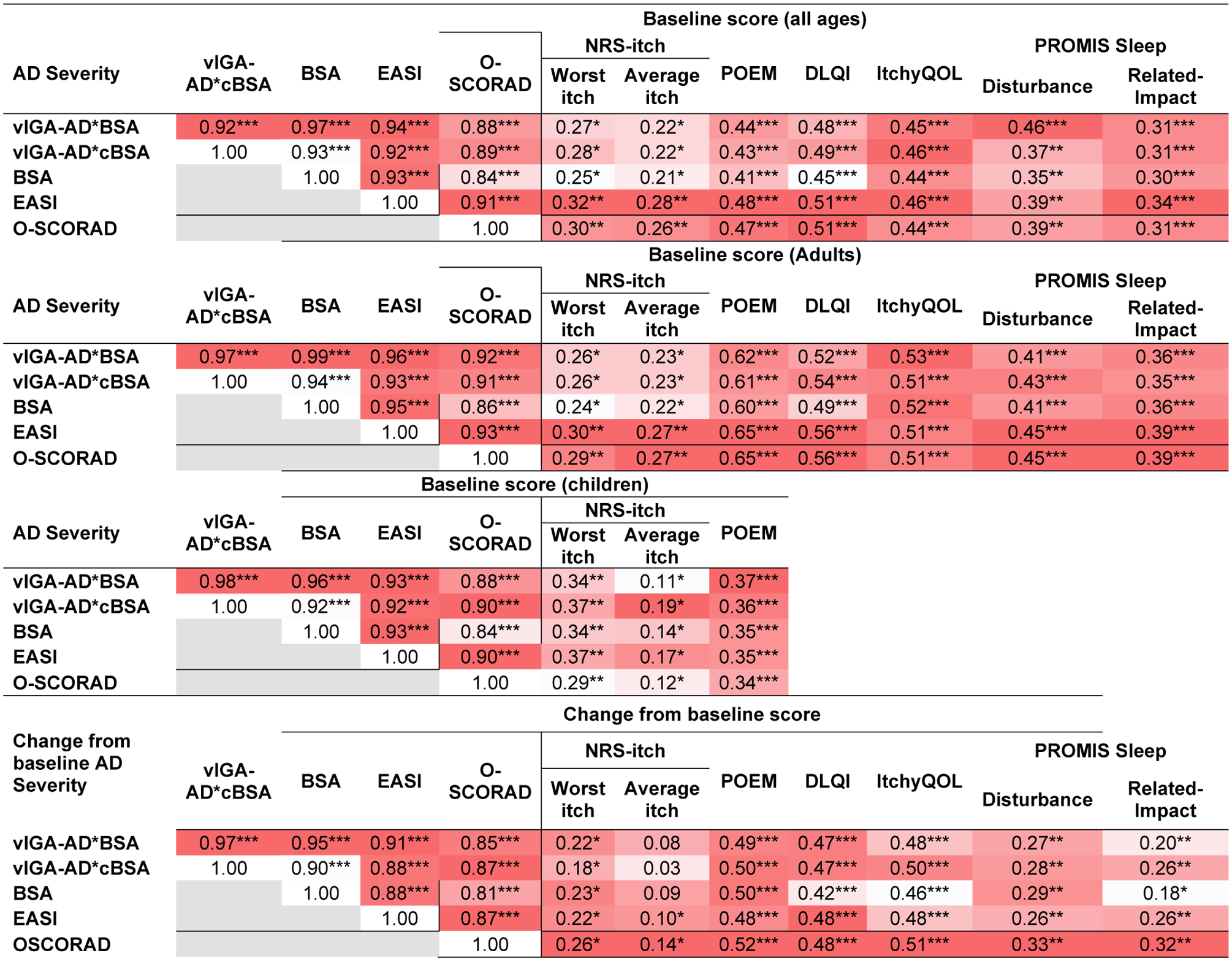
Results: vIGA*BSA and vIGA*cBSA had good convergent validity with BSA (Spearman's ρ = 0.97 and 0.93), eczema area and severity index (ρ = 0.94 and 0.92), and objective SCORAD (ρ = 0.88 and 0.89); and weak-to-good convergent validity with Numeric Rating Scale average itch (ρ = 0.22 and 0.22) and worst itch (ρ = 0.27 and 0.28), Patient-Oriented Eczema Measure (ρ = 0.44 and 0.43), Dermatology Life Quality Index (ρ = 0.48 and 0.49), ItchyQOL (ρ = 0.45 and 0.46), PROMIS Sleep Disturbance (ρ = 0.46 and 0.37) and sleep-related impairment (ρ = 0.31 and 0.31) in adults and/or children; very good discriminant validity for physician-reported global AD severity; good responsiveness to change of severity of AD and itch; and good reliability (intraclass correlation coefficient [95% confidence interval]: 0.72 [0.60-0.81] and 0.74 [0.62-0.82]) with no floor or ceiling effects. Thresholds for interpretability bands and clinically important difference were established.
Conclusions: vIGA*BSA and vIGA*cBSA scores showed good convergent and discriminant validity, reliability, responsiveness and interpretability in adults and children with AD, and were feasible for use in clinical practice. vIGA*BSA and vIGA*cBSA had slightly lower convergent validity than EASI or objective SCORAD, but might be more efficient to collect and score.
© 2020 European Academy of Dermatology and Venereology.
Conflict of interest statement
Conflicts of interest:
J Silverberg has been a consultant and/or advisory board member for Galderma; R Chavda and S Gabriel are employees of Galderma; No other authors declare any conflicts of interest.
Figures
References
-
- Yew YW, Thyssen JP, Silverberg JI. A systematic review and meta-analysis of the regional and age-related differences in atopic dermatitis clinical characteristics. Journal of the American Academy of Dermatology. 2019;80(2):390–401. - PubMed
-
- Severity scoring of atopic dermatitis: the SCORAD index. Consensus Report of the European Task Force on Atopic Dermatitis. Dermatology. 1993;186(1):23–31. - PubMed
-
- Hill MK, Kheirandish Pishkenari A, Braunberger TL, Armstrong AW, Dunnick CA. Recent trends in disease severity and quality of life instruments for patients with atopic dermatitis: A systematic review. Journal of the American Academy of Dermatology. 2016;75(5):906–17. - PubMed
MeSH terms
Grants and funding
LinkOut - more resources
Full Text Sources
Medical
Research Materials
