. 2020 Jul;17(Suppl 1):S20-S33.
doi: 10.14245/ns.2040116.058. Epub 2020 Jul 31.

A Narrative Review of Development of Full-Endoscopic Lumbar Spine Surgery

Affiliations

A Narrative Review of Development of Full-Endoscopic Lumbar Spine Surgery

Pang Hung Wu et al. Neurospine. 2020 Jul.

Abstract

In the first phase of development of lumbar endoscopic spine surgery, the focus was on removal of soft disc material through the working corridor of Kambin's triangle using transforaminal endoscopic lumbar discectomy. With the introduction of the interlaminar approach and increased interest from both industry and surgeons, there has been an exponential development of endoscopic surgical equipment and a corresponding expansion of endoscopic techniques. Endoscopic treatment strategies are applied to conditions ranging from contained prolapsed intervertebral discs to noncontained migrated herniated discs, hard calcified discs, spinal stenosis in the central or lateral recess and the foraminal and extraforaminal region, and other combinations of degenerative conditions requiring decompression or fusion surgery. The further expansion of endoscopic surgical management involving complicated spinal cases and the final quartet of trauma, infections, tumors, and possibly deformities could be the future stage of endoscopic spine surgery development. This article covers the full range of current treatment strategies and presents possible future developments of endoscopic spine surgery for the management of lumbar spinal conditions.

Keywords: Decompression; Degenerative spinal disease; Discectomy; Endoscopic spine surgery; Lumbar spine; Spinal fusion.


Conflict of interest statement

The authors have nothing to disclose.

Figures
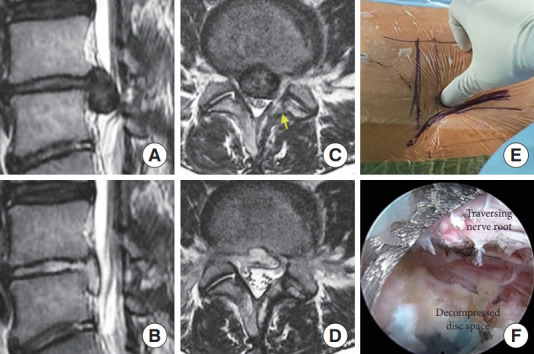
Fig. 1.
Fig. 1.
Revision right L4/5 transforaminal endoscopic lumbar discectomy (TELD). A 28-year-old woman who had previous L4/5 left mini-open microscopic discectomy presented with recurrence of central L4/5 prolapsed disc with right extensor hallucis longus weakness of motor grade 3. The decision was made to perform right TELD L4/5 with the mobile outside-in technique, and postoperatively the patient’s extensor hallucis longus strength recovered to motor grade 5. Panel A shows a sagittal view of a large sequestrated downward migrated central disc at L4/5. Panel B shows the corresponding cut demonstrating removal of the sequestrated disc. Panel C shows an axial cut at L4/5; a large centrally located L4/5 prolapsed disc is seen causing compression in the central and lateral recess of neural elements. Yellow arrow in panel C showed previous laminotomy in the left L4 lamina. Panel D shows the corresponding axial cut demonstrating removal of the sequestrated disc. Panel E shows the entry point of the needle and its docking; the mobile outside-in method was used, with the paraspinal skin entry point along the center of the disc space using the manual back assessment method. In this method, the borderline is checked between the back muscles and the abdominal muscles. The skin entry points are marked just medial to this borderline at the mid-disc level in both anteroposterior and lateral x-rays. Panel F shows an intraoperative view of decompression after complete discectomy; the epidural space is well decompressed with a pulsating traversing nerve root under irrigation fluid pressure.
Fig. 2.
Fig. 2.
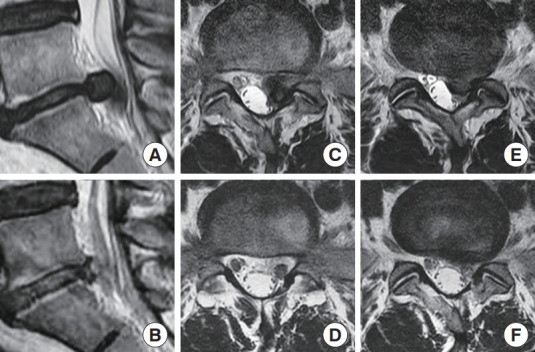
Left L4/5 prolapsed intervertebral disc with high canal compromise. A 30-year-old woman presented with sudden left extensor hallucis longus grade 3 weakness and radicular pain on the left L5 dermatome, and she underwent interlaminar endoscopic lumbar discectomy of left L4/5. Panel A shows a sagittal view of a large paracentral prolapsed intervertebral disc of L4/5 causing high canal compromise. Panel B shows the corresponding sagittal view with the decompressed L4/5 disc. Panels C–F are the corresponding preoperative and postoperative axial cuts of the left L4/5 prolapsed disc, showing effective discectomy of the large left L4/5 prolapsed disc.
Fig. 3.
Fig. 3.
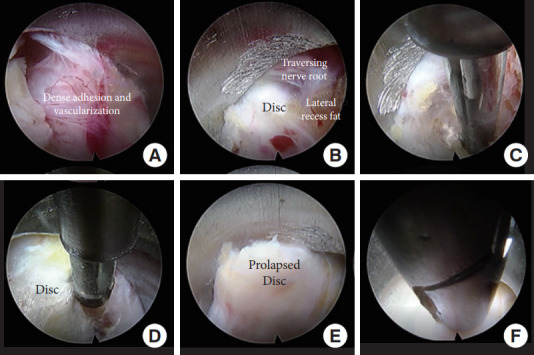
Endoscopic interlaminar approach radiofrequency ablation and discectomy of the L5/S1 intervertebral disc space with axial buttock pain. Panel A shows dense adhesion and neovascularization around the disc space (grade 3 according to Kim and Wu’s classification of neovascularization and adhesion for probability of sinuvertebral and basivertebral neuropathy). Panel B shows the use of the working channel; the traversing nerve root was protected, out of harm’s way, and the adhered and neovascularized soft tissue was dissected, exposing the disc and lateral recess. Panel C shows radiofrequency ablation at the region around the ipsilateral superior S1 pedicle; Kim’s twitching occurred upon radiofrequency ablation, but subsided after the basivertebral nerve was ablated. Panel D shows radiofrequency ablation of the sinuvertebral nerve under the L5–S1 disc in a central location. Panel E shows exposure of the prolapsed disc with the working channel protecting the neural elements. Panel F shows discectomy performed with endoscopic forceps.
Fig. 4.
Fig. 4.
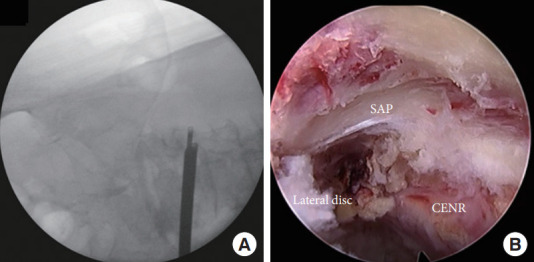
Panel A shows interlaminar contralateral endoscopic lumbar foraminotomy of left L4/5 foraminal stenosis; the intraoperative image intensifier shows endoscopic forceps reaching beyond the foramen of the left L4/5 foramen. Panel B shows an intraoperative endoscopic view of the contralateral exiting nerve root (CENR), which was free and pulsating, with the superior articular process (SAP) being decompressed and the lateral foraminal disc being removed to facilitate foraminal decompression.
Fig. 5.
Fig. 5.
Left uniportal endoscopic transforaminal lumbar interbody fusion at L5/S1. Panel A shows a computed tomography (CT) scan of L5/S1 spondylolisthesis. Panel B shows an endoscopic view of endplate preparation, as direct visualization of the endplate is helpful to ensure optimal endplate preparation to prevent subsidence and/or pseudarthrosis. Panel C shows a special tubular guide used for protecting neural elements and the insertion of a bone graft and interbody cage. Panel D shows the insertion of a 3-dimensional-printed interbody cage packed with mixed autograft and allograft. Panel E shows an endoscopic view of a cage inserted with a free pulsating traversing nerve root. Panel F shows a postoperative CT scan with restoration of disc height and reduction of L5/S1 spondylolisthesis.
Fig. 6.
Fig. 6.
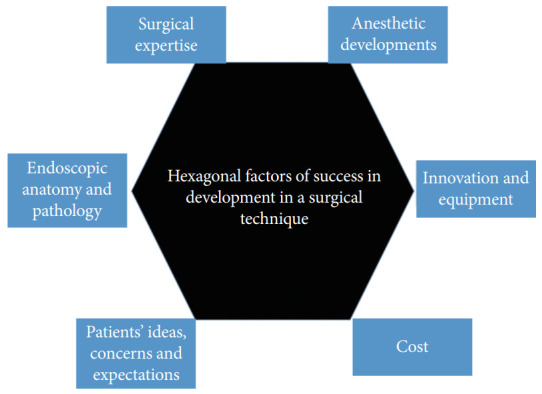
Hexagonal chart showing the 6 factors that work in sync to optimise the chance of success of a surgical technique, and in particular endoscopic surgical techniques.

References

    1. Yeung AT, Yeung CA. In-vivo endoscopic visualization of patho-anatomy in painful degenerative conditions of the lumbar spine. Surg Technol Int. 2006;15:243–56. - PubMed
    1. Ahn Y, Lee U. Use of lasers in minimally invasive spine surgery. Expert Rev Med Devices. 2018;15:423–33. - PubMed
    1. Pereira P, Severo M, Monteiro P, et al. Results of lumbar endoscopic adhesiolysis using a radiofrequency catheter in patients with postoperative fibrosis and persistent or recurrent symptoms after discectomy. Pain Pract. 2016;16:67–79. - PubMed
    1. Soliman HM. Irrigation endoscopic decompressive laminotomy. A new endoscopic approach for spinal stenosis decompression. Spine J. 2015;15:2282–9. - PubMed
    1. Kambin P, Sampson S. Posterolateral percutaneous suction-excision of herniated lumbar intervertebral discs. Report of interim results. Clin Orthop Relat Res. 1986;(207):37–43. - PubMed

LinkOut - more resources