


Dual molecular diagnosis of tricho-rhino-phalangeal syndrome type I and Okur-Chung neurodevelopmental syndrome in one Chinese patient: a case report
- PMID: 32746809
- PMCID: PMC7398275
- DOI: 10.1186/s12881-020-01096-w
Dual molecular diagnosis of tricho-rhino-phalangeal syndrome type I and Okur-Chung neurodevelopmental syndrome in one Chinese patient: a case report
Abstract
Background: Okur-Chung neurodevelopmental syndrome (OCNDS) and tricho-rhino-phalangeal syndrome type I (TRPSI) are rare Mendelian diseases. OCNDS is caused by CSNK2A1 gene variants and TRPSI is caused by the TRPS1gene. However, to have two Mendelian diseases in one patient is even rarer.
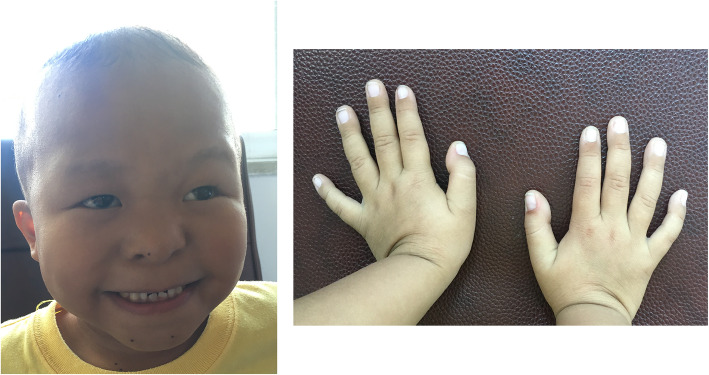
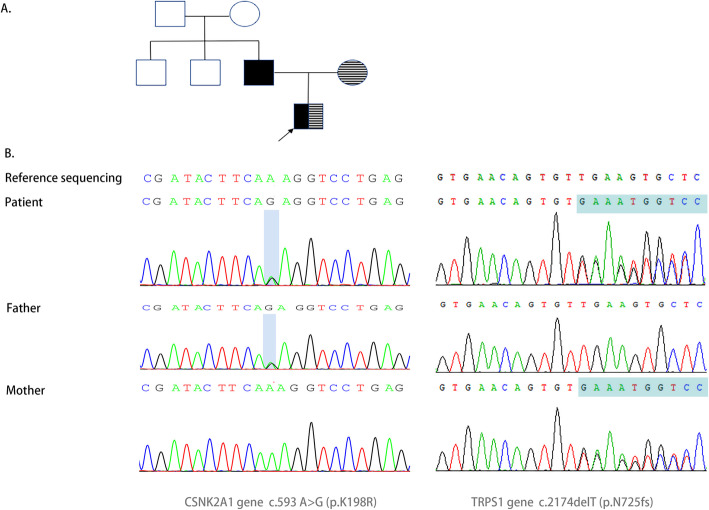
Case presentation: A 6-year-10-month-old boy characterized by special facial features, short stature and mental retardation was referred to our pediatric endocrinology department. Whole-exome sequencing (WES) was done to detect the molecular basis of his disease. This patient was confirmed to carry two variants in the CSNK2A1 gene and one in the TRPS1 gene. The variant in the CSNK2A1 gene was vertically transmitted from his father, and the variant in TRPS1 gene from his mother. These two variants are classified as pathogenic and the causes of the presentation in this child. This patient's father and mother have subsequently been diagnosed as having OCNDS and TRPSI respectively.
Conclusion: This is the first reported case of a dual molecular diagnosis of tricho-rhino-phalangeal syndrome type I and Okur-Chung neurodevelopmental syndrome in the same patient. This patient is the first published example of vertical transmission of this recurrent CSN2A1 variant from parent to child. A novel variant in the TRPS1 gene that is pathogenic was also identified. In conclusion, identification of the variants in this patient expands the phenotypes and molecular basis of dual Mendelian diseases.
Keywords: CSNK2A1; Case report; Dual molecular diagnosis; Okur-Chung neurodevelopmental syndrome; TRPS1; Tricho-rhino-phalangeal syndrome type I.
Conflict of interest statement
The authors declare that they have no competing interests.
Figures
References
-
- Giedion A. Das Tricho-rhino-phalangeal Syndrom. Helv Paediat Acta. 1966;21:475–482. - PubMed
-
- Momeni P, Glockner G, Schmidt O, von Holtum D, Albrecht B, Gillessen-Kaesbach G, Hennekam R, Meinecke P, Zabel B, Rosenthal A, Horsthemke B, Ludecke H-J. Mutations in a new gene, encoding a zinc-finger protein, cause tricho-rhino-phalangeal syndrome type I. Nat Genet. 2000;24:71–74. - PubMed
-
- Hilton MJ, Sawyer JM, Gutierrez L, et al. Analysis of novel and recurrent mutations responsible for the tricho–rhino–phalangeal syndromes. J Hum Genet. 2002;47:103–106. - PubMed
-
- Hou J, Parrish J, Ludecke H-J, Sapru M, Wang Y, Chen W, Hill A, Siegel-Bartelt J, Northrup H, Elde FFB, Chinault C, Horsthemke B, Wagner MJ, Wells DE. A 4-megabase YAC contig that spans the Langer-Giedion syndrome region on human chromosome 8q24.1: use in refining the location of the trichorhinophalangeal syndrome and multiple exostoses genes (TRPS1 and EXT1) Genomics. 1995;29:87–97. - PubMed
Publication types
MeSH terms
Supplementary concepts
LinkOut - more resources
Full Text Sources
Medical
