Review
. 2020 Aug 3;18(1):119.
doi: 10.1186/s12964-020-00581-2.

The crosstalk: exosomes and lipid metabolism

Affiliations
Review

The crosstalk: exosomes and lipid metabolism

Wei Wang et al. Cell Commun Signal. .

Abstract

Exosomes have been considered as novel and potent vehicles of intercellular communication, instead of "cell dust". Exosomes are consistent with anucleate cells, and organelles with lipid bilayer consisting of the proteins and abundant lipid, enhancing their "rigidity" and "flexibility". Neighboring cells or distant cells are capable of exchanging genetic or metabolic information via exosomes binding to recipient cell and releasing bioactive molecules, such as lipids, proteins, and nucleic acids. Of note, exosomes exert the remarkable effects on lipid metabolism, including the synthesis, transportation and degradation of the lipid. The disorder of lipid metabolism mediated by exosomes leads to the occurrence and progression of diseases, such as atherosclerosis, cancer, non-alcoholic fatty liver disease (NAFLD), obesity and Alzheimer's diseases and so on. More importantly, lipid metabolism can also affect the production and secretion of exosomes, as well as interactions with the recipient cells. Therefore, exosomes may be applied as effective targets for diagnosis and treatment of diseases. Video abstract.

Keywords: Atherosclerosis; Cancer; Exosome; Lipid metabolism.


Conflict of interest statement

The authors declare that they have no competing interests.

Figures
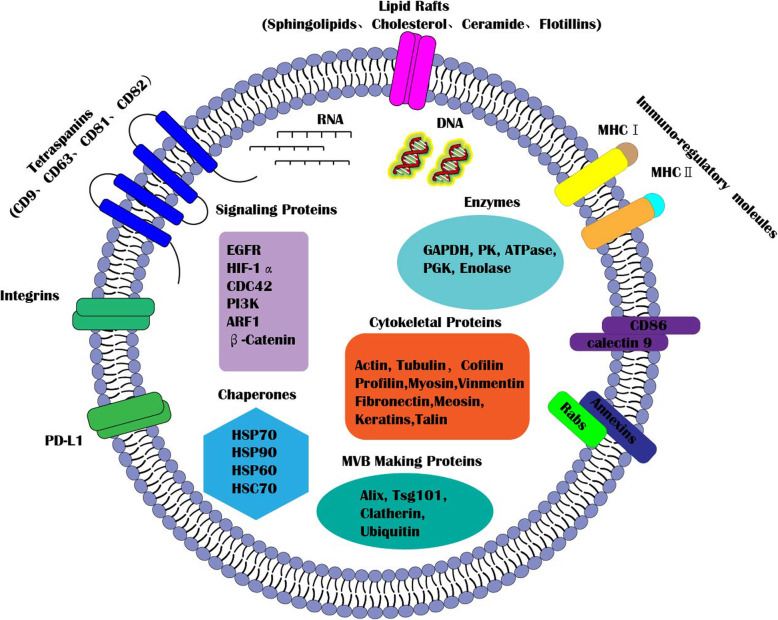
Fig. 1
Fig. 1
The basic structure and composition of exosomes. Exosomes have a typical lipid bilayer that protects and transfers exosomal bioactive molecules including proteins, lipids and nucleic acids. Exosomes from cells of different types have common proteins that can be used as cell surface markers such as annexins, flotillins, clathrin, Alix, TSG101, integrin and tetraspanins (CD63, CD9, CD81 and CD82). However, exosomes from specific sources have their own special markers, such as MHC-I/II on the surface of exosomes derived from dendritic cells, PD-L1 on the surface of cancer cell-derived exosomes, and adiponectin on the surface of adipocyte-derived exosomes. In addition, specific exosomes secreted by different cells also have their own specific compositions. In general, the proteins in exosomes can be divided into five categories, including signaling proteins (EGFR, HIF-1α, CDC42, PI3K, ARF1, β-Catenin), enzymes (GAPDH, PK, ATPase, PGK, Enolase), cytoskeletal proteins (Actin, Tubulin, Cofilin, profiling, Myosin, Vinmentin, Fibronectin, Meosin, Keratins, Talin), chaperones (HSP70, HSP90, HSP60, HSC70) and MVB making proteins(Alix, Tsg101, Clatherin, ubiquitin). Moreover, exosomes also carry many nucleic acids, including RNA and DNA
Fig. 2
Fig. 2
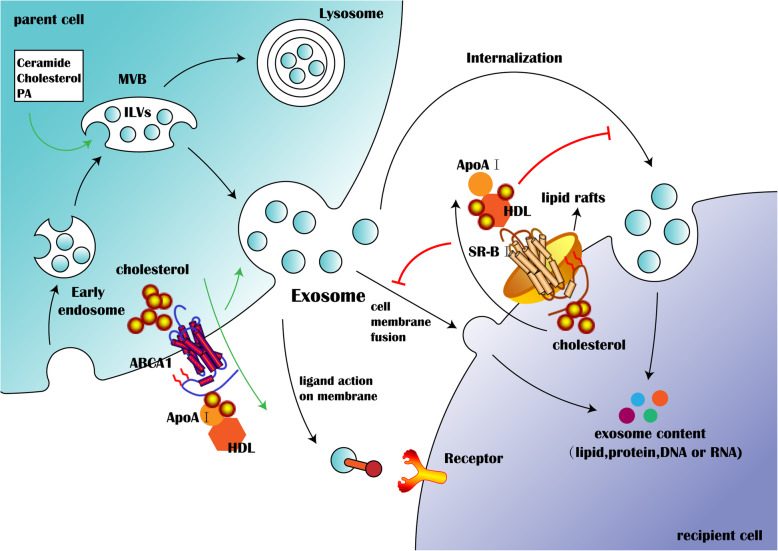
Lipid metabolism is involved in the biosynthesis and releases of exosomes, as well as its interaction with recipient cells. The transformation process from early endosomes to MVBs is induced by ceramide, cholesterol and PA. Then MVBs are either fused with lysosomes or with plasma membrane. And the fusion of MVBs with plasma membrane is promoted by ABCA1-mediated cholesterol efflux from the parent cells. The released exosomes deliver their contents to recipient cells through internalization, fusion with cell membrane or interaction with ligand on membrane. However, SR-B1-mediated cholesterol efflux inhibits the absorption of exosomes by recipient cells can be inhibited by SR-B1-mediated cholesterol efflux
Fig. 3
Fig. 3
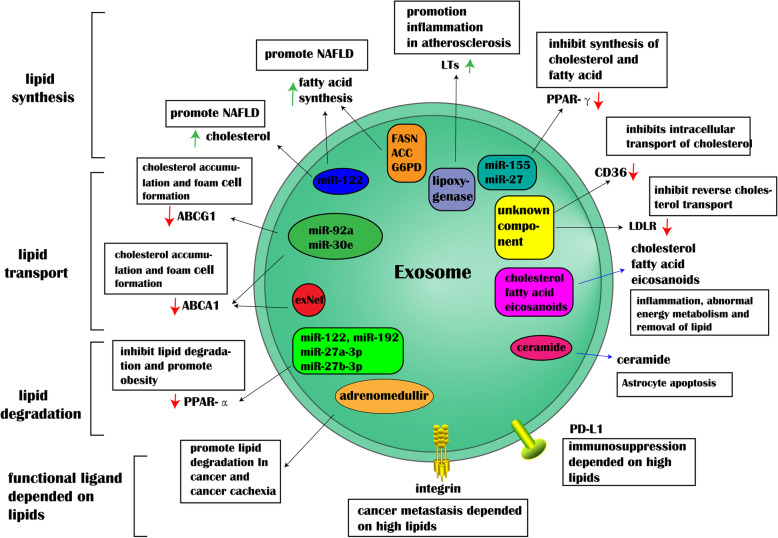
Regulation of exosomes on lipid metabolism. Exosomes regulate lipid metabolism, including lipid synthesis, transport, degradation, which involved in the development of lipid disorder diseases. In addition, functional ligands on exosomes membrane, such as PD-L1 and integrin, exert multiple effects depending on the level of lipids

References

    1. Wang G, Dinkins M, He Q, Zhu G, Poirier C, Campbell A, Mayer-Proschel M, Bieberich E. Astrocytes secrete exosomes enriched with proapoptotic ceramide and prostate apoptosis response 4 (PAR-4): potential mechanism of apoptosis induction in Alzheimer disease (AD) J Biol Chem. 2012;287:21384–21395. - PMC - PubMed
    1. Zhu L, Kalimuthu S, Gangadaran P, Oh JM, Lee HW, Baek SH, Jeong SY, Lee SW, Lee J, Ahn BC. Exosomes derived from natural killer cells exert therapeutic effect in melanoma. Theranostics. 2017;7:2732–2745. - PMC - PubMed
    1. Jong AY, Wu CH, Li J, Sun J, Fabbri M, Wayne AS, Seeger RC. Large-scale isolation and cytotoxicity of extracellular vesicles derived from activated human natural killer cells. J Extracell Vesicles. 2017;6:1294368. - PMC - PubMed
    1. McAtee CO, Booth C, Elowsky C, Zhao L, Payne J, Fangman T, Caplan S, Henry MD, Simpson MA. Prostate tumor cell exosomes containing hyaluronidase Hyal1 stimulate prostate stromal cell motility by engagement of FAK-mediated integrin signaling. Matrix Biol. 2019;78-79:165–179. - PMC - PubMed
    1. Yan W, Wu X, Zhou W, Fong MY, Cao M, Liu J, Liu X, Chen CH, Fadare O, Pizzo DP, et al. Cancer-cell-secreted exosomal miR-105 promotes tumour growth through the MYC-dependent metabolic reprogramming of stromal cells. Nat Cell Biol. 2018;20:597–609. - PMC - PubMed

Publication types

LinkOut - more resources