


PDCD6 cooperates with C-Raf to facilitate colorectal cancer progression via Raf/MEK/ERK activation
- PMID: 32746883
- PMCID: PMC7398064
- DOI: 10.1186/s13046-020-01632-9
PDCD6 cooperates with C-Raf to facilitate colorectal cancer progression via Raf/MEK/ERK activation
Abstract
Background: Colorectal cancer (CRC) is one of the most common malignancies, and it's expected that the CRC burden will substantially increase in the next two decades. New biomarkers for targeted treatment and associated molecular mechanism of tumorigenesis remain to be explored. In this study, we investigated whether PDCD6 plays an oncogenic role in colorectal cancer and its underlying mechanism.
Methods: Programmed cell death protein 6 (PDCD6) expression in CRC samples were analyzed by immunohistochemistry and immunofluorescence. The prognosis between PDCD6 and clinical features were analyzed. The roles of PDCD6 in cellular proliferation and tumor growth were measured by using CCK8, colony formation, and tumor xenograft in nude mice. RNA-sequence (RNA-seq), Mass Spectrum (MS), Co-Immunoprecipitation (Co-IP) and Western blot were utilized to investigate the mechanism of tumor progression. Immunohistochemistry (IHC) and quantitative real-time PCR (qRT-PCR) were performed to determine the correlation of PDCD6 and MAPK pathway.
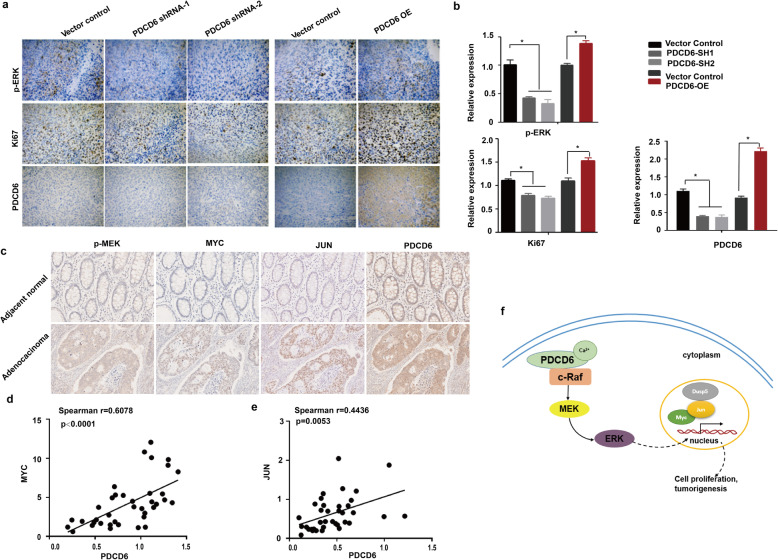
Results: Higher expression levels of PDCD6 in tumor tissues were associated with a poorer prognosis in patients with CRC. Furthermore, PDCD6 increased cell proliferation in vitro and tumor growth in vivo. Mechanistically, RNA-seq showed that PDCD6 could affect the activation of the MAPK signaling pathway. PDCD6 interacted with c-Raf, resulting in the activation of downstream c-Raf/MEK/ERK pathway and the upregulation of core cell proliferation genes such as MYC and JUN.
Conclusions: These findings reveal the oncogenic effect of PDCD6 in CRC by activating c-Raf/MEK/ERK pathway and indicate that PDCD6 might be a potential prognostic indicator and therapeutic target for patients with colorectal cancer.
Keywords: Colorectal cancer; Growth; MAPK signaling pathway; PDCD6.
Conflict of interest statement
The authors declare that they have no competing interests.
Figures


References
-
- Arnold M, Sierra MS, Laversanne M, Soerjomataram I, Jemal A, Bray F. Global patterns and trends in colorectal cancer incidence and mortality. Gut. 2017;66(4):683–691. - PubMed
-
- Siegel RL, Miller KD, Fedewa SA, Ahnen DJ, Meester RGS, Barzi A, Jemal A. Colorectal cancer statistics, 2017. CA Cancer J Clin. 2017;67(3):177–193. - PubMed
-
- Kim EK, Choi EJ. Compromised MAPK signaling in human diseases: an update. Arch Toxicol. 2015;89(6):867–882. - PubMed
-
- Eleveld TF, Schild L, Koster J, Zwijnenburg DA, Alles LK, Ebus ME, Volckmann R, Tijtgat GA, van Sluis P, Versteeg R, et al. RAS-MAPK pathway-driven tumor progression is associated with loss of CIC and other genomic aberrations in neuroblastoma. Cancer Res. 2018;78(21):6297–6307. - PubMed
MeSH terms
Substances
Grants and funding
- 2016-I2M-1-001/CAMS Innovation Fund for Medical Sciences
- 2017-I2M-3-009/CAMS Innovation Fund for Medical Sciences
- 2017-12M-4-002/CAMS Innovation Fund for Medical Sciences
- 2018YFC1003500/National Key Research and Development Program of China
- 81672472/National Natural Science Foundation of China
- 81672461/National Natural Science Foundation of China
- 31725013/National Natural Science Foundation of China
- 2015CB943001/National Key Basic Research Program of China
- 2017ZX10201021-007-003/State Key Project on Infection Diseases of China
- 2060204/State Key Laboratory Special fund from the Ministry of Science
LinkOut - more resources
Full Text Sources
Medical
Research Materials
Miscellaneous
