


Laboratory colonization and maintenance of Anopheles atroparvus from the Ebro Delta, Spain
- PMID: 32746901
- PMCID: PMC7398269
- DOI: 10.1186/s13071-020-04268-y
Laboratory colonization and maintenance of Anopheles atroparvus from the Ebro Delta, Spain
Abstract
Background: Historically, Anopheles atroparvus has been considered one of the most important malaria vectors in Europe. Since malaria was eradicated from the European continent, the interest in studying its vectors reduced significantly. Currently, to better assess the potential risk of malaria resurgence on the continent, there is a growing need to update the data on susceptibility of indigenous Anopheles populations to imported Plasmodium species. In order to do this, as a first step, an adequate laboratory colony of An. atroparvus is needed.
Methods: Anopheles atroparvus mosquitoes were captured in rice fields from the Ebro Delta (Spain). Field-caught specimens were maintained in the laboratory under simulated field-summer conditions. Adult females were artificially blood-fed on fresh whole rabbit blood for oviposition. First- to fourth-instar larvae were fed on pulverized fish and turtle food. Adults were maintained with a 10% sucrose solution ad libitum.
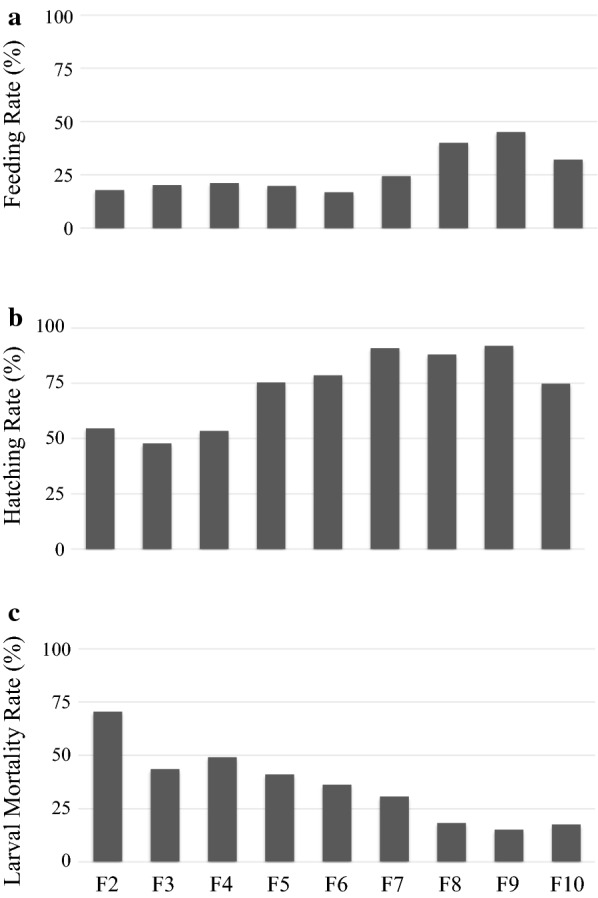
Results: An An. atroparvus population from the Ebro Delta was successfully established in the laboratory. During the colonization process, feeding and hatching rates increased, while a reduction in larval mortality rate was observed.
Conclusions: The present study provides a detailed rearing and maintenance protocol for An. atroparvus and a publicly available reference mosquito strain within the INFRAVEC2 project for further research studies involving vector-parasite interactions.
Keywords: Anopheles atroparvus; Colonization; Europe; Malaria.
Conflict of interest statement
The authors declare that they have no competing interests.
Figures
References
-
- Linton YM, Smith L, Koliopoulos G, Zounos AK, Samanidou-Voyadjoglou A, Patsoula E. The Anopheles (Anopheles) maculipennis complex (Diptera: Culicidae) in Greece. J Nat His. 2007;41:2683–2699. doi: 10.1080/00222930701403255. - DOI
-
- Harbach RE. The phylogeny and classification of Anopheles. In: Manguin S, editor. Anopheles mosquitoes - new insights into malaria vectors. London, UK: IntechOpen; 2013. pp. 4–55.
-
- Piperaki ET, Daikos GL. Malaria in Europe: emerging threat or minor nuisance? Clin Microbiol Infect. 2016;22:6. - PubMed
MeSH terms
Grants and funding
LinkOut - more resources
Full Text Sources
