. 2020 Aug 18;117(33):20077-20087.
doi: 10.1073/pnas.1919329117. Epub 2020 Aug 3.

Optimizing immunization protocols to elicit broadly neutralizing antibodies

Affiliations

Optimizing immunization protocols to elicit broadly neutralizing antibodies

Kayla G Sprenger et al. Proc Natl Acad Sci U S A. .

Abstract

Natural infections and vaccination with a pathogen typically stimulate the production of potent antibodies specific for the pathogen through a Darwinian evolutionary process known as affinity maturation. Such antibodies provide protection against reinfection by the same strain of a pathogen. A highly mutable virus, like HIV or influenza, evades recognition by these strain-specific antibodies via the emergence of new mutant strains. A vaccine that elicits antibodies that can bind to many diverse strains of the virus-known as broadly neutralizing antibodies (bnAbs)-could protect against highly mutable pathogens. Despite much work, the mechanisms by which bnAbs emerge remain uncertain. Using a computational model of affinity maturation, we studied a wide variety of vaccination strategies. Our results suggest that an effective strategy to maximize bnAb evolution is through a sequential immunization protocol, wherein each new immunization optimally increases the pressure on the immune system to target conserved antigenic sites, thus conferring breadth. We describe the mechanisms underlying why sequentially driving the immune system increasingly further from steady state, in an optimal fashion, is effective. The optimal protocol allows many evolving B cells to become bnAbs via diverse evolutionary paths.

Keywords: broadly neutralizing antibodies; evolutionary biology; highly mutable pathogens; sequential vaccination; statistical mechanics.


Conflict of interest statement

The authors declare no competing interest.

Figures
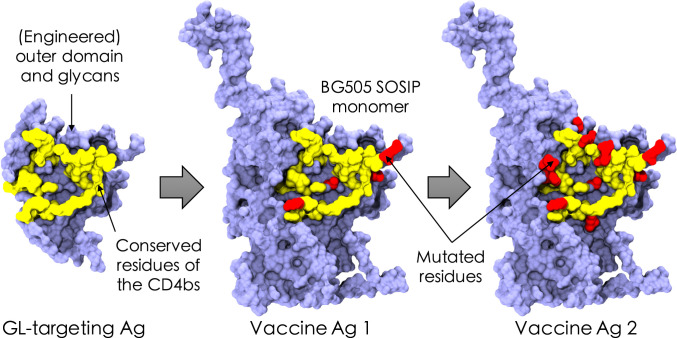
Fig. 1.
Fig. 1.
Schematic of the in silico immunization scheme, which consists of an assumed GL-targeting scheme (Left), followed by two immunizations with variant Ags that mimic the viral spike of HIV (Middle and Right). The GL-targeting Ag was inspired by the eOD-GT8 construct designed to target precursor naïve B cells against the CD4bs of HIV (31). Conserved residues of the CD4bs are schematically depicted in yellow, example mutated variable residues are shown in red, and the surrounding residues are shown in blue. Visual Molecular Dynamics (VMD) (47) was used to construct the images from Protein Data Bank ID code 5fyj (48).
Fig. 2.
Fig. 2.
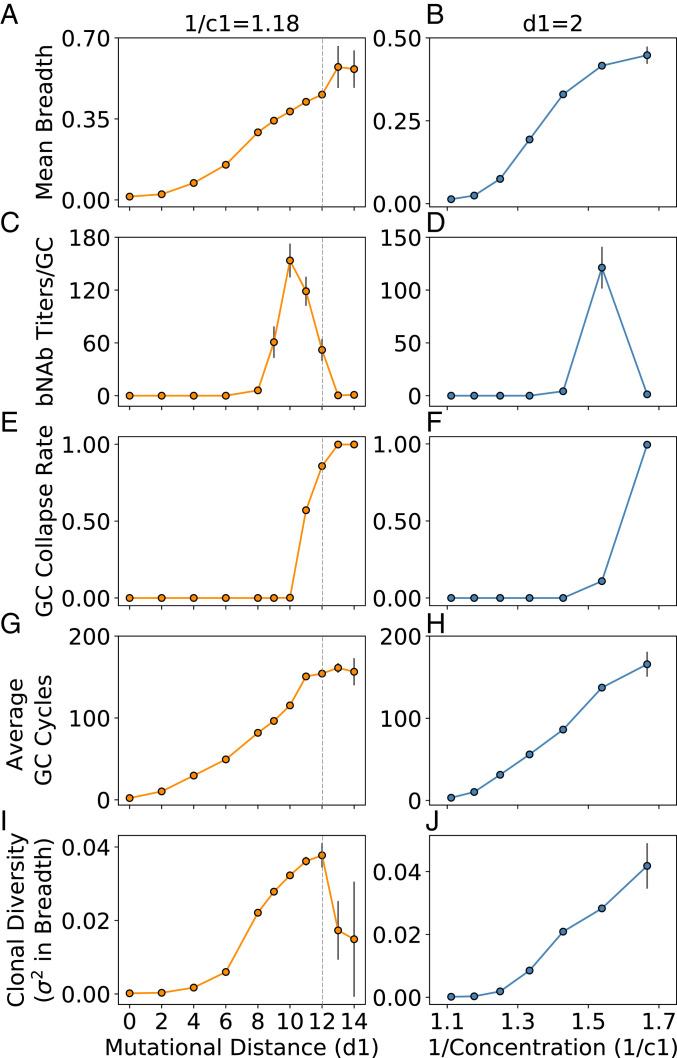
The outcomes of AM after a single vaccine immunization (second overall immunization after GL targeting) are presented above after changing mutational distance d1 at constant concentration 1/c1 (Left) and concentration 1/c1 at constant d1 (Right). The measured parameters from the simulations are mean clonal breadth (A and B), bnAb titers/GC (C and D), fraction of collapsed GCs (E and F), average number of GC cycles (G and H), and clonal diversity (variance in breadth; I and J). Gray dotted lines indicate the point beyond which GCs are unlikely to be seeded due to a low Ag–BCR binding affinity. Error bars represent the SD of the mean across multiple simulations (n = 1,000 GCs). Note that some error bars are too small to be visible but are included on all points and are largest where some GC collapse occurs (introducing much stochasticity into the data), or at the highest levels of frustration where few statistics could be obtained altogether.
Fig. 3.
Fig. 3.
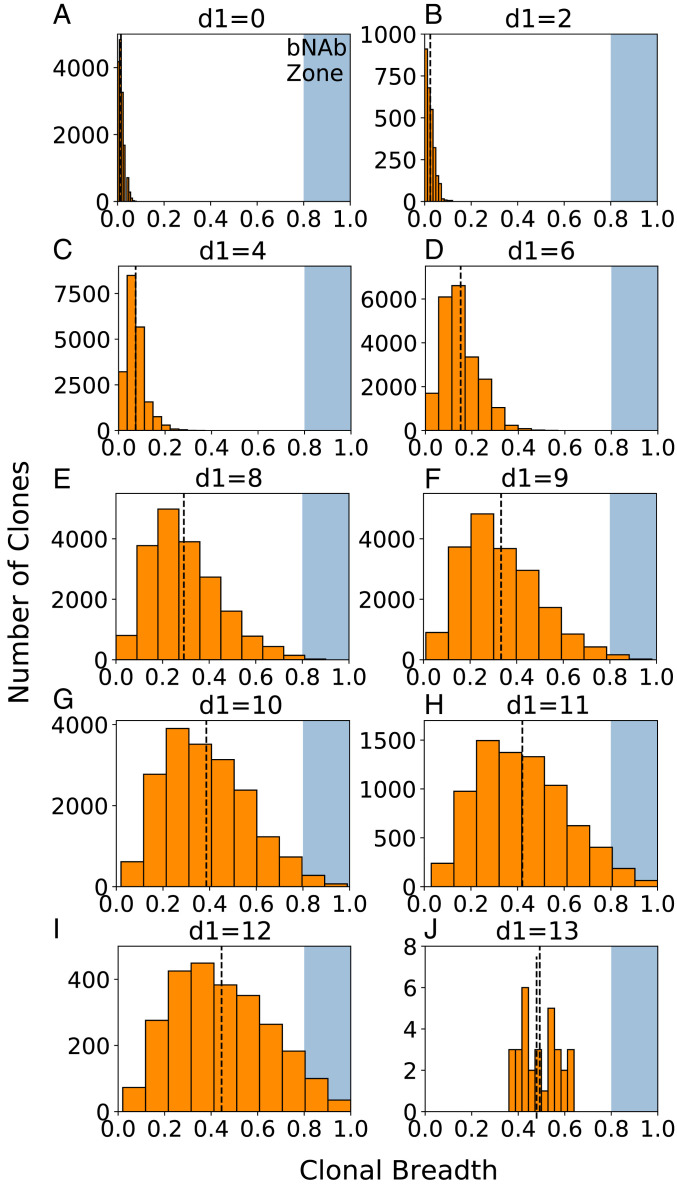
(AJ) Clonal breadth distributions characterize the diversity among clones across different GCs, corresponding to the points in Fig. 2 A, C, E, G, and I. A shaded blue region in each plot indicates the threshold above which BCRs are considered to have acquired breadth equivalent to a bnAb (breadth >0.8). The amount of overlap with this region (the “bnAb zone”) is indicative of the overall bnAb titers produced at the given vaccination condition indicated above each plot. A black dashed line indicates the mean clonal breadth at that particular vaccination setting. Results are plotted for all clones produced in 1,000 GC reactions at each vaccination setting.
Fig. 4.
Fig. 4.
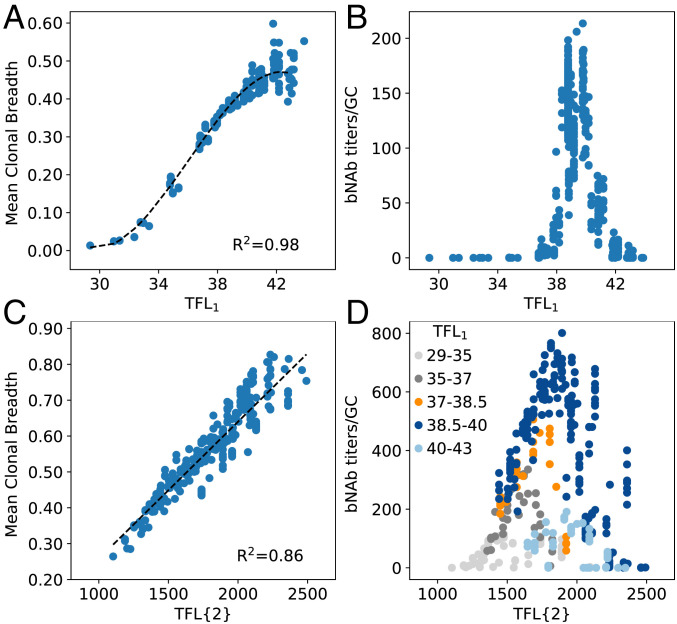
TFL of the first single-Ag vaccine immunization (A and B) and two sequential single-Ag immunizations (C and D), versus the mean clonal breadth (A and C) and bnAb titers/GC (B and D). Black dashed lines in A and C indicate the polynomial and linear fits used to collapse the data, respectively (A: 512 points; C: 331 points, due to some cases of complete GC collapse after immunization 1). Each dot represents the average output from n = 1,000 GCs and is colored in D according to the corresponding value of TFL1. Ten points were identified as outliers from each dataset due to a lack of statistics (<10/1,000 successful GCs) and removed before fitting.
Fig. 5.
Fig. 5.
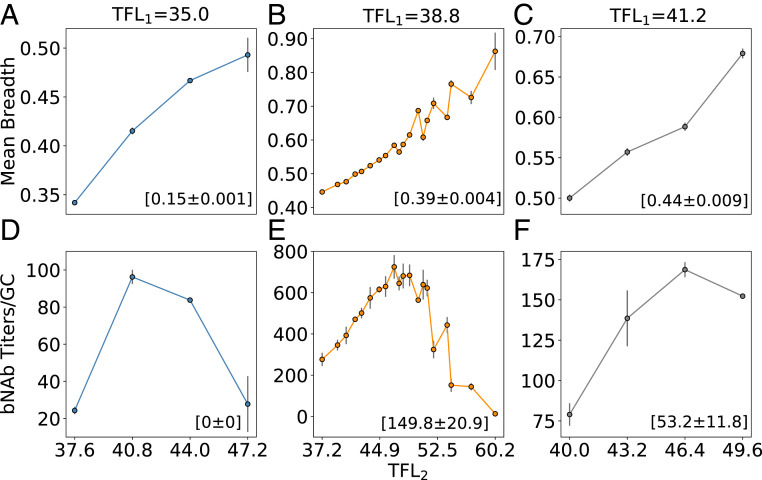
Effect of changing the TFL administered in the second immunization (TFL2), conditioned on (A, D) a low TFL administered in the first immunization (TFL1), (B, E) an intermediate TFL1, and (C, F) a high TFL1, on the mean clonal breadth (A–C) and bnAb titers/GC (D–F) after the second vaccine immunization. Values in parentheses indicate the mean clonal breadth and bnAb titers/GC after the first immunization.
Fig. 6.
Fig. 6.
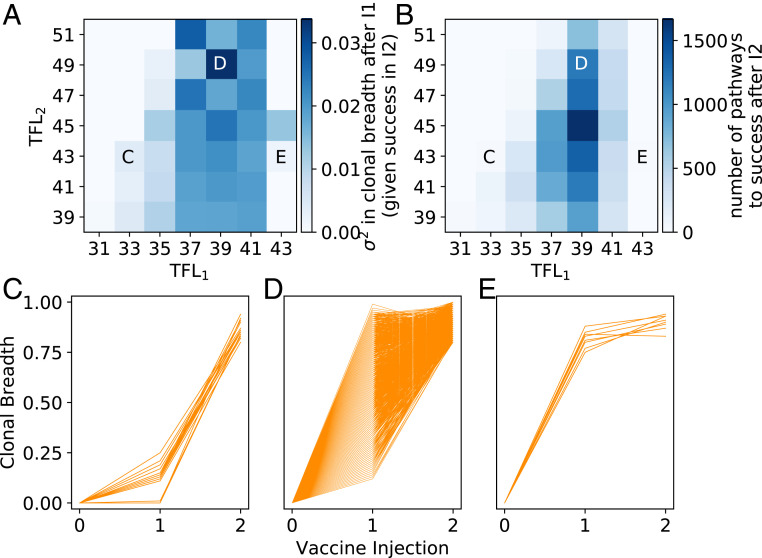
(A) Clonal diversity after the first vaccine immunization (variance in clonal breadth across all n = 1,000 GCs), conditioned on “success” in the second immunization (becoming a bnAb; clonal breadth >0.8). (B) Number of successful trajectories after the second immunization. (CE) Mutational trajectories of individual clones across multiple vaccine immunizations and n = 1,000 GCs, for (C) a low TFL1, (D) an intermediate TFL1, and (E) a high TFL1. Corresponding points in frustration space are indicated on the top plots.

References

    1. Korber B. et al., Evolutionary and immunological implications of contemporary HIV-1 variation. Br. Med. Bull. 58, 19–42 (2001). - PubMed
    1. Shlomchik M. J., Weisel F., Germinal center selection and the development of memory B and plasma cells. Immunol. Rev. 247, 52–63 (2012). - PubMed
    1. Victora G. D., Nussenzweig M. C., Germinal centers. Annu. Rev. Immunol. 30, 429–457 (2012). - PubMed
    1. Mesin L., Ersching J., Victora G. D., Germinal center B cell dynamics. Immunity 45, 471–482 (2016). - PMC - PubMed
    1. Foy T. M. et al., gp39-CD40 interactions are essential for germinal center formation and the development of B cell memory. J. Exp. Med. 180, 157–163 (1994). - PMC - PubMed

Publication types