. 2020 Aug 25;117(34):20926-20931.
doi: 10.1073/pnas.2005496117. Epub 2020 Aug 3.

Tuning the circadian period of cyanobacteria up to 6.6 days by the single amino acid substitutions in KaiC

Affiliations

Tuning the circadian period of cyanobacteria up to 6.6 days by the single amino acid substitutions in KaiC

Kumiko Ito-Miwa et al. Proc Natl Acad Sci U S A. .

Abstract

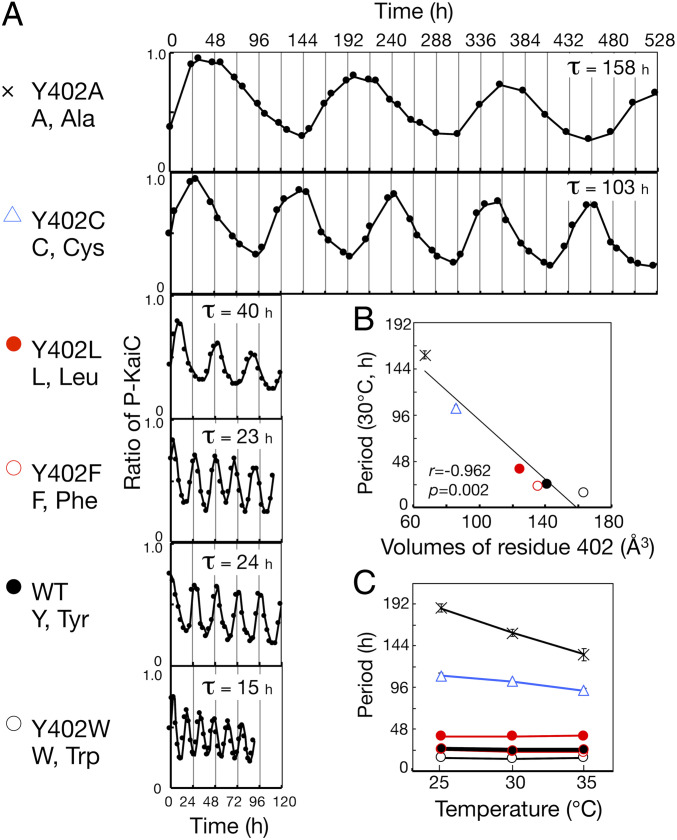
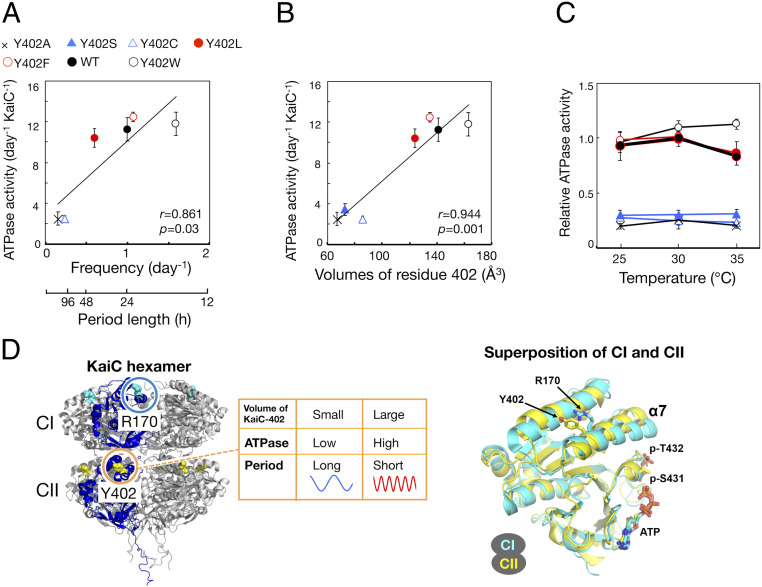
The circadian clock of cyanobacteria consists of only three clock proteins, KaiA, KaiB, and KaiC, which generate a circadian rhythm of KaiC phosphorylation in vitro. The adenosine triphosphatase (ATPase) activity of KaiC is the source of the 24-h period and temperature compensation. Although numerous circadian mutants of KaiC have been identified, the tuning mechanism of the 24-h period remains unclear. Here, we show that the circadian period of in vitro phosphorylation rhythm of mutants at position 402 of KaiC changed dramatically, from 15 h (0.6 d) to 158 h (6.6 d). The ATPase activities of mutants at position 402 of KaiC, without KaiA and KaiB, correlated with the frequencies (1/period), indicating that KaiC structure was the source of extra period change. Despite the wide-range tunability, temperature compensation of both the circadian period and the KaiC ATPase activity of mutants at position 402 of KaiC were nearly intact. We also found that in vivo and in vitro circadian periods and the KaiC ATPase activity of mutants at position 402 of KaiC showed a correlation with the side-chain volume of the amino acid at position 402 of KaiC. Our results indicate that residue 402 is a key position of determining the circadian period of cyanobacteria, and it is possible to dramatically alter the period of KaiC while maintaining temperature compensation.

Keywords: ATPase; KaiC; circadian clock; cyanobacteria; period.


Conflict of interest statement

The authors declare no competing interest.

Figures
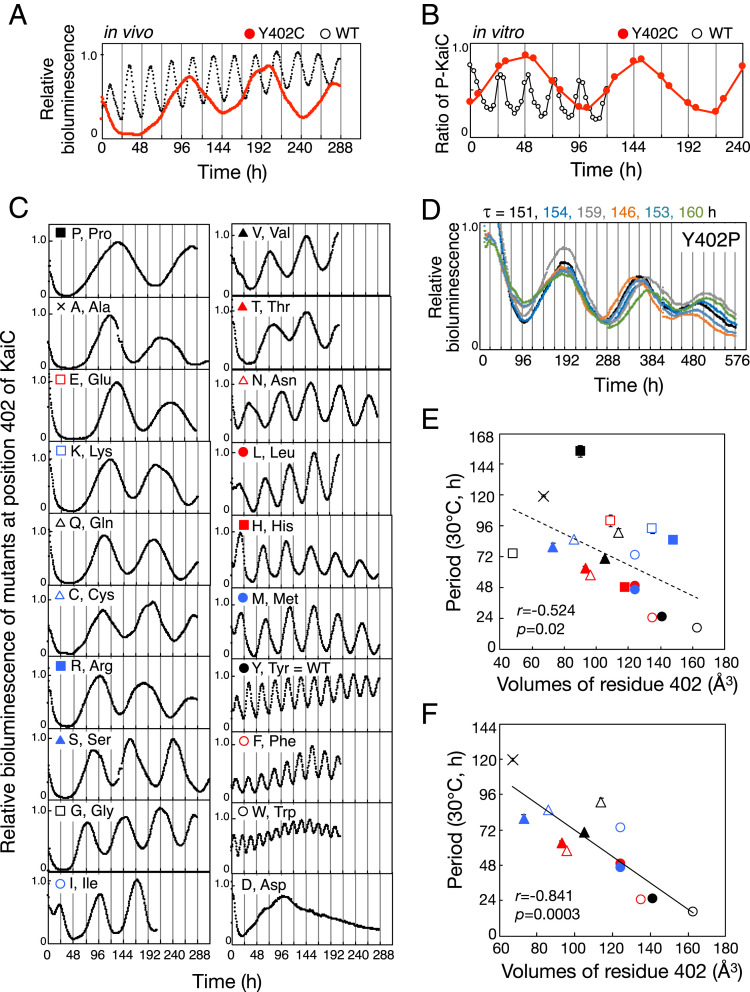
Fig. 1.
Fig. 1.
Aberrant circadian rhythms of mutants at position 402 of KaiC. (A) Representative bioluminescence rhythms of Y402C (red circles) and WT (black circles) at 30 °C. (B) Representative in vitro phosphorylation rhythm of Y402C (black circles) and WT (gray circles). KaiC protein was incubated at 30 °C in the presence of KaiA and KaiB, and aliquots of reaction mixtures were collected every 3 h (WT) or twice a day (Y402C). (C) Representative bioluminescence rhythms of the indicated KaiC mutants of Tyr402 at 30 °C. Data are shown in the order of period lengths. (D) Six independent measurements of bioluminescence rhythms and periods (τ) of Y402P at 30 °C. (E) Periods of bioluminescence rhythms of cyanobacteria with all possible amino acid substitutions at residue 402 of KaiC, plotted against van der Waals volumes of residue 402. Y402D is not shown because it was arrhythmic. (F) Periods of bioluminescence rhythms of cyanobacteria with uncharged amino acids other than proline and glycine at residue 402 of KaiC, plotted against van der Waals volumes of residue 402. Symbols are as in C. Values are represented as means ± SD. The sample sizes (n) are shown in SI Appendix, Table S1. r, correlation coefficient. p, P value. To determine period, peak times after 48 h (Y402P, Y402A, Y402E, Y402K, Y402Q, Y402C, Y402R, Y402S, Y402G, Y402I, Y402V, Y402T, Y402N, Y402L, Y402H, and Y402M) were used for the analysis to reject unstable peaks during the first 2 d.
Fig. 2.
Fig. 2.
In vitro phosphorylation rhythms of mutants at position 402 of KaiC. (A) Representative in vitro phosphorylation rhythms and periods (τ) of Y402A, Y402C, Y402L, Y402F, WT, and Y402W at 30 °C. (B) Periods of in vitro phosphorylation rhythms of Y402A, Y402C, Y402L, Y402F, WT, and Y402W, plotted against van der Waals volumes of residue 402. r, correlation coefficient. p, P value. (C) Effect of temperature on period lengths of the in vitro phosphorylation rhythms of Y402A, Y402C, Y402L, Y402F, WT, and Y402W. Symbols are as in A. Values are represented as means ± SD. The sample sizes (n) are shown in SI Appendix, Table S1.
Fig. 3.
Fig. 3.
ATPase activities of mutants at position 402 of KaiC. (A and B) ATPase activity of Y402A, Y402S, Y402C, Y402L, Y402F, WT, and Y402W plotted against frequencies of in vitro phosphorylation rhythms (A) and van der Waals volumes of residue 402 of KaiC (B). In the absence of KaiA and KaiB, KaiC was incubated at 30 °C for 3 d (n = 11 for WT; n = 7 for Y402A, Y402S, Y402C, Y402W and Y402L; n = 9 for Y402F). r, correlation coefficient. p, P value. (C) Effects of temperature on ATPase activity of Y402A, Y402C, Y402L, Y402F, WT, and Y402W (n = 4 for WT, Y402A, Y402S, Y402C, Y402W and Y402L; n = 3 for Y402F). Values are presented as means ± SD. (D) (Left) Overall structure of KaiC hexamer and positions Y402 and R170, colored yellow and cyan (PDB ID: 3DVL). (Right) Superposition of CI (residues 19–250; cyan) and CII domains (residues 261–482; yellow) (accession code: 3DVL) (20). Y402, R170, phosphorylated T432, phosphorylated S432, and ATP are shown in the stick model. The rmsd of the Cα pairs is 1.52 Å.

References

    1. Johnson C. H. et al. ., “Fundamental properties of circadian rhythms” in Chronobiology: Biological Timekeeping, Dunlap J. C., Loros J. J., Decoursey P. J., Eds. (Sinauer, 2004), pp. 67–105.
    1. Nakajima M. et al. ., Reconstitution of circadian oscillation of cyanobacterial KaiC phosphorylation in vitro. Science 308, 414–415 (2005). - PubMed
    1. Ishiura M. et al. ., Expression of a gene cluster kaiABC as a circadian feedback process in cyanobacteria. Science 281, 1519–1523 (1998). - PubMed
    1. Iwasaki H., Taniguchi Y., Ishiura M., Kondo T., Physical interactions among circadian clock proteins KaiA, KaiB and KaiC in cyanobacteria. EMBO J. 18, 1137–1145 (1999). - PMC - PubMed
    1. Mori T. et al. ., Circadian clock protein KaiC forms ATP-dependent hexameric rings and binds DNA. Proc. Natl. Acad. Sci. U.S.A. 99, 17203–17208 (2002). - PMC - PubMed

Publication types

MeSH terms

Substances

Supplementary concepts

LinkOut - more resources