


The role of hnRNPs in frontotemporal dementia and amyotrophic lateral sclerosis
- PMID: 32748079
- PMCID: PMC7547044
- DOI: 10.1007/s00401-020-02203-0
The role of hnRNPs in frontotemporal dementia and amyotrophic lateral sclerosis
Abstract
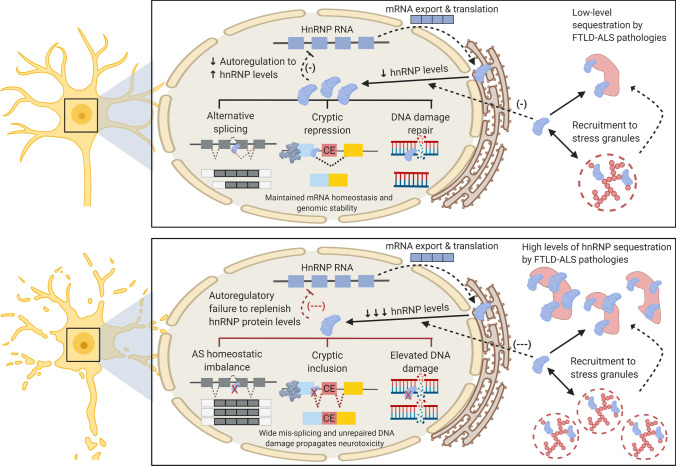
Dysregulated RNA metabolism is emerging as a crucially important mechanism underpinning the pathogenesis of frontotemporal dementia (FTD) and the clinically, genetically and pathologically overlapping disorder of amyotrophic lateral sclerosis (ALS). Heterogeneous nuclear ribonucleoproteins (hnRNPs) comprise a family of RNA-binding proteins with diverse, multi-functional roles across all aspects of mRNA processing. The role of these proteins in neurodegeneration is far from understood. Here, we review some of the unifying mechanisms by which hnRNPs have been directly or indirectly linked with FTD/ALS pathogenesis, including their incorporation into pathological inclusions and their best-known roles in pre-mRNA splicing regulation. We also discuss the broader functionalities of hnRNPs including their roles in cryptic exon repression, stress granule assembly and in co-ordinating the DNA damage response, which are all emerging pathogenic themes in both diseases. We then present an integrated model that depicts how a broad-ranging network of pathogenic events can arise from declining levels of functional hnRNPs that are inadequately compensated for by autoregulatory means. Finally, we provide a comprehensive overview of the most functionally relevant cellular roles, in the context of FTD/ALS pathogenesis, for hnRNPs A1-U.
Keywords: Amyotrophic lateral sclerosis; Autoregulation; Frontotemporal dementia; RNA; hnRNP.
Conflict of interest statement
The authors have no competing interests.
Figures
References
-
- Andersson MK, Ståhlberg A, Arvidsson Y, Olofsson A, Semb H, Stenman G, et al. The multifunctional FUS, EWS and TAF15 proto-oncoproteins show cell type-specific expression patterns and involvement in cell spreading and stress response. BMC Cell Biol. 2008;9:37. doi: 10.1186/1471-2121-9-37. - DOI - PMC - PubMed
-
- Arnold ES, Ling S-C, Huelga SC, Lagier-Tourenne C, Polymenidou M, Ditsworth D, et al. ALS-linked TDP-43 mutations produce aberrant RNA splicing and adult-onset motor neuron disease without aggregation or loss of nuclear TDP-43. Proc Natl Acad Sci USA. 2013;110:E736–E745. doi: 10.1073/pnas.1222809110. - DOI - PMC - PubMed
Publication types
MeSH terms
Substances
Supplementary concepts
Grants and funding
LinkOut - more resources
Full Text Sources
Other Literature Sources
Medical
Miscellaneous
