


Bone density and strength from thoracic and lumbar CT scans both predict incident vertebral fractures independently of fracture location
- PMID: 32748310
- PMCID: PMC8265597
- DOI: 10.1007/s00198-020-05528-4
Bone density and strength from thoracic and lumbar CT scans both predict incident vertebral fractures independently of fracture location
Abstract
In a population-based study, we found that computed tomography (CT)-based bone density and strength measures from the thoracic spine predicted new vertebral fracture as well as measures from the lumbar spine, suggesting that CT scans at either the thorax or abdominal regions are useful to assess vertebral fracture risk.
Introduction: Prior studies have shown that computed tomography (CT)-based lumbar bone density and strength measurements predict incident vertebral fracture. This study investigated whether CT-based bone density and strength measurements from the thoracic spine predict incident vertebral fracture and compared the performance of thoracic and lumbar bone measurements to predict incident vertebral fracture.
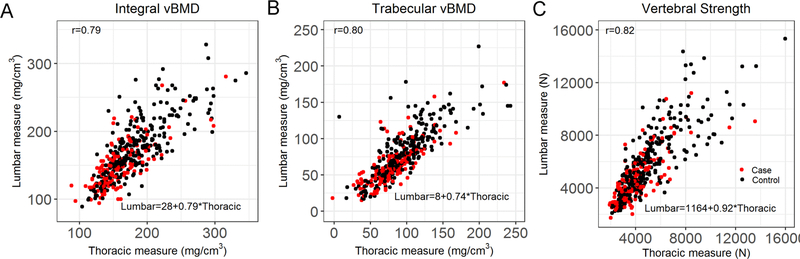
Methods: This case-control study of community-based men and women (age 74.6 ± 6.6) included 135 cases with incident vertebral fracture at any level and 266 age- and sex-matched controls. We used baseline CT scans to measure integral and trabecular volumetric bone mineral density (vBMD) and vertebral strength (via finite element analysis, FEA) at the T8 and L2 levels. Association between these measurements and vertebral fracture was determined by using conditional logistic regression. Sensitivity and specificity for predicting incident vertebral fracture were determined for lumbar spine and thoracic bone measurements.
Results: Bone measurements from T8 and L2 predicted incident vertebral fracture equally well, regardless of fracture location. Specifically, for predicting vertebral fracture at any level, the odds ratio (per 1-SD decrease) for the vBMD and strength measurements at L2 and T8 ranged from 2.0 to 2.7 (p < 0.0001) and 1.8 to 2.8 (p < 0.0001), respectively. Results were similar when predicting fracture only in the thoracic versus the thoracolumbar spine. Lumbar and thoracic spine bone measurements had similar sensitivity and specificity for predicting incident vertebral fracture.
Conclusion: These findings indicated that like those from the lumbar spine, CT-based bone density and strength measurements from the thoracic spine may be useful for identifying individuals at high risk for vertebral fracture.
Keywords: Finite element analysis; Fracture prediction; Osteoporosis; QCT; Vertebral fracture.
Figures
References
MeSH terms
Grants and funding
LinkOut - more resources
Full Text Sources
Medical
