Attention-Guided 3D-CNN Framework for Glaucoma Detection and Structural-Functional Association Using Volumetric Images
- PMID: 32750930
- PMCID: PMC7811826
- DOI: 10.1109/JBHI.2020.3001019
Attention-Guided 3D-CNN Framework for Glaucoma Detection and Structural-Functional Association Using Volumetric Images
Abstract
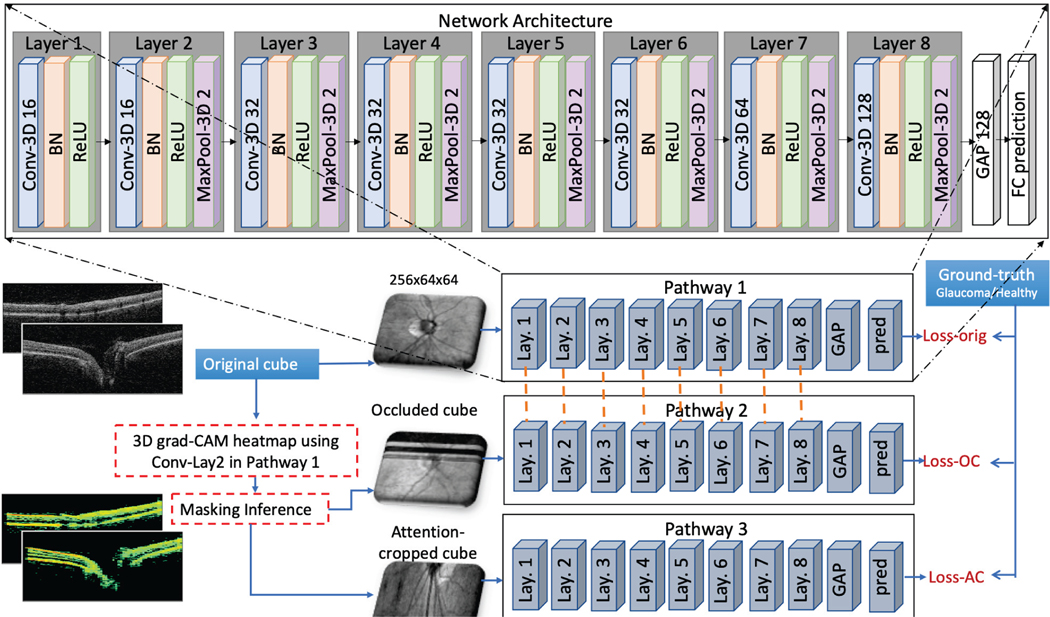
The direct analysis of 3D Optical Coherence Tomography (OCT) volumes enables deep learning models (DL) to learn spatial structural information and discover new bio-markers that are relevant to glaucoma. Downsampling 3D input volumes is the state-of-art solution to accommodate for the limited number of training volumes as well as the available computing resources. However, this limits the network's ability to learn from small retinal structures in OCT volumes. In this paper, our goal is to improve the performance by providing guidance to DL model during training in order to learn from finer ocular structures in 3D OCT volumes. Therefore, we propose an end-to-end attention guided 3D DL model for glaucoma detection and estimating visual function from retinal structures. The model consists of three pathways with the same network architecture but different inputs. One input is the original 3D-OCT cube and the other two are computed during training guided by the 3D gradient class activation heatmaps. Each pathway outputs the class-label and the whole model is trained concurrently to minimize the sum of losses from three pathways. The final output is obtained by fusing the predictions of the three pathways. Also, to explore the robustness and generalizability of the proposed model, we apply the model on a classification task for glaucoma detection as well as a regression task to estimate visual field index (VFI) (a value between 0 and 100). A 5-fold cross-validation with a total of 3782 and 10,370 OCT scans is used to train and evaluate the classification and regression models, respectively. The glaucoma detection model achieved an area under the curve (AUC) of 93.8% compared with 86.8% for a baseline model without the attention-guided component. The model also outperformed six different feature based machine learning approaches that use scanner computed measurements for training. Further, we also assessed the contribution of different retinal layers that are relevant to glaucoma. The VFI estimation model achieved a Pearson correlation and median absolute error of 0.75 and 3.6%, respectively, for a test set of size 3100 cubes.
Figures
References
-
- Flaxman SR, Bourne RR, Resnikoff S, Ackland P, Braithwaite T, Cicinelli MV, Das A, Jonas JB, Keeffe J, Kempen JH et al., “Global causes of blindness and distance vision impairment 1990–2020: a systematic review and meta-analysis,” The Lancet Global Health, vol. 5, no. 12, pp. e1221–e1234, 2017. - PubMed
-
- Peracha M, Hughes B, Tannir J, Momi R, Goyal A, Juzych M, Kim C, McQueen M, Eby A, and Fatima F, “Assessing the reliability of humphrey visual field testing in an urban population,” Investigative Ophthalmology & Visual Science, vol. 54, no. 15, pp. 3920–3920, 2013.
Publication types
MeSH terms
Grants and funding
LinkOut - more resources
Full Text Sources
Medical