


Short-Term Compound Training on Physical Performance in Young Soccer Players
- PMID: 32751640
- PMCID: PMC7466703
- DOI: 10.3390/sports8080108
Short-Term Compound Training on Physical Performance in Young Soccer Players
Abstract
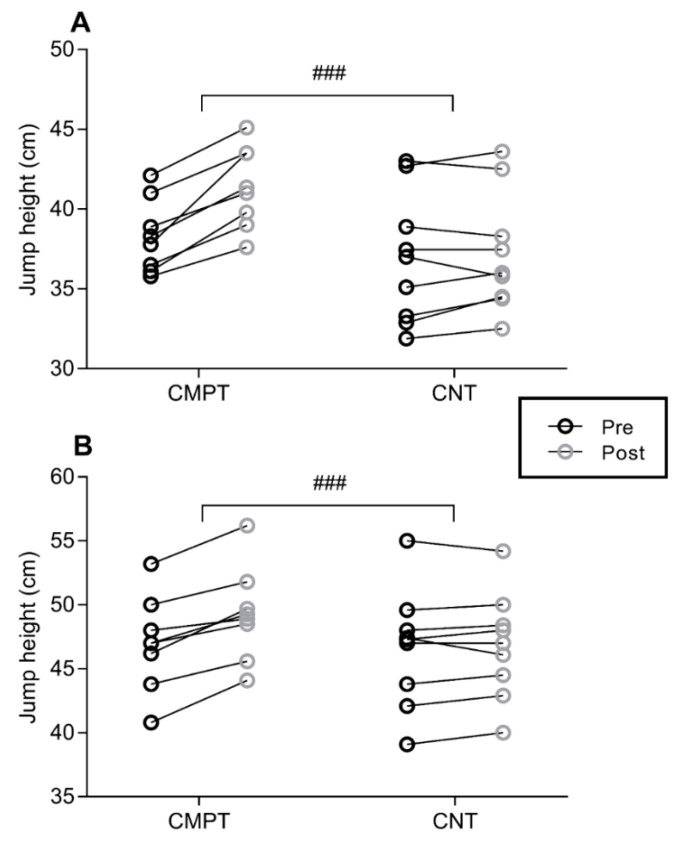
This study aimed to investigate the effects of a five-week compound training (with strength and plyometric exercises performed on separate days) on sprint, change of direction, and vertical jump in young soccer players. Eighteen novices in strength and plyometric training were assigned to either a compound training (CMPT) or a control condition (CNT). Both groups trained three times per week. One session was dedicated to soccer-specific drills. The other two weekly sessions were dedicated to circuit-based training routines employing on one-day strength exercises and on the other day plyometric exercises in the CMPT group. At the same time, the CNT group performed two weekly soccer-specific training sessions. All players were tested by 15-m sprint, change-of-direction and acceleration test (CODAT), squat jump, and countermovement jump with arms swing tests. CMPT group improved CODAT, squat jump and countermovement jump to a higher extent compared to CNT group (large vs small or trivial effects, p < 0.05), while both groups had similar 15-m sprint performance (p > 0.05). These results support the use of compound training to improve change of direction and vertical jump performances in young novice soccer players, which are unfamiliar with structured and advanced strength and plyometric training.
Keywords: plyometrics; strength training; team sport; testing; youth.
Conflict of interest statement
The authors declare no conflict of interest.
Figures


References
-
- Radzimiński Ł., Hajduczenia A. Influence of different forms of creatine supplementation on aerobic and anaerobic capacity of soccer players during preparation period. Atena J. Sports Sci. 2019;1:18.
-
- Lloyd R.S., Meyers R.W., Oliver J.L. The Natural Development and Trainability of Plyometric Ability during Childhood. Strength Cond. J. 2011;33:23–32. doi: 10.1519/SSC.0b013e3182093a27. - DOI
LinkOut - more resources
Full Text Sources
