Review
. 2020 Jul 30;7(3):83.
doi: 10.3390/bioengineering7030083.

Emerging Contact-Killing Antibacterial Strategies for Developing Anti-Biofilm Dental Polymeric Restorative Materials

Affiliations
Review

Emerging Contact-Killing Antibacterial Strategies for Developing Anti-Biofilm Dental Polymeric Restorative Materials

Heba Mitwalli et al. Bioengineering (Basel). .

Abstract

Polymeric materials are the first choice for restoring tooth cavities, bonding tooth-colored fillings, sealing root canal systems, and many other dental restorative applications. However, polymeric materials are highly susceptible to bacterial attachment and colonization, leading to dental diseases. Many approaches have been investigated to minimize the formation of biofilms over polymeric restorative materials and at the tooth/material interfaces. Among them, contact-killing compounds have shown promising results to inhibit dental biofilms. Contact-killing compounds can be immobilized within the polymer structure, delivering a long-lasting effect with no leaching or release, thus providing advantages compared to release-based materials. This review discusses cutting-edge research on the development of contact-killing compounds in dental restorative materials to target oral pathogens. Contact-killing compounds in resin composite restorations, dental adhesives, root canal sealers, denture-based materials, and crown cements have all demonstrated promising antibacterial properties. Contact-killing restorative materials have been found to effectively inhibit the growth and activities of several oral pathogens related to dental caries, periodontal diseases, endodontic, and fungal infections. Further laboratory optimization and clinical trials using translational models are needed to confirm the clinical applicability of this new generation of contact-killing dental restorative materials.

Keywords: antibacterial agents; biofilms; composite resins; dental caries; polymers.


Conflict of interest statement

The authors declare no conflict of interest.

Figures

Figure 1
Figure 1
Clinical aspect of several secondary carious lesions around resin composite restorations in the anterior teeth. The arrows in the photo showing the location of the lesions at the tooth/restoration interface presented by yellow and brownish to black discoloration.
Figure 2
Figure 2
Antibacterial killing strategies imparted in biomedical and dental devices to induce bioactivity against pathogenic biofilms.
Figure 3
Figure 3
Core properties of an Ideal antibacterial material intended for dental restorations [10,13].
Figure 4
Figure 4
Antibacterial killing strategies can be achieved via different approaches. The contact-killing mechanism can be provided by quaternary ammonium compounds posing highly positive charged surfaces to disrupt accumulated microorganisms (A). Antimicrobial peptides (AMPs) and antimicrobial enzymes (AMEs) can conduct contact-killing by invading the cellular membrane and targeting the main cellular components (B). Antimicrobial peptides can also conduct antibacterial action via its positively-charged surface. The antibacterial action via ion release can be provided by release-based (C) and on-demand (D) antibacterial materials. Materials interfering with bacterial adhesion can be designed using bacterial-resistance and bacterial-release surfaces (E,F).
Figure 5
Figure 5
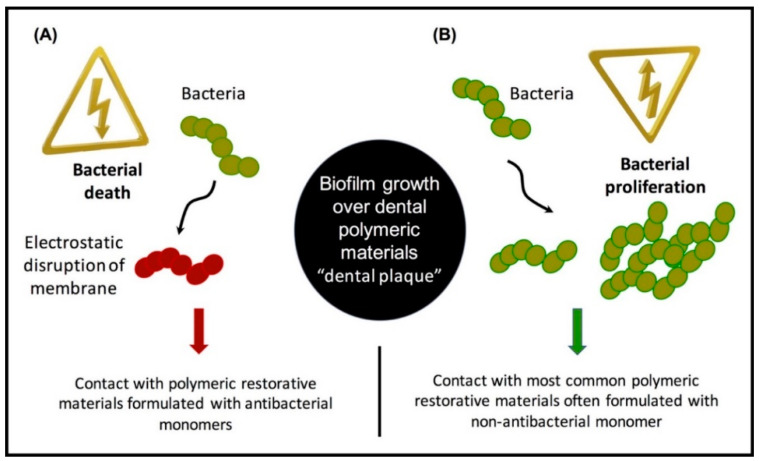
The contact-killing mechanism has been introduced in dental resin composites through the use of antibacterial monomers. Resin composite containing an antibacterial monomer was associated with fewer bacterial colonies (A) compared to a conventional resin composite (B).
Figure 6
Figure 6
Colony-forming units were grown over the resin composite surfaces using saliva-derived biofilm: (A) total microorganisms; (B) total Streptococci; and (C) Mutans streptococci. Adapted from Reference [65], with permission from © 2020 Elsevier.
Figure 7
Figure 7
Representative live/dead staining images of a 48 h biofilms grown over different resin composite formulations: (A) control; (B) 3% DMHADM; and (C) 5% DMHADM.
Figure 8
Figure 8
Resin composites containing quaternary ammonium monomers were associated with lower, but not significant, biofilm growth of total microorganisms, total Streptococci, Mutans streptococci, and total Lactobacilli after 7 (A) and 14 (B) days of biofilm formation in situ. Adapted from Reference [68], with permission Melo et al., 2018.
Figure 9
Figure 9
Representative live/dead staining images of biofilms grown over different dental resin composite samples: (A) commercial control; (B) 0% MPC + 0% DMAHDM; (C) 3% MPC; (D) 1.5% DMAHDM; (E) 3% MPC + 1.5% DMAHDM and (F) area fraction of live bacteria. Adapted from Reference [64], with permission from © 2020 Elsevier.
Figure 10
Figure 10
The quantification of metabolic activities (A) and lactic acid production (B) induced by a multispecies saliva-derived biofilm grown over the resin composite containing an antibacterial monomer. Adapted from Reference [64], with permission from © 2020 Elsevier.

References

    1. Neelakantan P., Romero M., Vera J., Daood U., Khan A.U., Yan A., Cheung G.S.P. Biofilms in Endodontics—Current Status and Future Directions. Int. J. Mol. Sci. 2017;18:1748. doi: 10.3390/ijms18081748. - DOI - PMC - PubMed
    1. Yu Q., Wu Z., Chen H. Dual-function antibacterial surfaces for biomedical applications. Acta Biomater. 2015;16:1–13. doi: 10.1016/j.actbio.2015.01.018. - DOI - PubMed
    1. Harding J.L., Reynolds M.M. Combating medical device fouling. Trends Biotechnol. 2014;32:140–146. doi: 10.1016/j.tibtech.2013.12.004. - DOI - PubMed
    1. Balhaddad A.A., Melo M.A.S., Gregory R.L. Inhibition of nicotine-induced Streptococcus mutans biofilm formation by salts solutions intended for mouthrinses. Restor. Dent. Endod. 2019;44:e4. doi: 10.5395/rde.2019.44.e4. - DOI - PMC - PubMed
    1. Dental Caries Among Adults and Older Adults. [(accessed on 8 June 2020)]; Available online: https://www.cdc.gov/oralhealth/publications/OHSR-2019-dental-carries-adu....

LinkOut - more resources