


Modelling the Effectiveness of Epidemic Control Measures in Preventing the Transmission of COVID-19 in Malaysia
- PMID: 32751669
- PMCID: PMC7432794
- DOI: 10.3390/ijerph17155509
Modelling the Effectiveness of Epidemic Control Measures in Preventing the Transmission of COVID-19 in Malaysia
Abstract
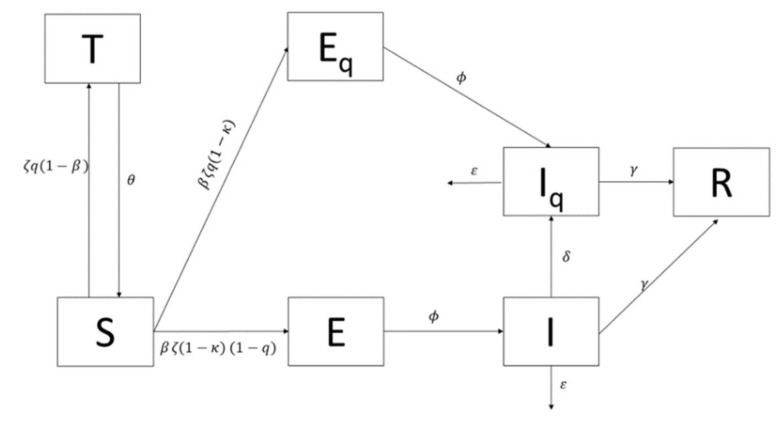
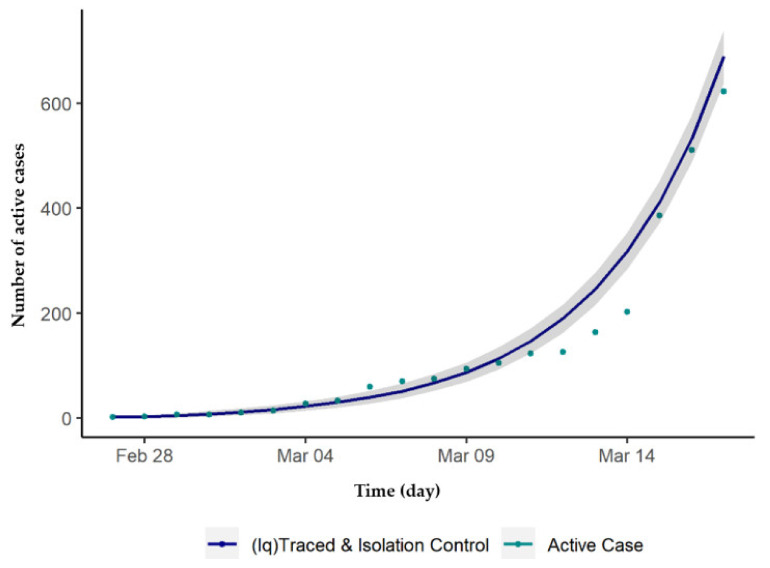
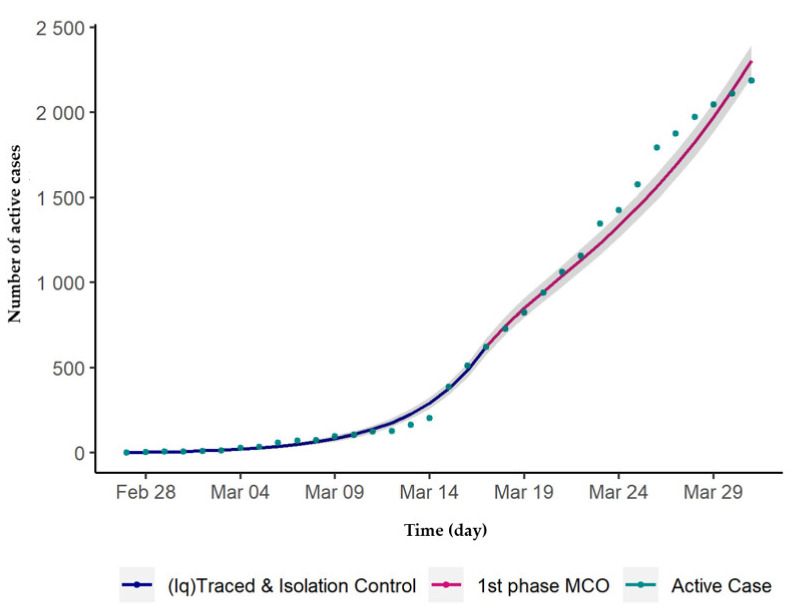
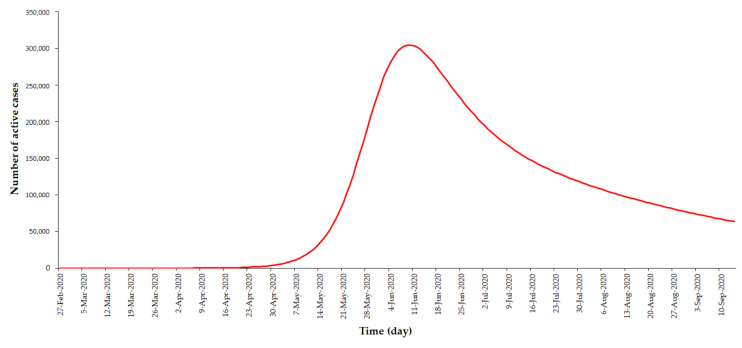
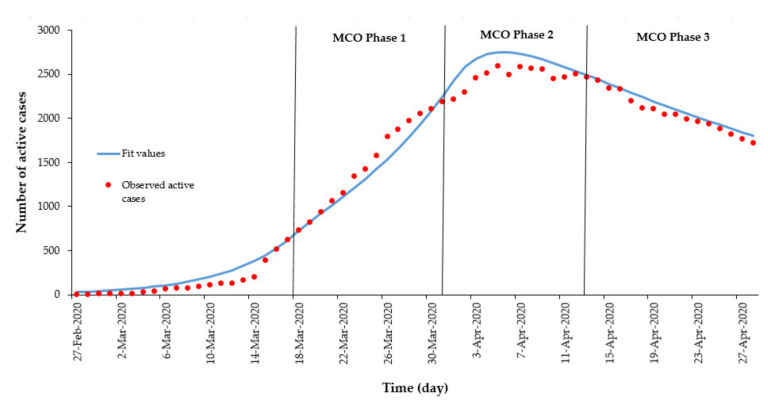
Malaysia is currently facing an outbreak of COVID-19. We aim to present the first study in Malaysia to report the reproduction numbers and develop a mathematical model forecasting COVID-19 transmission by including isolation, quarantine, and movement control measures. We utilized a susceptible, exposed, infectious, and recovered (SEIR) model by incorporating isolation, quarantine, and movement control order (MCO) taken in Malaysia. The simulations were fitted into the Malaysian COVID-19 active case numbers, allowing approximation of parameters consisting of probability of transmission per contact (β), average number of contacts per day per case (ζ), and proportion of close-contact traced per day (q). The effective reproduction number (Rt) was also determined through this model. Our model calibration estimated that (β), (ζ), and (q) were 0.052, 25 persons, and 0.23, respectively. The (Rt) was estimated to be 1.68. MCO measures reduce the peak number of active COVID-19 cases by 99.1% and reduce (ζ) from 25 (pre-MCO) to 7 (during MCO). The flattening of the epidemic curve was also observed with the implementation of these control measures. We conclude that isolation, quarantine, and MCO measures are essential to break the transmission of COVID-19 in Malaysia.
Keywords: COVID-19; and recovered (SEIR); exposed; infectious; isolation; mathematical modeling; movement; susceptible.
Conflict of interest statement
The authors declare no conflict of interest.
Figures
References
-
- World Health Organization WHO Director-General’s Opening Remarks at the Media Briefing on COVID-19. [(accessed on 15 March 2020)];2020 Available online: https://www.who.int/dg/speeches/detail/who-director-general-s-opening-re....
-
- Ministry of Health (MOH) Malaysia COVID-19 (Maklumat Terkini) [(accessed on 15 March 2020)];2020 Available online: http://www.moh.gov.my/index.php/pages/view/2019-ncov-wuhan.
-
- World Health Organization Statement on the Second Meeting of the International Health Regulations (2005) Emergency Committee Regarding the Outbreak of Novel Coronavirus (2019-nCoV) [(accessed on 15 March 2020)];2020 Available online: https://www.who.int/news-room/detail/30-01-2020-statement-on-the-second-...
-
- Imai N., Dorigatti I., Cori A., Riley S., Ferguson N.M. Estimating the potential total number of novel Coronavirus cases in Wuhan City, China. Imp. Coll. Lon. 2020:1–4. doi: 10.25561/77150. - DOI
MeSH terms
LinkOut - more resources
Full Text Sources
