. 2020 Jul 31;6(3):124.
doi: 10.3390/jof6030124.

Zinc Binding by Histatin 5 Promotes Fungicidal Membrane Disruption in C. albicans and C. glabrata

Affiliations

Zinc Binding by Histatin 5 Promotes Fungicidal Membrane Disruption in C. albicans and C. glabrata

Hannah L Norris et al. J Fungi (Basel). .

Abstract

Histatin 5 (Hst 5) is an antimicrobial peptide produced in human saliva with antifungal activity for opportunistic pathogen Candida albicans. Hst 5 binds to multiple cations including dimerization-inducing zinc (Zn2+), although the function of this capability is incompletely understood. Hst 5 is taken up by C. albicans and acts on intracellular targets under metal-free conditions; however, Zn2+ is abundant in saliva and may functionally affect Hst 5. We hypothesized that Zn2+ binding would induce membrane-disrupting pores through dimerization. Through the use of Hst 5 and two derivatives, P113 (AA 4-15 of Hst 5) and Hst 5ΔMB (AA 1-3 and 15-19 mutated to Glu), we determined that Zn2+ significantly increases killing activity of Hst 5 and P113 for both C. albicans and Candida glabrata. Cell association assays determined that Zn2+ did not impact initial surface binding by the peptides, but Zn2+ did decrease cell association due to active peptide uptake. ATP efflux assays with Zn2+ suggested rapid membrane permeabilization by Hst 5 and P113 and that Zn2+ affinity correlates to higher membrane disruption ability. High-performance liquid chromatography (HPLC) showed that the higher relative Zn2+ affinity of Hst 5 likely promotes dimerization. Together, these results suggest peptide assembly into fungicidal pore structures in the presence of Zn2+, representing a novel mechanism of action that has exciting potential to expand the list of Hst 5-susceptible pathogens.

Keywords: Candida albicans; Candida glabrata; Histatin 5; P113; membrane disruption; zinc.


Conflict of interest statement

The authors declare no conflict of interest.

Figures
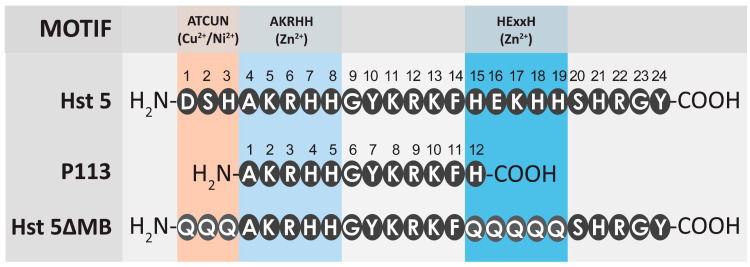
Figure 1
Figure 1
A comparison of the length and metal binding regions of amino acid sequences for Hst 5, Hst 5ΔMB, and P113. Three metal binding motifs are labeled—ATCUN (Cu2+, orange), HExxH (Zn2+, blue), and (H)AKRHH (Zn2+, light blue). P113 is truncated to amino acids 4-15 of Hst 5. The ATCUN (AA 1-3) and HExxH (AA 15-19) motifs of Hst 5ΔMB are mutated to glutamines.
Figure 2
Figure 2
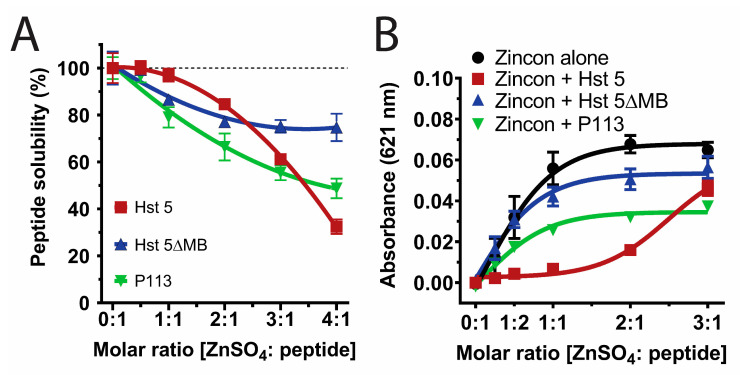
The three Hsts are all soluble at a physiological ratio of Zn2+ to peptide but differ in relative Zn2+ affinity. (A) Percent solubility of 15 µM Hst 5 (red), Hst 5ΔMB (blue), and P113 (green) in 10 mM sodium phosphate buffer pH 7.4 with increasing ratio of Zn2+ incubated at room temperature for 30 min. Peptide solubility was measured via NanoDrop A205 after removal of insoluble aggregates by centrifugation. (B) Binding competition assay with Zincon and peptides at 20 µM in 10 mM sodium phosphate buffer pH 7.4 to establish relative affinity of Hst 5 (red), Hst 5ΔMB (blue), and P113 (green) for Zn2+ at increasing molar ratios. Absorbance of Zincon at 621 nm was measured as an inverse indicator of relative peptide affinity, as Zincon has a blue color when bound to zinc. Experiments were performed in triplicate and averaged.
Figure 3
Figure 3
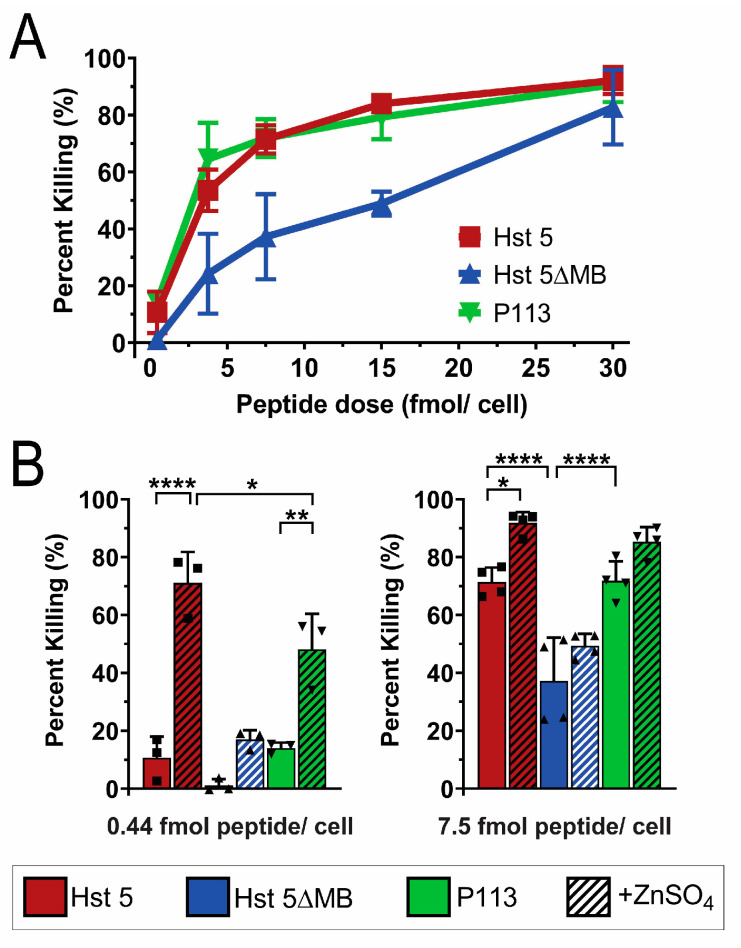
Hst 5ΔMB has less killing activity than Hst 5 or P113 and does not have increased killing activity with added Zn2+. (A) Candidacidal assays of C. albicans SC5314 cells with 1 h incubation at 30 °C of Hst 5 (red), Hst 5ΔMB (blue), and P113 (green) at dosages of 0.44, 3.75, 7.5, 15, and 30 fmol/cell in 10 mM sodium phosphate buffer pH 7.4. Data represent at least two replicates for each dose. (B) Candidacidal assays of C. albicans SC5314 cells with 1 h incubation at 30 °C of Hst 5 (red), Hst 5ΔMB (blue), and P113 (green) with and without a 1:2 ratio of Zn2+: peptide (hatched) at dosages of 0.44 fmol/cell (left) and 7.5 fmol/cell (right) in 10 mM sodium phosphate buffer pH 7.4. Squares and triangles indicate individual replicates. Significance of differences in killing activity were calculated using one way ANOVA with Sidak’s multiple comparisons test. * indicates p ≤ 0.05, ** indicates p ≤ 0.01, **** indicates p ≤ 0.0001.
Figure 4
Figure 4
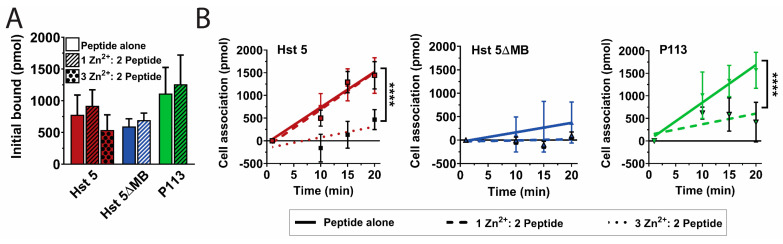
Zinc decreases uptake of P113 at a one Zn2+ to two peptides ratio and Hst 5 at a three Zn2+ to two peptides ratio. Cell association assays were performed at 30 °C with 0.44 fmol/cell. Hst 5 (red), Hst 5ΔMB (blue), and P113 (green) in 10 mM sodium phosphate buffer pH 7.4 with or without added Zn2+ at a one Zn2+ to two peptides ratio (hatched) or a three Zn2+ to two peptides ratio (dots). Time points were taken at 1, 10, 15, and 20 m. (A) One minute time points were taken as initial binding and (B) cell association attributed to active uptake was calculated by subtracting the initial time point from the 10, 15, and 20 m time points. Linear regressions were performed to determine rate of uptake. Experiments were repeated on at least three separate days and averaged. Significance of differences in initial binding were calculated using one-way ANOVA with Sidak’s multiple comparisons test. Significance of differences in rate of uptake were calculated using one-way ANOVA with Sidak’s multiple comparisons test. **** indicates p ≤ 0.0001
Figure 5
Figure 5
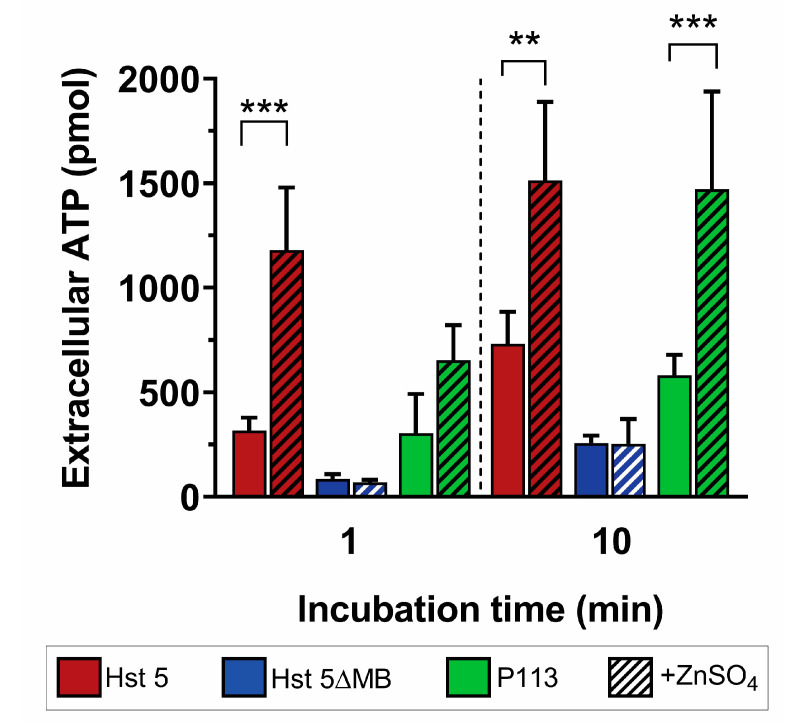
Zinc induces almost immediate ATP efflux. C. albicans SC5314 bioluminescent ATP efflux assay. Cells were treated at 30 °C with 0.88 fmol/ cell. Hst 5 (red), Hst 5ΔMB (blue), or P113 (green) in 10 mM sodium phosphate buffer pH 7.4 with or without added Zn2+ at a one to two peptides ratio (hatched). Cells were removed from samples via centrifugation and aliquots of supernatant were taken at 1 min and 10 min time points to measure extracellular ATP by luminescence. Experiments were repeated on at least three separate days and averaged. Significance of differences in ATP efflux calculated using one way ANOVA with Sidak’s multiple comparison test. ** indicates p ≤ 0.01, *** indicates p ≤ 0.001.
Figure 6
Figure 6
Zinc greatly increases Hst 5 and P113 killing of C. glabrata, and induces almost immediate ATP efflux. C. glabrata Cg931010 cells were used in candidacidal assays and ATP efflux assays. (A) For candidacidal assays, cells were incubated for 1 h at 30 °C with Hst 5 (red), Hst 5ΔMB (blue), and P113 (green) with and without a 1:2 ratio of Zn2+ to peptides (hatched) at 7.5 fmol peptides/cell in 10 mM sodium phosphate buffer pH 7.4. Squares and triangles indicate individual replicates. (B) In bioluminescent ATP efflux assays, cells were treated with 0.88 fmol/cell Hst 5 (red), Hst 5ΔMB (blue), or P113 (green) in 10 mM sodium phosphate buffer pH 7.4 with or without added Zn2+ at a one to two peptides ratio (hatched). Cells were removed from samples via centrifugation and aliquots of supernatant were taken at 1 and 10 min time points to measure extracellular ATP by luminescence. Both experiments were repeated on at least three separate days and averaged. Significance of differences in killing and ATP efflux were calculated using one way ANOVA with Sidak’s multiple comparison test. * indicates p ≤ 0.05, **** indicates p ≤ 0.0001
Figure 7
Figure 7
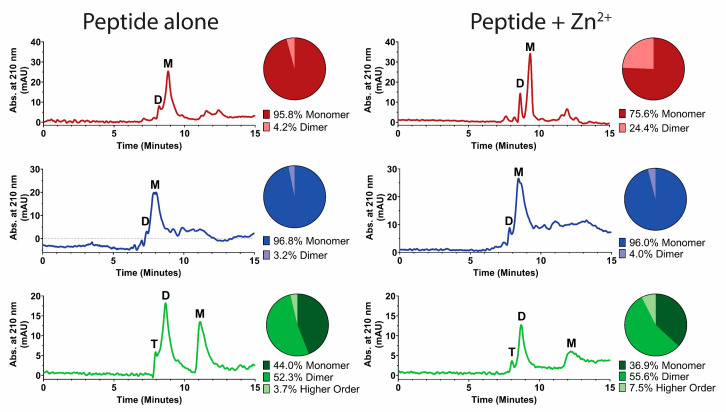
Zinc binding by Hst 5 promotes zinc-induced soluble dimers. Size-exclusion high-performance liquid chromatography (HPLC) was performed with protein detection at A210 to determine dimerization state of (top, red) Hst 5, (middle, blue) Hst 5ΔMB, and (bottom, green) P113 at a concentration of 329.34 µM in mobile phase composed of either zinc-free 10 mM sodium phosphate buffer pH 7.4, or buffer with added zinc at a concentration of 164.67 µM. Each condition was run in triplicate. Peak identification was made based upon comparison to known standards and area under the curve of peaks was used to calculate the relative percentage of peptide in monomer (M), dimer (D), and higher order oligomer (T) form (circle graphs). Representative traces of individual runs were subjected to second order smoothing for visualization.
Figure 8
Figure 8
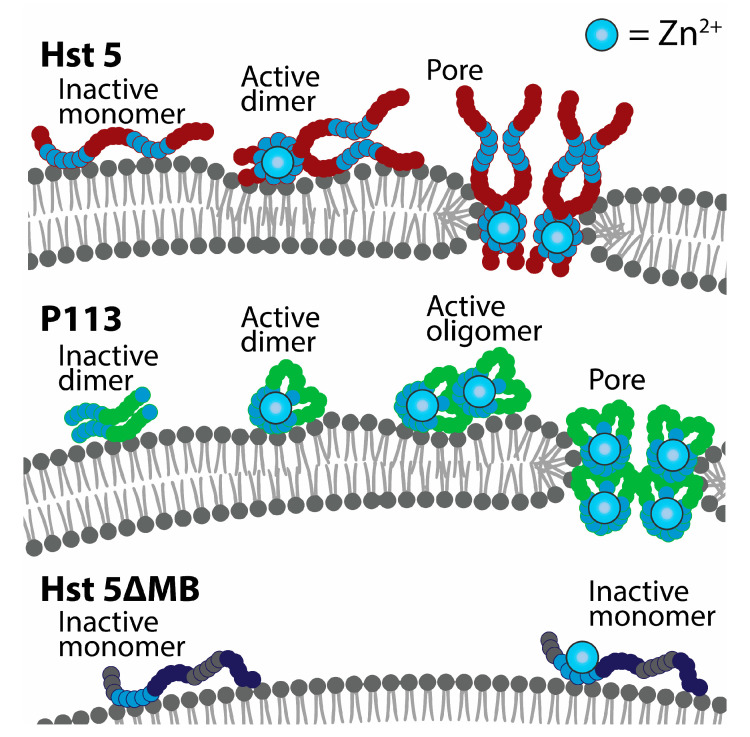
A model of Zn2+-induced pore formation by Hst 5 and P113. Zinc binding induces soluble dimers of Hst 5 that bind to the cell surface of C. albicans and C. glabrata. Interaction with fungal membranes induces dimer units to assemble into higher order structures, which induces membrane curvature and toroidal pores. P113 functions similarly but is dimeric before Zn2+ binding and requires more assembly steps to form a pore structure of the same size as Hst 5. Hst 5ΔMB binds to zinc but does not form dimers or assemble into higher order structures when membrane bound.

References

    1. Tsai H., Bobek L.A. Human salivary histatins: Promising anti-fungal therapeutic agents. Crit. Rev. Oral. Biol. Med. 1998;9:480–497. doi: 10.1177/10454411980090040601. - DOI - PubMed
    1. Oppenheim F.G., Xu T., Mcmillian F.M., Levitz S.M., Diamond R.D., Offner G.D., Troxler R.F. Histatins, A novel family of histidine-rich proteins in human parotid secretion. J. Biol. Chem. 1988;263:7472–7477. - PubMed
    1. Nikawa H., Jin C., Fukushima H., Makihira S., Hamada T. Antifungal activity of Histatin-5 against non-albicans Candida species. Oral. Microbiol. Immunol. 2001;16:250–252. doi: 10.1034/j.1399-302X.2001.160409.x. - DOI - PubMed
    1. Pathirana R.U., Friedman J., Norris H.L., Salvatori O., Mccall A.D., Kay J., Edgerton M. Fluconazole-resistant Candida auris is susceptible to salivary Histatin 5 killing and to intrinsic host defenses. Antimicrob. Agents Chemother. 2018;62:2. doi: 10.1128/AAC.01872-17. - DOI - PMC - PubMed
    1. Xu Y., Ambudkar I., Yamagishi H., Swaim W., Walsh T.J., O’connell B.C. Histatin 3-mediated killing of Candida albicans: Effect of extracellular salt concentration on binding and internalization. Antimicrob. Agents Chemother. 1999;43:2256. doi: 10.1128/AAC.43.9.2256. - DOI - PMC - PubMed

LinkOut - more resources