Review
. 2020 Jul 31;21(15):5497.
doi: 10.3390/ijms21155497.

Targeting of CD163+ Macrophages in Inflammatory and Malignant Diseases

Affiliations
Review

Targeting of CD163+ Macrophages in Inflammatory and Malignant Diseases

Maria K Skytthe et al. Int J Mol Sci. .

Abstract

The macrophage is a key cell in the pro- and anti-inflammatory response including that of the inflammatory microenvironment of malignant tumors. Much current drug development in chronic inflammatory diseases and cancer therefore focuses on the macrophage as a target for immunotherapy. However, this strategy is complicated by the pleiotropic phenotype of the macrophage that is highly responsive to its microenvironment. The plasticity leads to numerous types of macrophages with rather different and, to some extent, opposing functionalities, as evident by the existence of macrophages with either stimulating or down-regulating effect on inflammation and tumor growth. The phenotypes are characterized by different surface markers and the present review describes recent progress in drug-targeting of the surface marker CD163 expressed in a subpopulation of macrophages. CD163 is an abundant endocytic receptor for multiple ligands, quantitatively important being the haptoglobin-hemoglobin complex. The microenvironment of inflammation and tumorigenesis is particular rich in CD163+ macrophages. The use of antibodies for directing anti-inflammatory (e.g., glucocorticoids) or tumoricidal (e.g., doxorubicin) drugs to CD163+ macrophages in animal models of inflammation and cancer has demonstrated a high efficacy of the conjugate drugs. This macrophage-targeting approach has a low toxicity profile that may highly improve the therapeutic window of many current drugs and drug candidates.

Keywords: CD163; antibody-drug conjugate; cancer; glucocorticoid; inflammation; macrophage; targeting.


Conflict of interest statement

Søren Kragh Moestrup and Jonas Heilskov Graversen are shareholders in Deliver Pharma ApS, a biotech company focusing on drug targeting to macrophages via CD163.

Figures
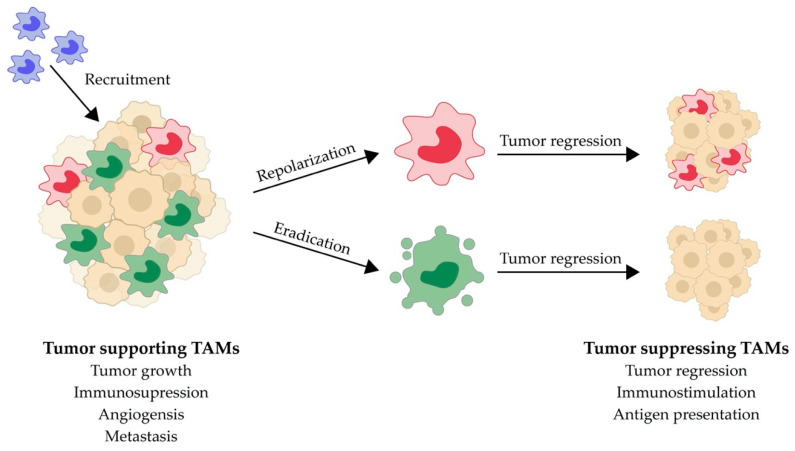
Figure 1
Figure 1
Targeting strategies of tumor associated macrophages (TAMs) in cancer therapy. Some of the tumor recruited macrophages adopt a tumor-supportive phenotype (green) in the tumor microenvironment which is immunosuppressive and supports tumor growth, angiogenesis and metastasis. Anti-tumor effects can be obtained by manipulating the TAM population. First, targeting of monocyte (blue) recruitment to limit TAM density in the tumor. Second, repolarization of tumor-promoting TAMs to tumor-suppressive macrophages (red) may promote tumor regression by stimulating the immune system. Or third, eradication of TAMs may promote tumor regression, either through general TAM depletion or, preferably, through selective depletion of tumor-supportive TAMs.
Figure 2
Figure 2
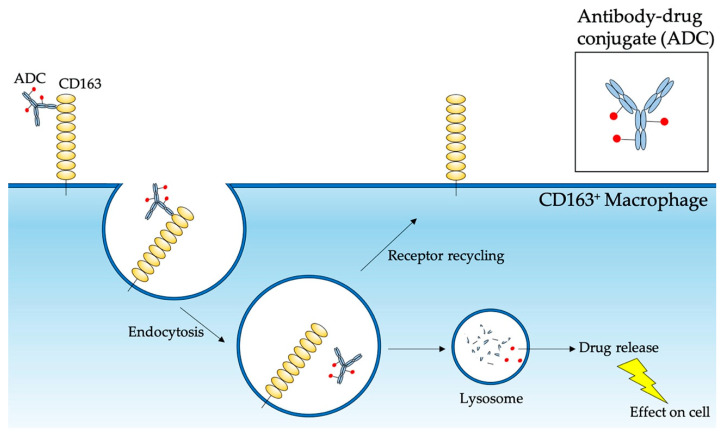
CD163 targeting using antibody-drug conjugates (ADC) in inflammatory and malignant diseases. CD163 is highly expressed on the surface of macrophages in many inflammatory diseases. A CD163-specific ADC is composed of a monoclonal anti-CD163 antibody which is conjugated to an anti-inflammatory or anti-tumor pharmaceutical ingredient by a chemical linker. The ADC binds to CD163 on the macrophage surface which triggers endocytosis of the conjugate. Within the exosome the ADC is released from CD163 and upon lysosome fusion the active pharmaceutical ingredient is released from the antibody to exert its function intracellularly.
Figure 3
Figure 3
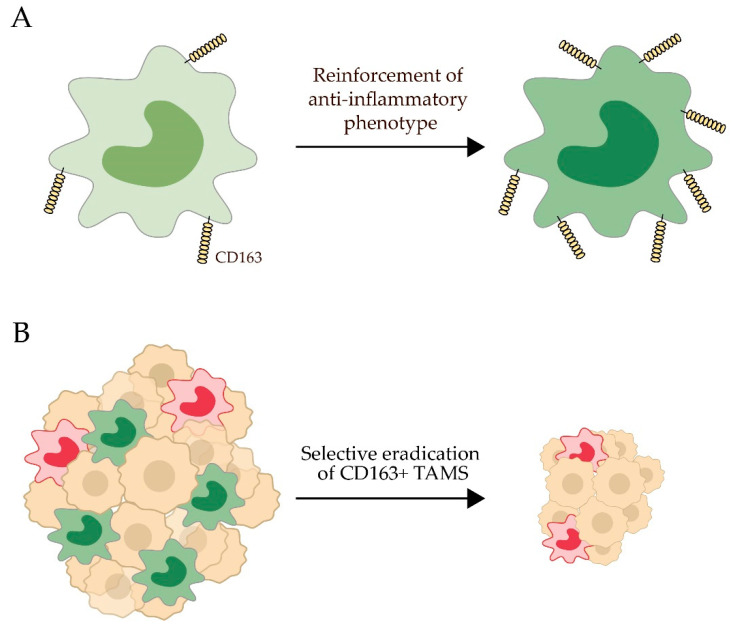
Selective targeting of CD163+ macrophages in inflammatory and cancer therapy. (A) The anti-inflammatory effects of CD163+ macrophages are reinforced by either high dose free dexamethasone or low dose CD163 targeted dexamethasone delivery system. High dose free dexamethasone carries a number of systemic side effects, including lymphocyte apoptosis that can be avoided by low dose dexamethasone targeting. (B) Selective eradication of CD163+ macrophages entail suppressed tumor growth and reduce metastatic spread in animal models.

References

    1. Gordon S., Martinez-Pomares L. Physiological roles of macrophages. Pflüg. Arch. 2017;469:365–374. doi: 10.1007/s00424-017-1945-7. - DOI - PMC - PubMed
    1. Rőszer T. Understanding the Mysterious M2 Macrophage through Activation Markers and Effector Mechanisms. Mediat. Inflamm. 2015;2015:1–16. doi: 10.1155/2015/816460. - DOI - PMC - PubMed
    1. Martinez F.O., Gordon S. The M1 and M2 paradigm of macrophage activation: Time for reassessment. F1000Prime Rep. 2014;6:13. doi: 10.12703/P6-13. - DOI - PMC - PubMed
    1. Oishi Y., Manabe I. Macrophages in inflammation, repair and regeneration. Int. Immunol. 2018;30:511–528. doi: 10.1093/intimm/dxy054. - DOI - PubMed
    1. Zhang L., Wang C. Inflammatory response of macrophages in infection. Hepatobiliary Pancreat. Dis. Int. 2014;13:138–152. doi: 10.1016/S1499-3872(14)60024-2. - DOI - PubMed