


Fibroblast Growth Factor Receptor 3 Alteration Status is Associated with Differential Sensitivity to Platinum-based Chemotherapy in Locally Advanced and Metastatic Urothelial Carcinoma
- PMID: 32753285
- PMCID: PMC8215618
- DOI: 10.1016/j.eururo.2020.07.018
Fibroblast Growth Factor Receptor 3 Alteration Status is Associated with Differential Sensitivity to Platinum-based Chemotherapy in Locally Advanced and Metastatic Urothelial Carcinoma
Erratum in
-
Corrigendum re "Fibroblast Growth Factor Receptor 3 Alteration Status is Associated with Differential Sensitivity to Platinum-based Chemotherapy in Locally Advanced and Metastatic Urothelial Carcinoma" [Eur Urol 2020;78:907-15].Eur Urol. 2021 May;79(5):e158-e159. doi: 10.1016/j.eururo.2021.01.031. Epub 2021 Feb 9. Eur Urol. 2021. PMID: 33579575 No abstract available.
Abstract
Background: Alterations in fibroblast growth factor receptor 3 (FGFR3) occur in ∼15% of muscle-invasive bladder cancers (MIBCs) and metastatic urothelial carcinomas (mUCs).
Objective: To determine the association between FGFR3 status and response to platinum-based chemotherapy in patients with MIBC or mUC.
Design, setting, and participants: The authors conducted a retrospective review and comparison of patients having (1) MIBC treated with neoadjuvant chemotherapy (NAC), (2) mUC treated with first-line platinum-based chemotherapy (M1 cohort), and (3) MIBC who were from The Cancer Genome Atlas (TCGA).
Intervention: Platinum-based chemotherapy.
Outcome measurements and statistical analysis: Pathologic response, recurrence-free (RFS) or progression-free (PFS) survival, and overall survival (OS) were compared between patients with FGFR3 alteration (FGFR3alt) and those without it (FGFR3wild type [FGFR3wt]) in the three cohorts.
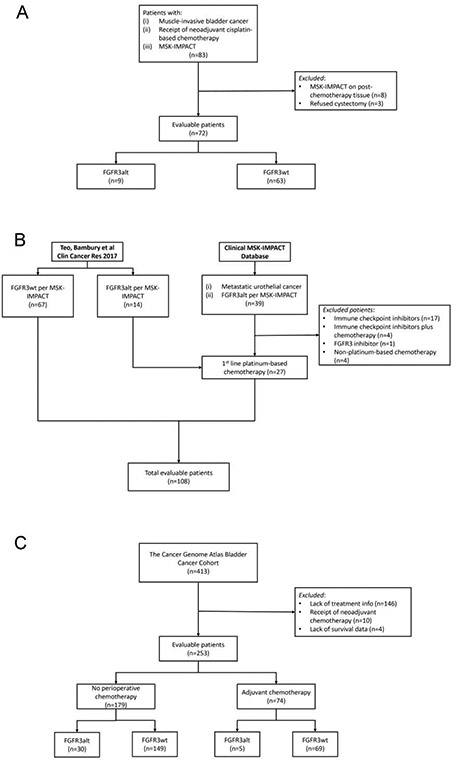
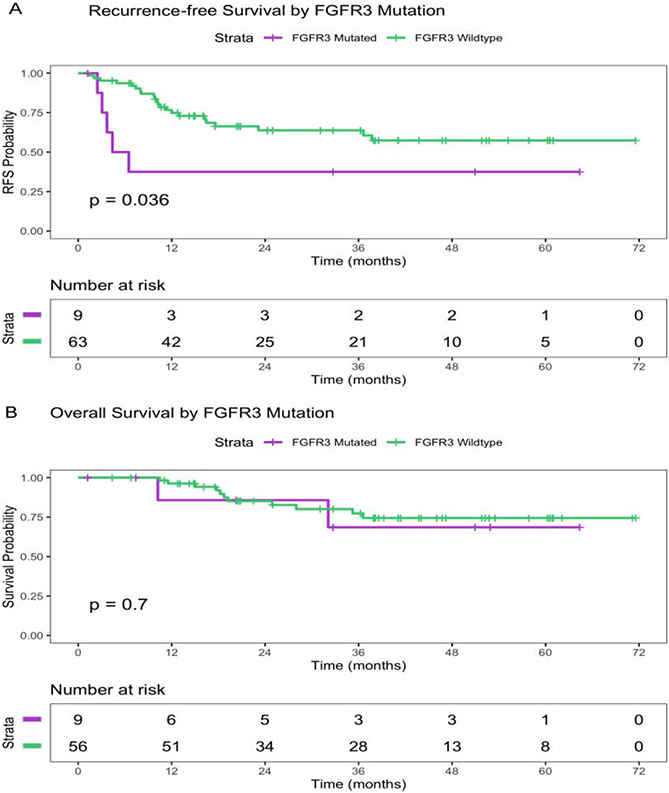
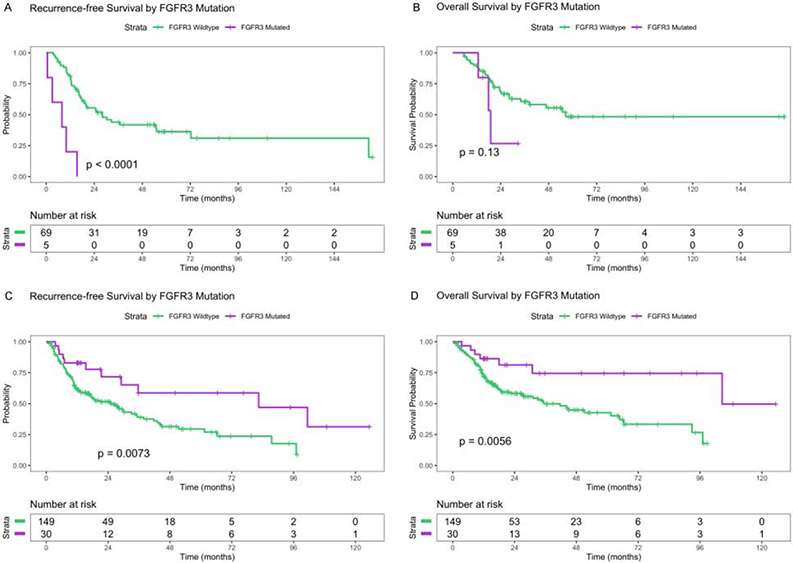
Results and limitations: Nine of 72 NAC patients (13%) had FGFR3alt, of whom none had pathologic complete response and three had residual non-MIBC (carcinoma in situ, n = 1; pT1, n = 2). FGFR3alt was associated with shorter RFS (hazard ratio, 2.74; p = 0.044) but not OS. Among TCGA patients who underwent adjuvant chemotherapy (n = 74), FGFR3alt patients had shorter RFS as well. Conversely, among chemotherapy-naive TCGA patients, FGFR3alt was associated with longer RFS and OS. In the M1 cohort (FGFR3alt, n = 27; FGFR3wt, n = 81), FGFR3alt was associated with higher rates of pulmonary metastases and nonregional lymphadenopathy. Despite lower response rates among FGFR3alt patients (37% vs 49%; p = 0.056), PFS and OS were not significantly different from FGFR3wt patients.
Conclusions: FGFR3 status is associated with lower responses to platinum-based chemotherapy, which may prompt exploration of nonchemotherapeutic approaches for perioperative management of FGFR3alt urothelial cancers.
Patient summary: Approximately 15% of bladder cancers harbor mutations in the fibroblast growth factor receptor 3 (FGFR3) gene. Our findings suggest that FGFR3 mutations might be associated with lower responses and shorter time to recurrence among patients with muscle-invasive bladder cancer who received perioperative platinum-based chemotherapy. FGFR3 status does not significantly impact response to chemotherapy among those with metastatic urothelial cancers.
Keywords: Chemotherapy; FGFR3; Platinum; Urothelial cancer.
Copyright © 2020 European Association of Urology. Published by Elsevier B.V. All rights reserved.
Conflict of interest statement
Figures
Comment in
-
Re: Ming Yuen Teo, Jose Mauricio Mota, Karissa A. Whiting, et al. Fibroblast Growth Factor Receptor 3 Alteration Status is Associated with Differential Sensitivity to Platinum-based Chemotherapy in Locally Advanced and Metastatic Urothelial Carcinoma. Eur Urol 2020;78:907-15: Linking FGFR3 Mutation Status and Luminal Papillary Subtype to Response to Cisplatin-based Chemotherapy in Bladder Cancer.Eur Urol. 2021 Jun;79(6):e182-e183. doi: 10.1016/j.eururo.2021.03.028. Epub 2021 Apr 8. Eur Urol. 2021. PMID: 33838962 No abstract available.
-
Urological Oncology: Bladder, Penis and Urethral Cancer, and Basic Principles of Oncology.J Urol. 2022 Jun;207(6):1346-1348. doi: 10.1097/JU.0000000000002650. Epub 2022 Mar 23. J Urol. 2022. PMID: 35319252 No abstract available.
References
-
- Kirkali Z, Chan T, Manoharan M, et al. Bladder cancer: epidemiology, staging and grading, and diagnosis. Urology 2005;66(6 Suppl 1):4–34. - PubMed
-
- Grossman HB, Natale RB, Tangen CM, et al. Neoadjuvant chemotherapy plus cystectomy compared with cystectomy alone for locally advanced bladder cancer. N Engl J Med 2003;349:859–66. - PubMed
-
- von der Maase H, Sengelov L, Roberts JT, et al. Long-term survival results of a randomized trial comparing gemcitabine plus cisplatin, with methotrexate, vinblastine, doxorubicin, plus cisplatin in patients with bladder cancer. J Clin Oncol 2005;23:4602–8. - PubMed
Publication types
MeSH terms
Substances
Grants and funding
LinkOut - more resources
Full Text Sources
Medical
