


Investigation of Human IFITM3 Polymorphisms rs34481144A and rs12252C and Risk for Influenza A(H1N1)pdm09 Severity in a Brazilian Cohort
- PMID: 32754450
- PMCID: PMC7366732
- DOI: 10.3389/fcimb.2020.00352
Investigation of Human IFITM3 Polymorphisms rs34481144A and rs12252C and Risk for Influenza A(H1N1)pdm09 Severity in a Brazilian Cohort
Abstract
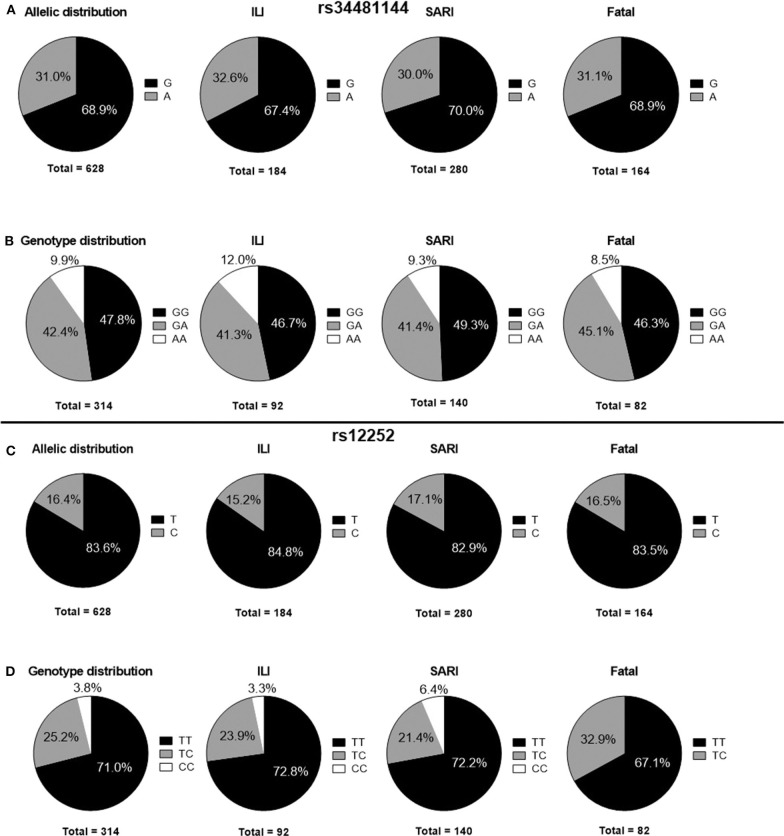
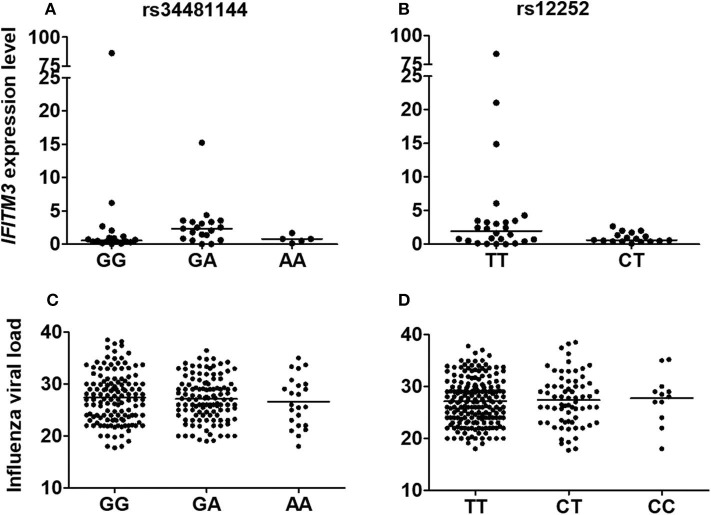
Influenza is a major public health problem that causes acute respiratory infection in humans. Identification of host factors influencing in disease outcome is critical for recognition of individuals with increased risk. Investigations on the role of rs34481144A and rs12252C IFITM3 polymorphisms in influenza A(H1N1)pdm09 severity is not yet conclusively determined. This study aimed to evaluate such polymorphisms frequencies and IFITM3 levels in an infected Brazilian cohort of 314 influenza A(H1N1)pdm09 cases and its putative association with clinical, epidemiological and virological data. Individuals were clinically classified into mild, severe and fatal cases. IFITM3 polymorphisms were detected by specific Taqman probes in real time PCR reactions. IFITM3 levels were determined by quantitative real time PCR. Thus, the different clinical groups presented similar distribution of rs34481144 and rs12252 genotypes and allelic frequencies. There was no significant association between the polymorphisms with severity of disease by using distinct genetic models. Additionally, geographic distribution of mutants showed that rs34481144A allele was more predominant in Brazilian Southern region. In contrast, rs12252C allele presented similar frequencies in all regions. Individuals with the distinct rs34481144 and rs12252 genotypes showed similar levels of IFITM3 and viral load in their respiratory specimens. Furthermore, IFITM3 levels were comparable in the distinct clinical groups and were not correlated with influenza viral load in analyzed samples. Thereby, rs34481144A and rs12252C polymorphisms were not associated with severity or mortality of influenza A(H1N1)pdm09 infection nor with IFITM3 transcript levels and influenza viral load in upper respiratory tract samples in a Brazilian cohort.
Keywords: IFITM3; biomarker; influenza; polymorphism; susceptibility.
Copyright © 2020 Martins, Oliveira, Garcia, Siqueira and Matos.
Figures
References
-
- Behillil S., May F., Fourati S., Luyt S.-E., Chicheportiche T, Sonneville R., et al. (2018). Oseltamivir resistance in severe influenza A(H1N1)pdm09 pneumonia and acute respiratory distress syndrome: a French multicenter observational cohort study. J. Med. Virol. 5, 836–843. 10.1093/cid/ciz904 - DOI - PubMed
Publication types
MeSH terms
Substances
LinkOut - more resources
Full Text Sources
Medical
