. 2020 Aug 4;12(15):15290-15301.
doi: 10.18632/aging.103428. Epub 2020 Aug 4.

Neutrophil depletion enhances the therapeutic effect of PD-1 antibody on glioma

Affiliations

Neutrophil depletion enhances the therapeutic effect of PD-1 antibody on glioma

Peng-Fei Wang et al. Aging (Albany NY). .

Abstract

Tumor-infiltrating neutrophils (TINs), the predominant leukocytes in the tumor microenvironment, are important for cancer-related immunosuppression. Combinations of multiple immune checkpoint inhibitors can significantly improve outcomes in murine glioma models. Here, we investigated TIN levels in human glioma samples and tested the antitumor efficacy of neutrophil depletion alone or in combination with an anti-programmed death 1 (PD-1) antibody. To investigate the clinical relevance, we determined the correlation between tumor grade or survival and TIN levels in 202 resected glioma specimens. TCGA and CGGA data were used to validate the results and analyze the biological functions of TINs in gliomas. An orthotopic xenograft glioma mouse model was used to study the therapeutic effect of anti-PD-1 and/or anti-ly6G. Decreased TIN levels correlated with lower grades, mutant isocitrate dehydrogenase, and favorable prognosis, which was validated by CGGA and TCGA dataset results. Bioinformatics analysis revealed that TINs are mainly involved in angiogenic, inflammatory, and interferon-γ responses in gliomas. TINs were positively correlated with programmed death ligand-1 expression. In xenograft models, combined anti-PD-1 and neutrophil depletion therapy significantly inhibited tumor growth and promoted survival. This study demonstrates that TINs were related to glioma tumorigenesis. Targeting neutrophils could thus enhance the therapeutic effect of PD-1 blockade for gliomas.

Keywords: PD-1; gliomas; immunotherapy; tumor infiltrating neutrophils.


Conflict of interest statement

CONFLICTS OF INTEREST: The authors declare that they have no conflicts of interest.

Figures

Figure 1
Figure 1
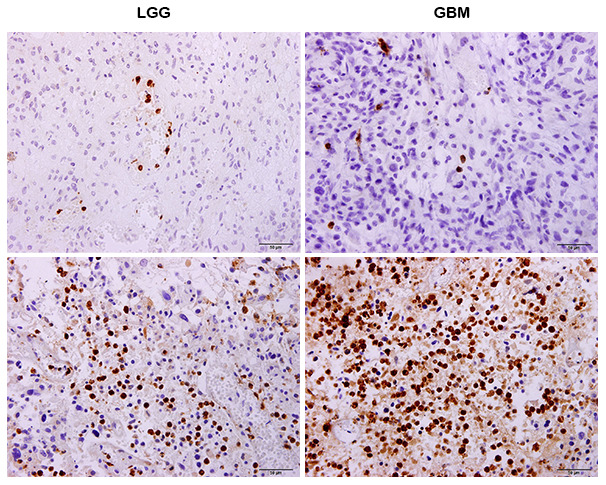
Immunohistochemistry (IHC) showing that neutrophils differently infiltrate tumors in both LGG and glioblastomas (GBMs).
Figure 2
Figure 2
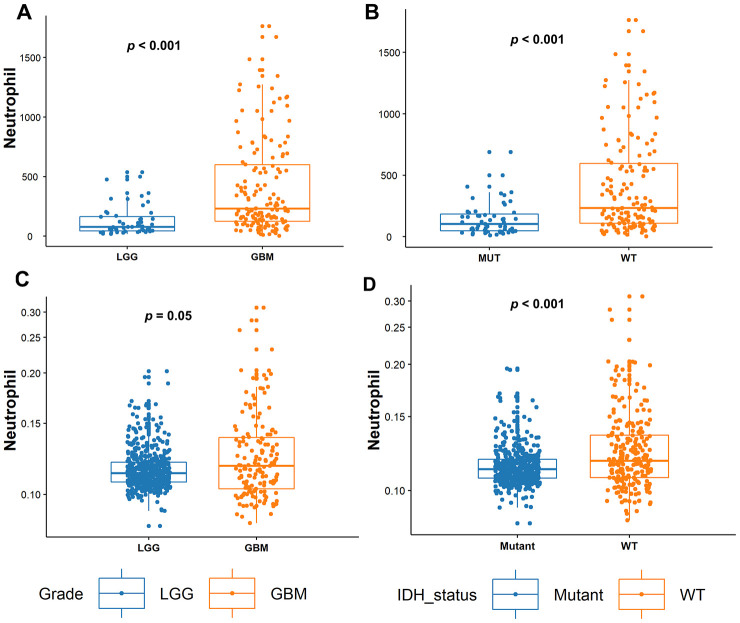
Tumor-infiltrating neutrophil (TIN) levels increase with tumor grades and in IDH-WT gliomas. (A) In the Sanbo cohort, TIN levels were compared between LGG (n = 52) and glioblastoma (GBM; n = 150) gliomas, and (B) in IDH-mutant (Mut; n = 55) and IDH wild-type (WT; n = 147) gliomas. (C) In the TCGA dataset, TIN levels were compared between LGG (n = 524) and GBMs (n = 153), and (D) IDH-Mut (n = 424) and IDH-WT (n = 234) gliomas.
Figure 3
Figure 3
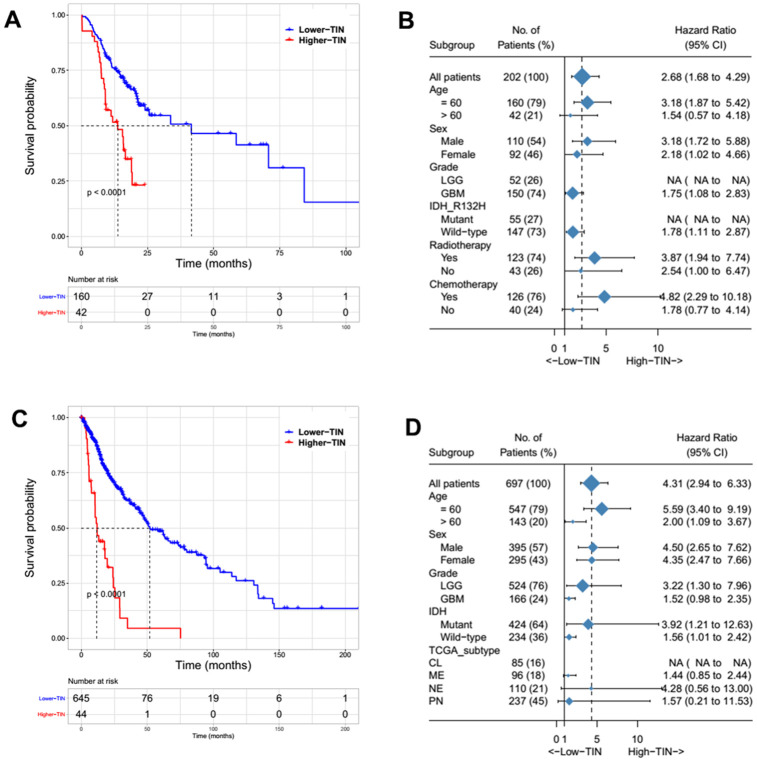
Survival and subgroup analysis of the tumor-infiltrating neutrophils (TINs) to predict overall survival (OS) in patients with gliomas from the Sanbo cohort (A, B) and TCGA dataset (C, D).
Figure 4
Figure 4
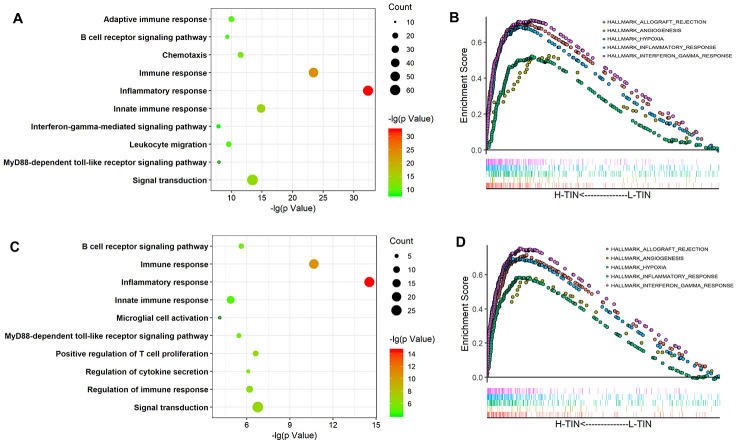
Biological process of tumor-infiltrating neutrophils (TINs) in gliomas. GO analysis of the TCGA and CGGA datasets shows that TINs are involved in the inflammatory response, immune response, and other GO immune functions (A, C). GSEA analysis showed that TINs participate in the inflammatory response, angiogenesis, and interferon-γ responses (B, D).
Figure 5
Figure 5
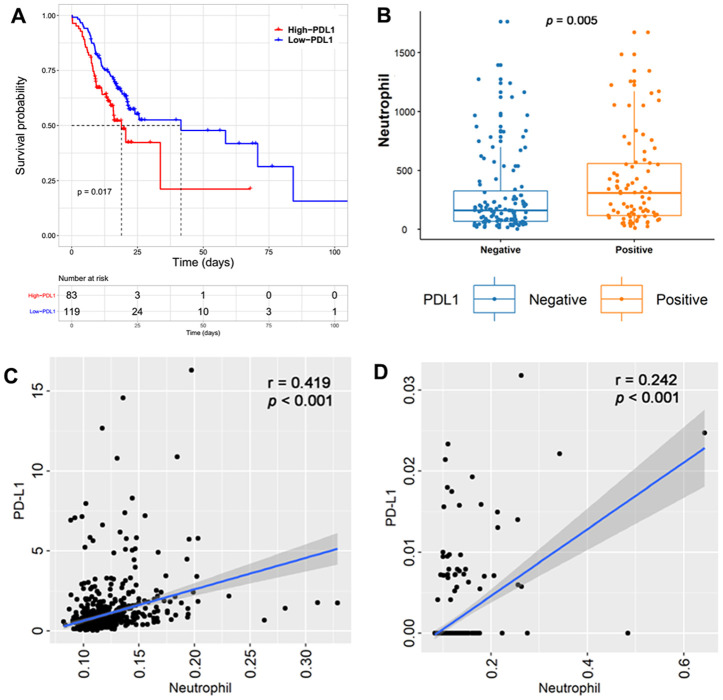
Tumors with higher PD-L1 expression were associated with a poor clinical outcome in the Sanbo cohort (p =0.017, (A). Tumor-infiltrating neutrophils (TINs) were significantly increased in tumors with PD-L1 positivity (p = 0.005, (B). Spearman correlation between TINs and PD-L1 mRNA levels showed that PD-L1 transcript levels were significantly positive with TINs in TCGA (p < 0.001, (C) and CGGA cohorts (p < 0.001, (D).
Figure 6
Figure 6
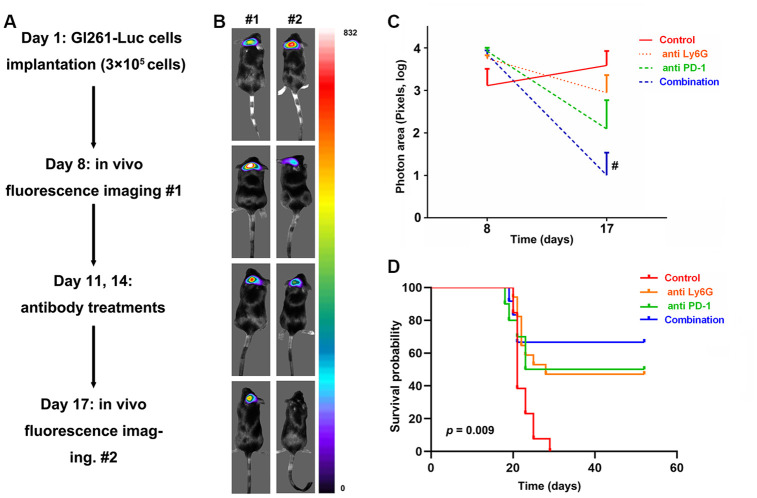
In vivo evaluation of targeting tumor-infiltrating neutrophils (TINs) and PD-L1 to treat glioblastomas (GBMs) in mice. The study flow of animal experiments (A). The representative image of tumor changes before and after antibody treatments (B). The tumor sizes significantly decreased with the dual therapy comprising anti- PD-1 and depletion of neutrophils compared to those in the control groups (C). Survival analysis showed that the mice receiving dual therapy had the longest survival times (D).

References

    1. Ostrom QT, Cioffi G, Gittleman H, Patil N, Waite K, Kruchko C, Barnholtz-Sloan JS. CBTRUS statistical report: primary brain and other central nervous system tumors diagnosed in the United States in 2012-2016. Neuro Oncol. 2019. (Suppl 5); 21:v1–100. 10.1093/neuonc/noz150 - DOI - PMC - PubMed
    1. Stupp R, Mason WP, van den Bent MJ, Weller M, Fisher B, Taphoorn MJ, Belanger K, Brandes AA, Marosi C, Bogdahn U, Curschmann J, Janzer RC, Ludwin SK, et al. , European Organisation for Research and Treatment of Cancer Brain Tumor and Radiotherapy Groups, and National Cancer Institute of Canada Clinical Trials Group. Radiotherapy plus concomitant and adjuvant temozolomide for glioblastoma. N Engl J Med. 2005; 352:987–96. 10.1056/NEJMoa043330 - DOI - PubMed
    1. Ribas A, Wolchok JD. Cancer immunotherapy using checkpoint blockade. Science. 2018; 359:1350–55. 10.1126/science.aar4060 - DOI - PMC - PubMed
    1. Blumenthal DT, Yalon M, Vainer GW, Lossos A, Yust S, Tzach L, Cagnano E, Limon D, Bokstein F. Pembrolizumab: first experience with recurrent primary central nervous system (CNS) tumors. J Neurooncol. 2016; 129:453–60. 10.1007/s11060-016-2190-1 - DOI - PubMed
    1. Reardon DA, Omuro A, Brandes AA, Rieger J, Wick A, Sepulveda J, Phuphanich S, de Souza P, Ahluwalia MS, Lim M, Vlahovic G, Sampson J. OS10.3 Randomized Phase 3 Study Evaluating the Efficacy and Safety of Nivolumab vs Bevacizumab in Patients With Recurrent Glioblastoma: CheckMate 143. Neuro-Oncology. 2017; 19:iii21–iii. 10.1093/neuonc/nox036.071 - DOI

Publication types

Substances