


Molecular profiling of non-small cell lung cancer
- PMID: 32756609
- PMCID: PMC7406040
- DOI: 10.1371/journal.pone.0236580
Molecular profiling of non-small cell lung cancer
Abstract
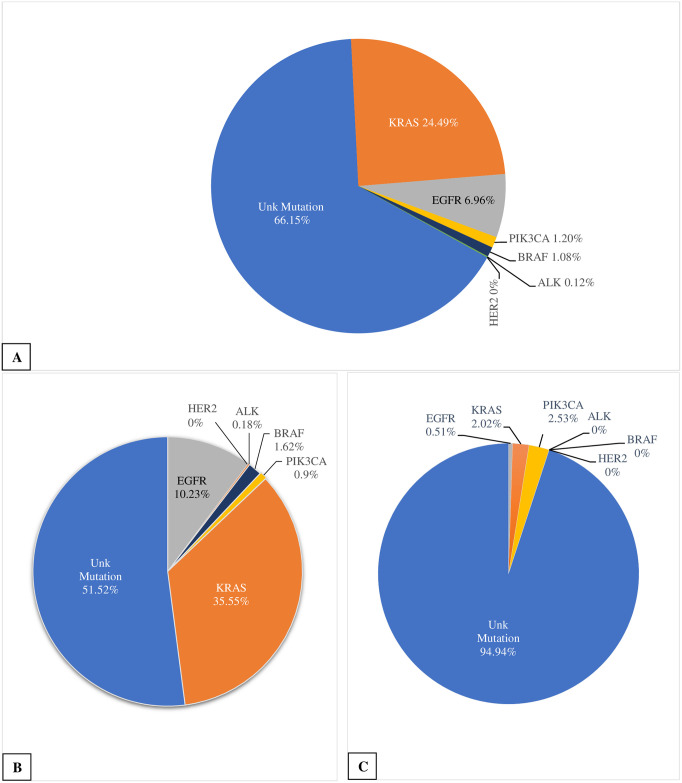
Lung cancer is generally treated with conventional therapies, including chemotherapy and radiation. These methods, however, are not specific to cancer cells and instead attack every cell present, including normal cells. Personalized therapies provide more efficient treatment options as they target the individual's genetic makeup. The goal of this study was to identify the frequency of causal genetic mutations across a variety of lung cancer subtypes in the earlier stages. 833 samples of non-small cell lung cancer from 799 patients who received resection of their lung cancer, were selected for molecular analysis of six known mutations, including EGFR, KRAS, BRAF, PIK3CA, HER2 and ALK. A SNaPshot assay was used for point mutations and fragment analysis searched for insertions and deletions. ALK was evaluated by IHC +/- FISH. Statistical analysis was performed to determine correlations between molecular and clinical/pathological patient data. None of the tested variants were identified in most (66.15%) of cases. The observed frequencies among the total samples vs. only the adenocarcinoma cases were notable different, with the highest frequency being the KRAS mutation (24.49% vs. 35.55%), followed by EGFR (6.96% vs. 10.23%), PIK3CA (1.20% vs. 0.9%), BRAF (1.08% vs. 1.62%), ALK (0.12% vs. 0.18%), while the lowest was the HER2 mutation (0% for both). The statistical analysis yielded correlations between presence of a mutation with gender, cancer type, vascular invasion and smoking history. The outcome of this study will provide data that helps stratify patient prognosis and supports development of more precise treatments, resulting in improved outcomes for future lung cancer patients.
Conflict of interest statement
The study was partially supported by Roche Canada, Pfizer Canada and Boehringer Ingelheim Canada. The funders had no role in study design, data collection and analysis, decision to publish, or preparation of the manuscript. The funding provided by the pharmaceutical companies were helping us for validation of the tests and not related to employment, consultancy, patents, products in development, marketed products, and any commercial purposes. This does not alter our adherence to PLOS ONE policies on sharing data and materials.
Figures
References
-
- Coleman MP, Forman D, Bryant H, Butler J, Rachet B, Maringe C, et al. Cancer survival in Australia, Canada, Denmark, Norway, Sweden, and the UK, 1995–2007 (the International Cancer Benchmarking Partnership): an analysis of population-based cancer registry data. Lancet. 2011; 377(9760): 127–38. 10.1016/S0140-6736(10)62231-3 - DOI - PMC - PubMed
-
- Afrose R, Akram M, Karimi AM, and Siddiqui SA. Correlation of age and gender with different histological subtypes of primary lung cancer. Med J DY Patil Univ. 2015; 8(4): 447–51. 10.4103/0975-2870.160783 - DOI
-
- Kumar V, Abbas AK, Fausto N, and Aster J. Robbins and Cotran Pathologic Basis of Disease. Eighth edition Philadelphia, PA: Saunders/Elsevier; 2010.
Publication types
MeSH terms
Substances
LinkOut - more resources
Full Text Sources
Research Materials
Miscellaneous
