Association Between ABCB1 Genetic Variants and Persistent Chemotherapy-Induced Alopecia in Women With Breast Cancer
- PMID: 32756886
- PMCID: PMC7407317
- DOI: 10.1001/jamadermatol.2020.1867
Association Between ABCB1 Genetic Variants and Persistent Chemotherapy-Induced Alopecia in Women With Breast Cancer
Abstract
Importance: Persistent chemotherapy-induced alopecia (pCIA) has been recently described in patients with breast cancer and in its most severe form occurs in up to 10% of these patients. Genetic risk factors associated with pCIA have not been adequately explored.
Objective: To identify genetic variants associated with pCIA.
Design, setting, and participants: In this genetic association study, 215 women with breast cancer treated with docetaxel-based chemotherapy with a follow-up of 1.5 to 10 years after the end of the treatment were recruited retrospectively through 3 hospital oncology units across Spain between 2005 and 2018. Severe pCIA was defined as lack of scalp hair recovery (Common Terminology Criteria for Adverse Events, version 3.0, grade 2) 18 months or more after the end of treatment. Patients with grade 2 pCIA were selected as cases, and those with no sign of residual alopecia 12 months after the end of docetaxel treatment were selected as controls. A genome-wide association study in a discovery phase was conducted, and logistic regression was used to identify variants associated with the risk to develop this adverse effect. The validity of the association was addressed through a replication phase.
Exposures: Docetaxel-based chemotherapy.
Main outcomes and measures: Genotypes of single-nucleotide variants associated with pCIA.
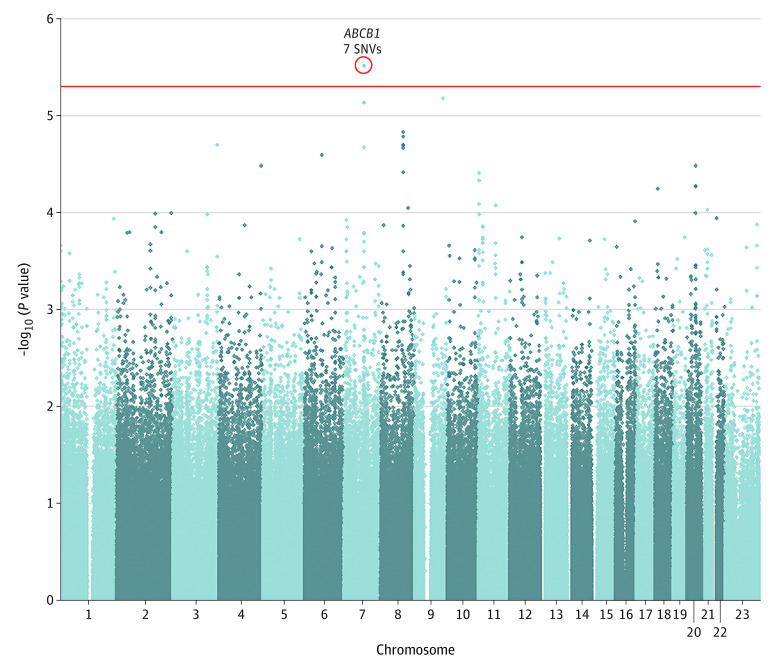
Results: In total, 215 women with breast cancer (median age, 51.6 years; interquartile range, 44-60 years) were recruited (173 patients for the discovery phase and 42 patients for the replication phase). In the discovery phase, ABCB1 genetic variants were associated with risk to develop pCIA. In particular, single-nucleotide variation rs1202179, a regulatory variant located in an enhancer element that interacts with the ABCB1 promoter, was associated with the occurrence of pCIA. This finding was validated in the replication cohort (combined odds ratio, 4.05; 95% CI, 2.46-6.67; P = 3.946 × 10⁻⁸). This variant is associated with ABCB1 mRNA expression, and the risk allele was associated with decreased ABCB1 expression levels (P = 1.64 × 10⁻²⁰).
Conclusions and relevance: This is the first study, to our knowledge, that identifies an association between a regulatory variant in the ABCB1 gene and the occurrence of pCIA in patients with breast cancer who were treated with docetaxel-based therapies. This finding suggests an important insight into the biological mechanisms underlying pCIA and opens the opportunity to explore personalized treatment of these patients.
Conflict of interest statement
Figures
Comment in
-
Insights Into the Biology of Persistent Chemotherapy-Induced Alopecia via Genomic Approaches-An Avenue to Clinical Translation?JAMA Dermatol. 2020 Sep 1;156(9):947-948. doi: 10.1001/jamadermatol.2020.1866. JAMA Dermatol. 2020. PMID: 32756883 No abstract available.
References
Publication types
MeSH terms
Substances
LinkOut - more resources
Full Text Sources
Medical