Review
. 2020 Aug 28;48(4):1707-1724.
doi: 10.1042/BST20200193.

Computational methods for exploring protein conformations

Affiliations
Review

Computational methods for exploring protein conformations

Jane R Allison. Biochem Soc Trans. .

Abstract

Proteins are dynamic molecules that can transition between a potentially wide range of structures comprising their conformational ensemble. The nature of these conformations and their relative probabilities are described by a high-dimensional free energy landscape. While computer simulation techniques such as molecular dynamics simulations allow characterisation of the metastable conformational states and the transitions between them, and thus free energy landscapes, to be characterised, the barriers between states can be high, precluding efficient sampling without substantial computational resources. Over the past decades, a dizzying array of methods have emerged for enhancing conformational sampling, and for projecting the free energy landscape onto a reduced set of dimensions that allow conformational states to be distinguished, known as collective variables (CVs), along which sampling may be directed. Here, a brief description of what biomolecular simulation entails is followed by a more detailed exposition of the nature of CVs and methods for determining these, and, lastly, an overview of the myriad different approaches for enhancing conformational sampling, most of which rely upon CVs, including new advances in both CV determination and conformational sampling due to machine learning.

Keywords: collective variables; conformational ensemble; enhanced sampling; machine learning; molecular dynamics; proteins.


Conflict of interest statement

The author declares that there are no competing interests associated with this manuscript.

Figures
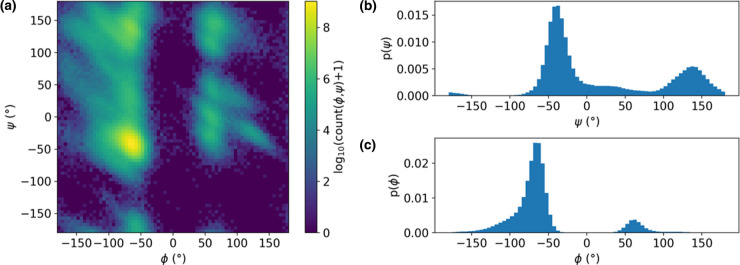
Figure 1.
Figure 1.. Illustration of projection of a free energy landscape onto commonly used CVs.
(a) Ramachandran maps project the conformational free energy landscape onto the backbone φ and ψ dihedral angle values. The example shown here is for a 100 ns MD simulation of hen egg white lysozyme (PDB ID: 1aki). (b,c) Projections of the conformational free energy landscape onto a single CV: (b) ψ and (c) φ. All angle values are in degrees. Projection of the free energy landscape onto the combination of both backbone dihedral angles is useful because it clearly separates the two major regions of secondary structure, namely (right-handed) α-helices and β-strands, although it is less effective at providing a more detailed degree of separation, such as between parallel and antiparallel β-strands — for this, additional CVs are required. ψ alone (b) could be a useful CV, as it preserves this separation, whereas projection onto φ (c) conflates α-helical and β-strand structure.
Figure 2.
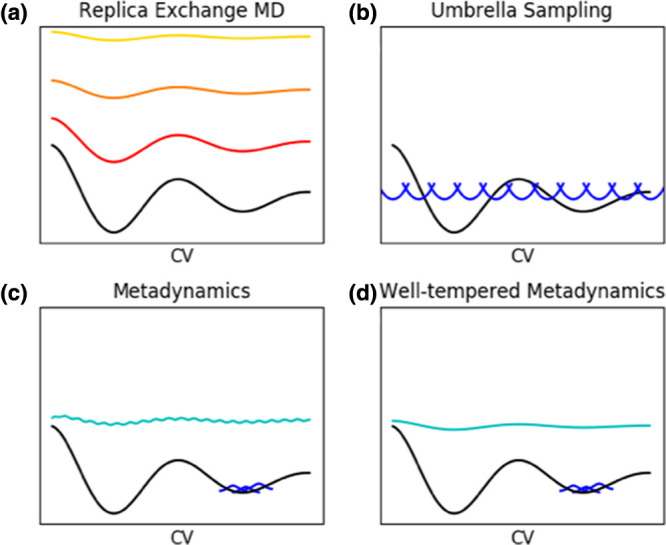
Figure 2.. Schematic illustration of three key enhanced sampling methods.
In all cases, the black line represents a free energy landscape projected onto a single CV, for simplicity. (a) Replica exchange MD, in which multiple independent replicas are run under different conditions, such as at increasingly high temperatures (red to yellow lines), which smooth the free energy landscape; (b) Umbrella sampling, where the blue harmonic potentials represent the ‘umbrellas’ that restraint conformational sampling along the CV; (c) metadynamics, where the potential energy surface is smoothed along one or more CVs by adding Gaussian functions (blue) to regions of the conformational space that have already been visited until ultimately (cyan) the entire surface is filled; (d) well-tempered metadynamics, where the rate and size of the Gaussian functions (blue) are reduced as sampling progresses, resulting in a smooth free energy surface (or a pre-specified distribution function, cyan) and avoiding over-filling.

References

    1. Yonath A. (2011) X-ray crystallography at the heart of life science. Curr. Opin. Struct. Biol. 21, 622–626 10.1016/j.sbi.2011.07.005 - DOI - PubMed
    1. Bax A. and Clore G.M. (2019) Protein NMR: boundless opportunities. J. Magn. Reson. 306, 187–191 10.1016/j.jmr.2019.07.037 - DOI - PMC - PubMed
    1. Lerner E., Cordes T., Ingargiola A., Alhadid Y., Chung S., Michalet X. et al. (2018) Toward dynamic structural biology: two decades of single-molecule Förster resonance energy transfer. Science 359, eaan1133 10.1126/science.aan1133 - DOI - PMC - PubMed
    1. Allison J.R. (2017) Using simulation to interpret experimental data in terms of protein conformational ensembles. Curr. Opin. Struct. Biol. 43, 79–87 10.1016/j.sbi.2016.11.018 - DOI - PubMed
    1. Bottaro S. and Lindorff-Larsen K. (2018) Biophysical experiments and biomolecular simulations: a perfect match? Science 361, 355 10.1126/science.aat4010 - DOI - PubMed

Publication types