Review
. 2021 Jan 1;27(1):15-23.
doi: 10.1158/1078-0432.CCR-20-1395. Epub 2020 Aug 5.

Designing Evolutionary-based Interception Strategies to Block the Transition from Precursor Phases to Multiple Myeloma

Affiliations
Review

Designing Evolutionary-based Interception Strategies to Block the Transition from Precursor Phases to Multiple Myeloma

Francesco Maura et al. Clin Cancer Res. .

Abstract

The development of next-generation sequencing technology has dramatically improved our understanding of the genetic landscape of multiple myeloma. Several new drivers and recurrent events have been reported and linked to a potential driver role. This complex landscape is enhanced by intraclonal mutational heterogeneity and variability introduced through the dimensions of time and space. The evolutionary history of multiple myeloma is driven by both the accumulation of different genomic drivers and by the activity of different mutational processes active overtime. In this review, we describe how these new findings and sequencing technologies have been progressively allowed to understand and reshape our knowledge of the complexity of multiple myeloma at each of its developmental stages: premalignant, at diagnosis, and in relapsed/refractory states. We discuss how these evolutionary concepts can be utilized in the clinic to alter evolutionary trajectories providing a framework for therapeutic intervention at early-disease stages.


Conflict of interest statement

Disclosure of conflicts of interest: No conflict of interests to declare.

Figures

Fig. 1.
Fig. 1.
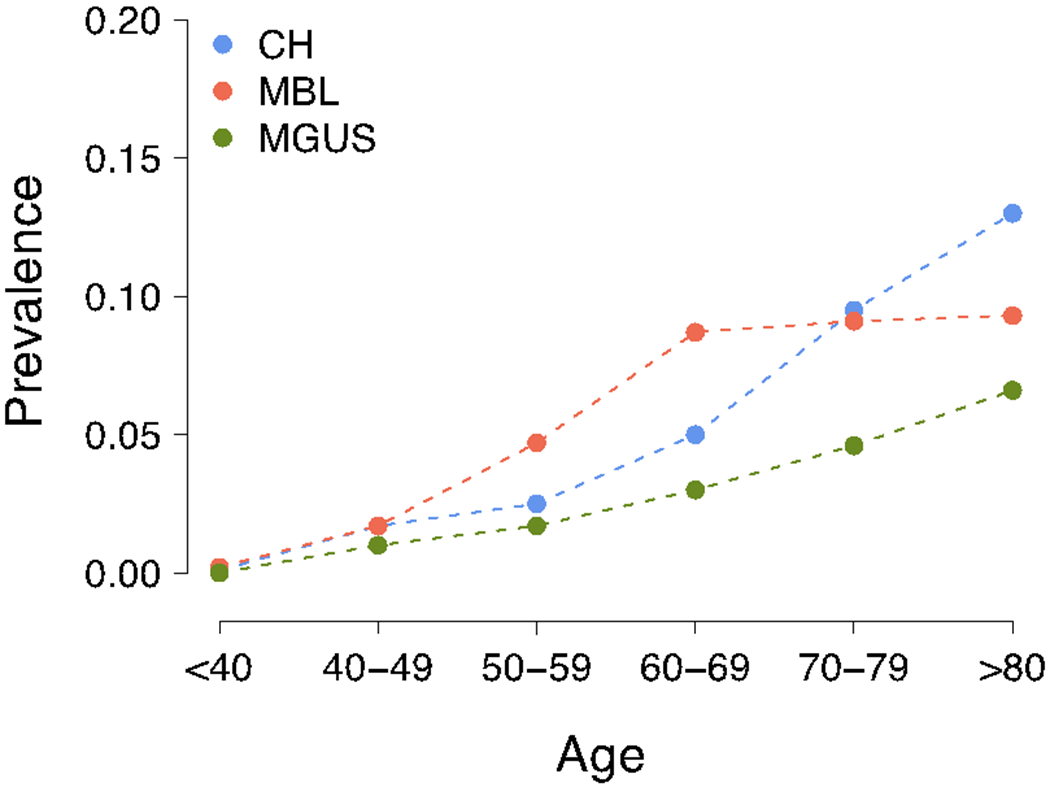
Increasing prevalence of MGUS, monoclonal B-cell lymphoproliferation (MBL) and clonal hemopoiesis (CH) with ageing.
Fig. 2.
Fig. 2.
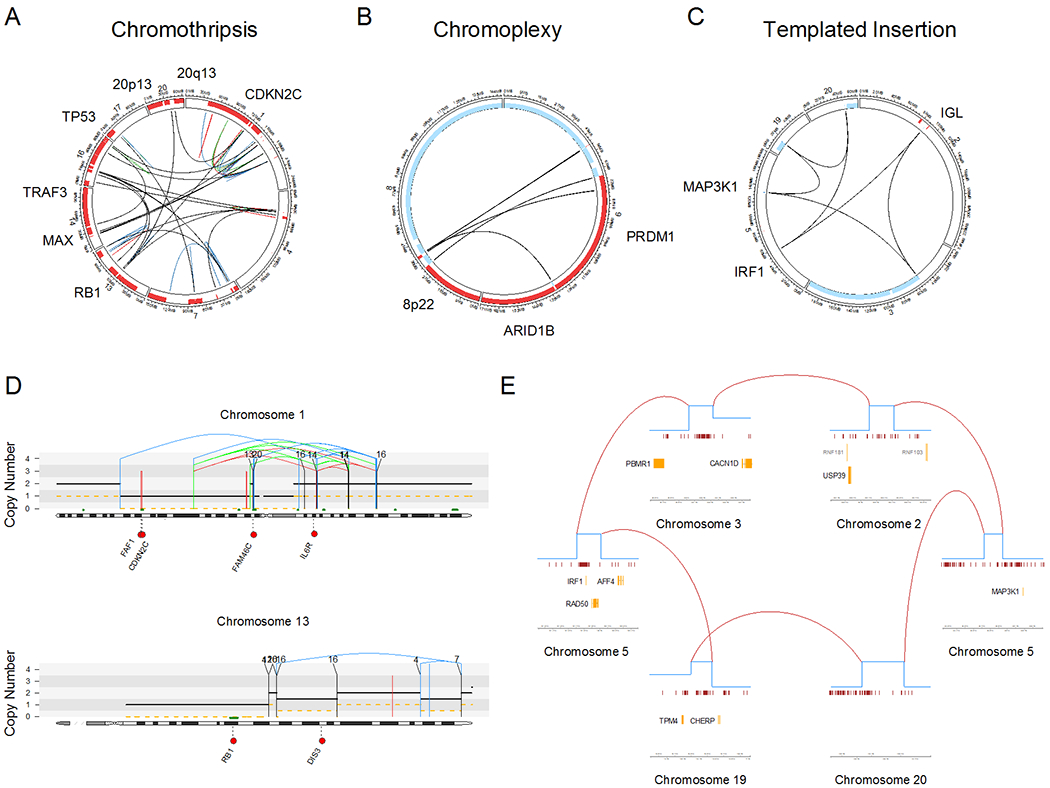
Types of complex structural variants identified in multiple myeloma patients enrolled in CoMMpass trial. A-C) Example of patients with chromothripsis (MMRF_2671_1_BM; A), chromoplexy (MMRF_2516_1_BM; b) and templated insertions (MMRF_1928_1_BM; C). All these complex events simultaneously involved multiple known driver events. D) Examples of chromothripsis (top) and chromoplexy (bottom) responsible for major copy number aberrations. E) Zoom in on each focal copy number gain and structural variants involved by a templated insertion (CoMMpass patient: MMRF_2330_1_BM).
Fig. 3.
Fig. 3.
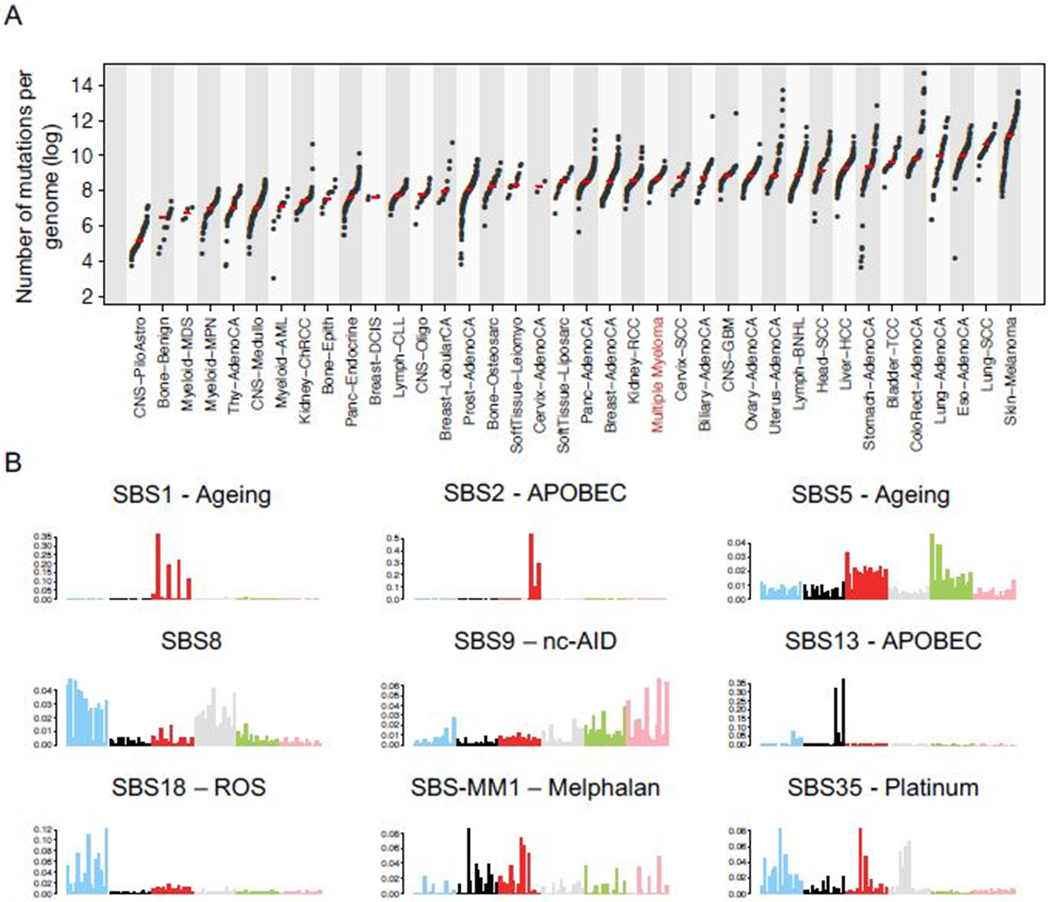
The multiple myeloma mutational signature landscape. a) The prevalence and median of somatic mutations across human cancer types evaluated by WGS. b) The nine mutational signatures extracted from WGS data in multiple myeloma.
Fig. 4.
Fig. 4.
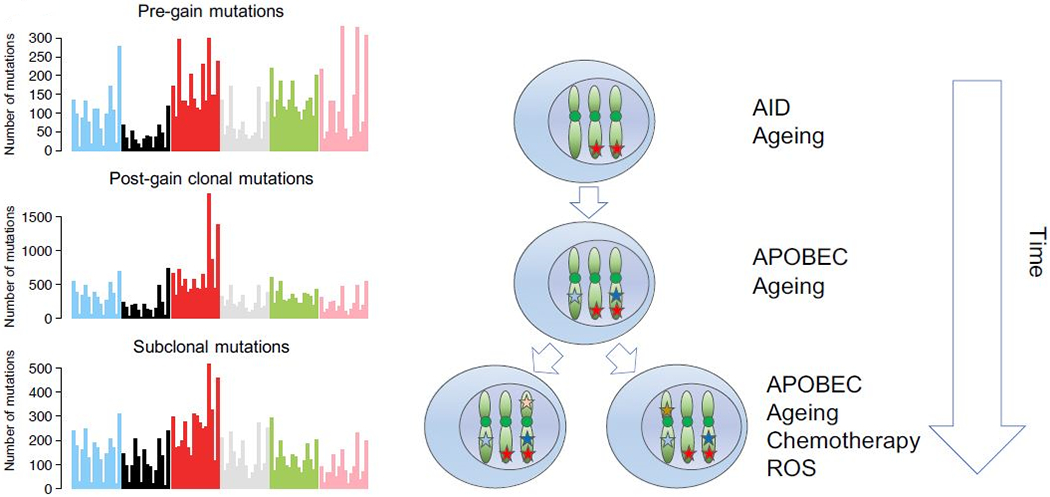
Illustration of how to reconstruct the mutational signature activity over time in multiple myeloma. When an allele is duplicated, all the mutations acquired since the fertilized egg will be duplicated and present on the two duplicated alleles. This will change their VAF from 50% to 66%. In contrast, all the mutations acquired after the duplication will be present only on one allele and have a 33% VAF. Differentiating pre and post gain mutations allows to explore the chronological order of clonal events. Combining this with data from phylogenic tree reconstruction (i.e. clonal vs subclonal) we can divide a faction of genomic events in early (pre gain), intermediate (post gain) and late (subclonal). Doing so on 52 WGS, we observed different patterns of mutations and signatures. Specifically, AID tends to dramatically decrease from pre to post gain (e.g. T>G peaks); APOBEC increase after gains (e.g. peaks in A[C>T]T and T[C>T]T); chemotherapy signatures are acquired later G[C>G]X, in line with their post-diagnosis acquisition.
Fig. 5.
Fig. 5.
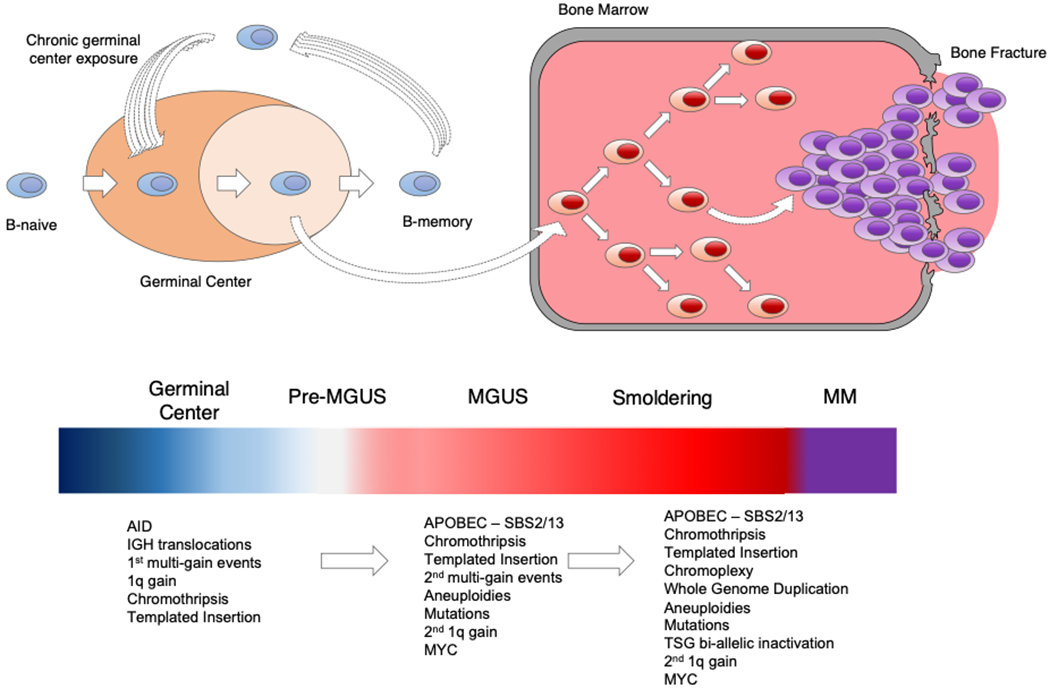
Model for the development of multiple myeloma based on the latest whole genome sequencing data. Compared to previous model we proposed here the existence of a pre-MGUS GC-phase. Recent data suggest that the pre-MGUS cell experienced a prolonged exposure to the GC. During these exposures several key drivers and AID mediated mutations are acquired. At certain point, this clone becomes GC-independent and move to the bone marrow, where it starts the MGUS>SMM>MM evolution.

References

    1. Ghobrial IM, Detappe A, Anderson KC, Steensma DP. The bone-marrow niche in MDS and MGUS: implications for AML and MM. Nat Rev Clin Oncol 2018;15(4):219–33 doi 10.1038/nrclinonc.2017.197 - DOI - PubMed
    1. Landgren O, Albitar M, Ma W, Abbasi F, Hayes RB, Ghia P, et al. B-cell clones as early markers for chronic lymphocytic leukemia. N Engl J Med 2009;360(7):659–67 doi 10.1056/NEJMoa0806122. - DOI - PMC - PubMed
    1. Genovese G, Kahler AK, Handsaker RE, Lindberg J, Rose SA, Bakhoum SF, et al. Clonal hematopoiesis and blood-cancer risk inferred from blood DNA sequence. N Engl J Med 2014;371(26):2477–87 doi 10.1056/NEJMoa1409405. - DOI - PMC - PubMed
    1. Jaiswal S, Fontanillas P, Flannick J, Manning A, Grauman PV, Mar BG, et al. Age-related clonal hematopoiesis associated with adverse outcomes. N Engl J Med 2014;371(26):2488–98 doi 10.1056/NEJMoa1408617. - DOI - PMC - PubMed
    1. Kyle RA, Remstein ED, Therneau TM, Dispenzieri A, Kurtin PJ, Hodnefield JM, et al. Clinical course and prognosis of smoldering (asymptomatic) multiple myeloma. N Engl J Med 2007;356(25):2582–90 doi 10.1056/NEJMoa070389. - DOI - PubMed

Publication types

MeSH terms