


Spatiotemporal patterns of anemia among lactating mothers in Ethiopia using data from Ethiopian Demographic and Health Surveys (2005, 2011 and 2016)
- PMID: 32760116
- PMCID: PMC7410320
- DOI: 10.1371/journal.pone.0237147
Spatiotemporal patterns of anemia among lactating mothers in Ethiopia using data from Ethiopian Demographic and Health Surveys (2005, 2011 and 2016)
Abstract
Introduction: Maternal anemia is a worldwide public health problem especially in developing countries including Ethiopia. The burden of anemia among lactating mothers in Ethiopia was higher than those who were neither pregnant nor breastfeeding. To date, there is limited evidence on spatiotemporal patterns of anemia among lactating mothers in the country. Exploring the spatial patterns of maternal anemia is vital to design and monitor effective intervention programs. Therefore this study aimed to explore spatiotemporal patterns of anemia among lactating mothers in Ethiopia over the past one and half-decades.
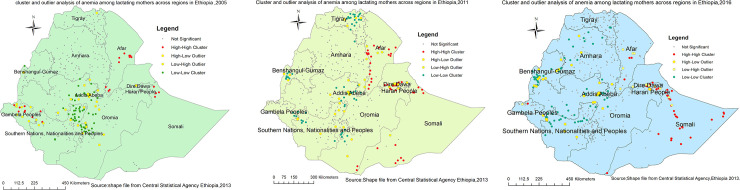
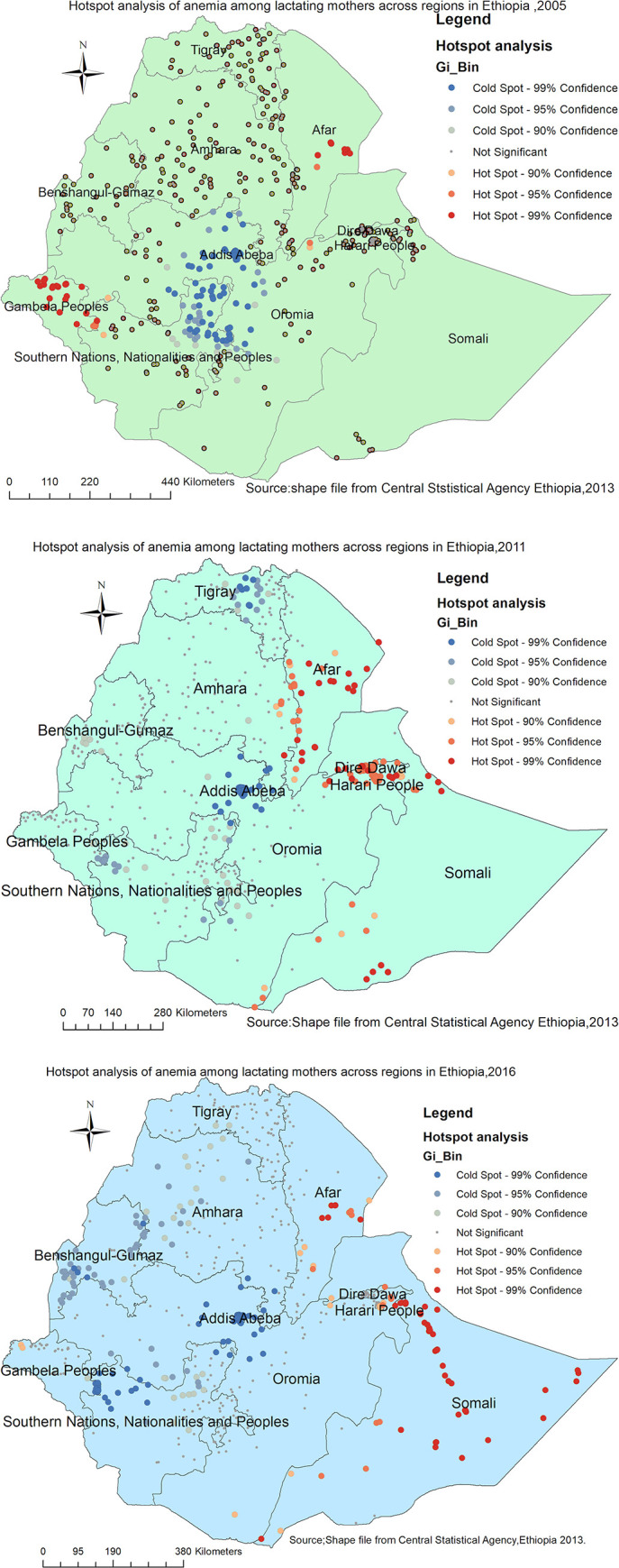
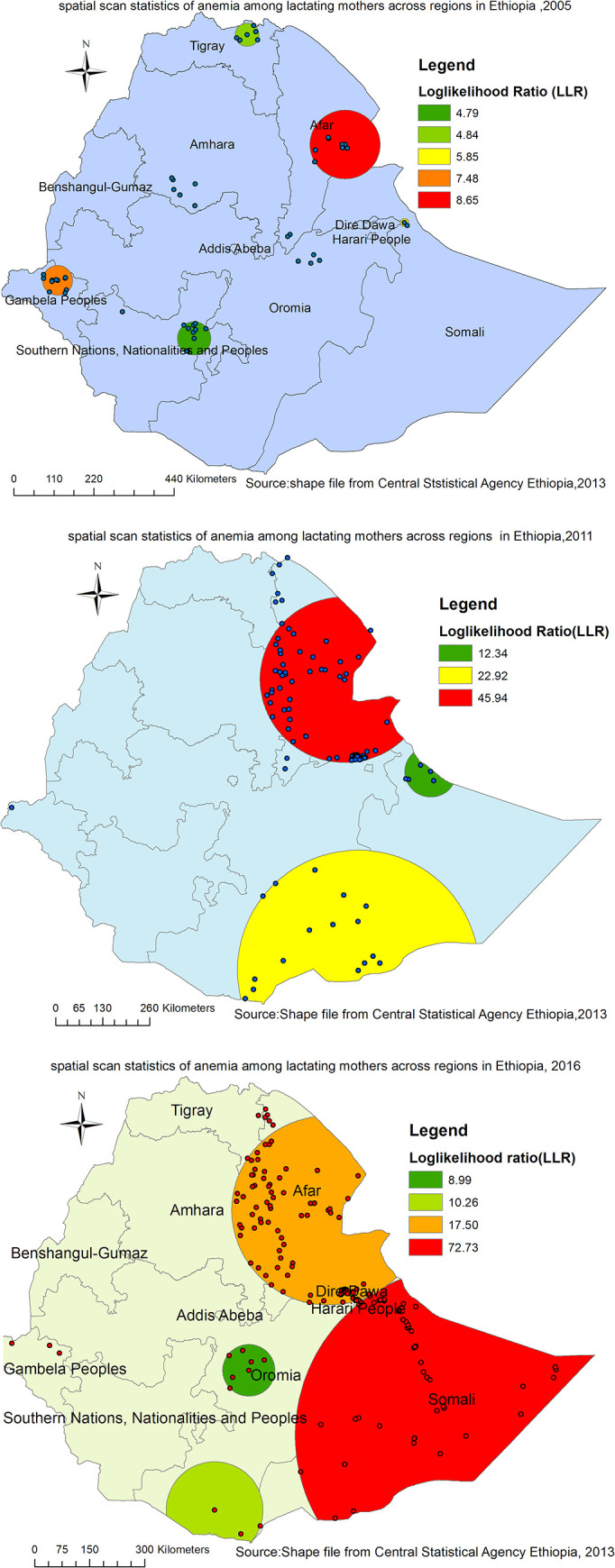
Methods: A total of 11,989 lactating mothers were included from the three consecutive Ethiopian Demographic and Health Surveys(2005, 2011, and 2016). The trend of anemia over the three surveys was showed. Furthermore, spatial autocorrelation analysis, cluster and outlier analysis, hotspot analysis, spatial interpolation, and spatial scan statistics were carried out to identify geographically risk areas of anemia among lactating mothers in Ethiopia. Finally, the most anemia risk areas were detected consistently by different spatial analytic methods in each survey.
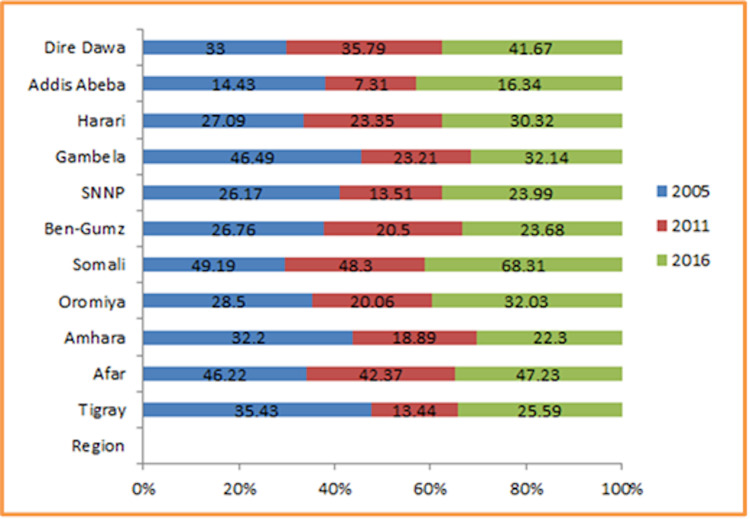
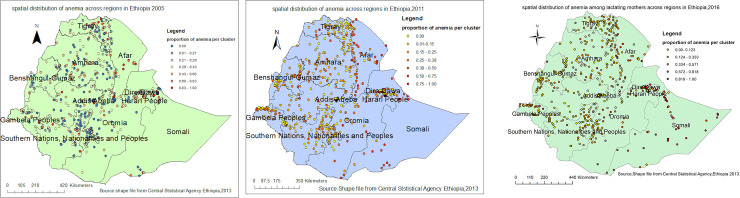
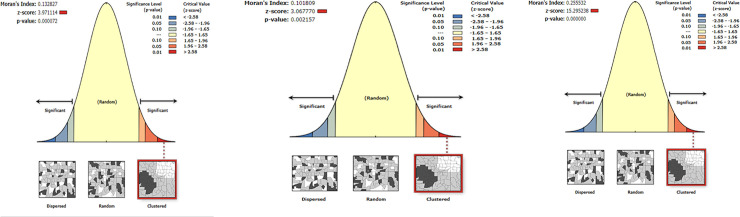
Results: Anemia during lactation had an increasing trend from 2011 to 2016 in all regions of Ethiopia. It was also spatially clustered over three survey periods (Moran's I: 0.102-0.256, P<0.01).The hotspot areas were detected in Afar, Somali, Gambela, Dire Dawa, and Oromia regions during the last fifteen years. In 2005 and 2011, a total of 100 most likely clusters (Loglikelihood Ratio(LLR) = 8.8, P<0.05, and LLR = 45.94, P<0.001, respectively) were identified in the Afar region. However, in the 2016 survey period, primary clusters were shifted to the Somali region where 57 clusters (LLR = 72.73, P<0.001) were detected in the entire region. Besides, the risk prediction map showed that the eastern part of the country was at a higher risk of anemia during lactation.
Conclusion: Anemia during lactation was spatially clustered in Ethiopia. High-risk areas were detected in the eastern part of Ethiopia prominently in the Afar and Somali regions. Therefore, public health intervention activities designed in a targeted approach to impact high-risk populations in those hot spot areas wound be helpful to reduce anemia in Ethiopia.
Conflict of interest statement
The authors have declared that no competing interests exist.
Figures

References
-
- Geneva S. Haemoglobin Concentrations for the Diagnosis of Anaemia and Assessment of Severity. Vitamin and Mineral Nutrition Information System. Document Reference WHO. NMH/NHD/MNM/11.1. http://www.who.int/entity/vmnis/indicators/haemoglobin …, 2011.
-
- Organization WH. Assessing the iron status of populations: report of a joint World Health Organization/Centers for Disease Control and Prevention technical consultation on the assessment of iron status at the population level.: Geneva, Switzerland. world health organization, 2007
-
- De Benoist B, Cogswell M, Egli I, McLean E. Worldwide prevalence of anaemia 1993–2005; WHO Global Database of anaemia. 2008. - PubMed
-
- Stevens GA, Finucane MM, De-Regil LM, Paciorek CJ, Flaxman SR, Branca F, et al. Global, regional, and national trends in haemoglobin concentration and prevalence of total and severe anaemia in children and pregnant and non-pregnant women for 1995–2011: a systematic analysis of population-representative data. The Lancet Global Health. 2013;1(1):e16–e25. 10.1016/S2214-109X(13)70001-9 - DOI - PMC - PubMed
-
- Central Statistical Agency (CSA) [Ethiopia] and ICF:2005. Ethiopia Demographic and Health Survey 2005. Addis Ababa, Ethiopia, and Rockville, Maryland, USA: CSA and ICF, 2005.
MeSH terms
LinkOut - more resources
Full Text Sources
Miscellaneous
