


Predictors of unmet need for contraception among adolescent girls and young women in selected high fertility countries in sub-Saharan Africa: A multilevel mixed effects analysis
- PMID: 32760153
- PMCID: PMC7410238
- DOI: 10.1371/journal.pone.0236352
Predictors of unmet need for contraception among adolescent girls and young women in selected high fertility countries in sub-Saharan Africa: A multilevel mixed effects analysis
Abstract
Introduction: Despite the desire of adolescent girls and young women (AGYW) in sub-Saharan Africa (SSA) to use contraceptives, the majority of them have challenges with access to contraceptive services. This is more evident in high fertility countries in SSA. The purpose of this study was to examine the predictors of unmet need for contraception among AGYW in selected high fertility countries in SSA.
Materials and methods: Data from current Demographic and Health Surveys (DHS) carried out between 2010 and 2018 in 10 countries in SSA were analysed. A sample size of 24,898 AGYW who were either married or cohabiting was used. Unmet need for contraception was the outcome variable in this study. The explanatory variables were age, marital status, occupation, educational level, frequency of reading newspaper/magazine, frequency of listening to radio, frequency of watching television and parity (individual level variables) and wealth quintile, sex of household head, place of residence and decision-maker in healthcare (household/community level variables). Descriptive and multilevel logistic regression analyses were carried out. The results of the multilevel logistic regression analyses were reported using adjusted odds ratios at 95% confidence interval.
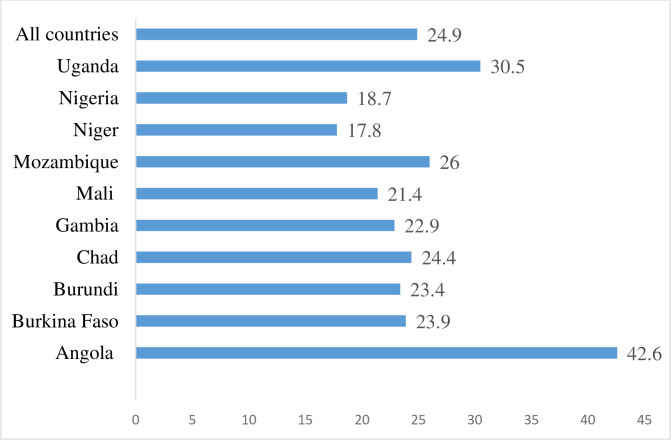
Results: The prevalence of unmet need for contraception in all the countries considered in this study was 24.9%, with Angola, recording the highest prevalence of 42.6% while Niger had the lowest prevalence of 17.8%. In terms of the individual level predictors, the likelihood of unmet need for contraception was low among AGYW aged 20-24 [aOR = 0.82; 95% CI = 0.76-0.88], those with primary [aOR = 1.22; 95% CI = 1.13-1.31] and secondary/higher levels of formal education [aOR = 1.18; 95% CI = 1.08-1.28, p < 0.001], cohabiting AGYW [aOR = 1.52; 95% CI = 1.42-1.63] and AGYW with three or more births [aOR = 3.41; 95% CI = 3.02-3.85]. At the household/community level, the odds of unmet need for contraception was highest among poorer AGYW [aOR = 1.36; 95% CI = 1.21-1.53], AGYW in female-headed households [aOR = 1.22; 95% CI = 1.13-1.33], urban AGYW [aOR = 1.21; 95% CI = 1.11-1.32] and AGYW who took healthcare decisions alone [aOR = 1.10; 95% CI = 1.01-1.21].
Conclusion: This study has identified disparities in unmet need for contraception among AGYW in high fertility countries in SSA, with AGYW in Angola having the highest prevalence. Both individual and household/community level factors predicted unmet need for contraception among AGYW in this study. However, based on the ICC values, household/community level factors prevailed the individual level factors. Enhancing access to contraception among poorer AGYW, those in female-headed households, those in urban areas and those who take healthcare decisions alone by both governmental and non-governmental organisations in high fertility countries is recommended.
Conflict of interest statement
The author has declared that no competing interests exist.
Figures
References
-
- Naidoo K, Adeagbo O, Pleaner M. Sexual and Reproductive Health Needs of Adolescent Girls and Young Women in Sub-Saharan Africa: Research, Policy, and Practice. SAGE Open. 2019;9(3):2158244019859951.
-
- Adolescent Health. [Internet]. WHO. 2020 [cited April 9, 2020.]. Available from: https://www.who.int/southeastasia/health-topics/adolescent-health
-
- Adolescents and young people in sub-Saharan Africa: Opportunities and challenges [Internet]. 2012 [cited April 30, 2020]. Available from: https://www.k4health.org/toolkits/youthpolicy/adolescents-and-young-peop....
MeSH terms
Substances
LinkOut - more resources
Full Text Sources
Medical
Research Materials
