Review
. 2020 Jul 15:10:346.
doi: 10.3389/fcimb.2020.00346. eCollection 2020.

Extracellular Vesicles in Fungi: Past, Present, and Future Perspectives

Affiliations
Review

Extracellular Vesicles in Fungi: Past, Present, and Future Perspectives

Juliana Rizzo et al. Front Cell Infect Microbiol. .

Abstract

Extracellular vesicles (EVs) have garnered much interest in the cell biology and biomedical research fields. Many studies have reported the existence of EVs in all types of living cells, including in fifteen different fungal genera. EVs play diverse biological roles, from the regulation of physiological events and response to specific environmental conditions to the mediation of highly complex interkingdom communications. This review will provide a historical perspective on EVs produced by fungi and an overview of the recent discoveries in the field. We will also review the current knowledge about EV biogenesis and cargo, their role in cell-to-cell interactions, and methods of EV analysis. Finally, we will discuss the perspectives of EVs as vehicles for the delivery of biologically active molecules.

Keywords: extracellular vesicles; fungal infections; fungal physiology; intercellular communication; pathogenesis.


Figures

Figure 1
Figure 1
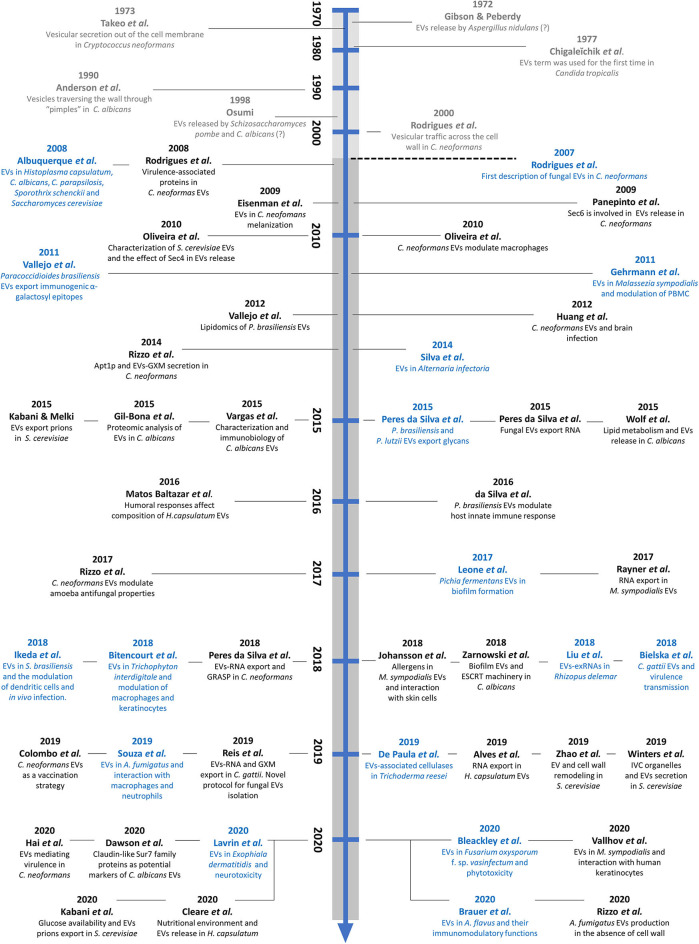
Timeline showing early evidence and recent discoveries in the field of fungal EVs. The studies in gray represent early suggestions of fungal EVs. The dashed line represents the first direct description of fungal EVs, in the C. neoformans model. The studies in blue illustrate the initial characterization of EVs in the twenty different fungal species, and those in black represent compositional, methodological, or functional discoveries regarding fungal EVs.
Figure 2
Figure 2
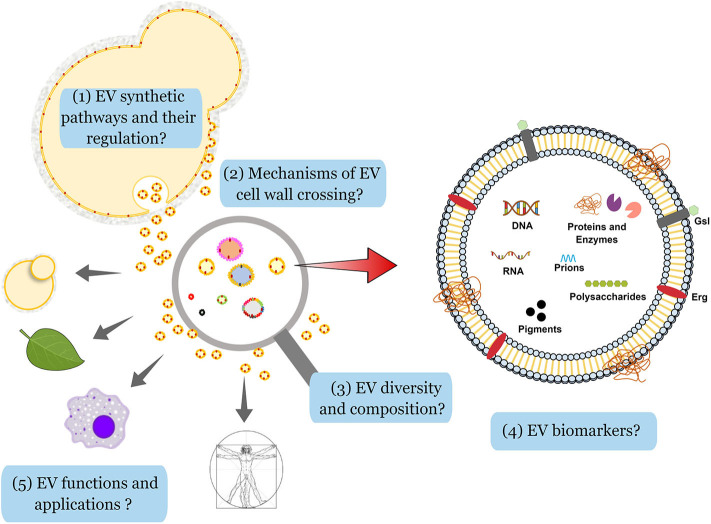
Challenges in the analysis of fungal EVs. By analogy with the metazoans, and based on the knowledge on secretion and regulation of vesicle production in eukaryotes, one can anticipate the existence of a least two pathways for the production of EVs in fungi. Although some elements implicated in these pathways (ESCRT proteins, for instance) have been already identified in fungi, little is known about the differential regulation in the formation of fungal EVs (1). In fungi, the presence of a thick cell wall was initially considered as a physical barrier for EV crossing, but recent evidence has shown that the cell wall is a viscoelastic structure and different hypotheses have been proposed to explore how it is compatible with the transit of lipid membranes (2). On the experimental side, a large diversity of EV morphology, size, and content has been observed, but different technical limitations have impaired the analysis. For instance, NTA or flow cytometry analyses do not detect particles smaller than 100 nm in diameter in a reliable fashion. Moreover, the current protocols used to purify EVs do not prevent contamination with aggregates potentially containing proteins, nucleic acids and polysaccharides, thus limiting the knowledge on EV structure and cargo. Differential EV purification according to their size and/or density from the contaminating aggregates should shed light on their intrinsic diversity (3). Despite their complex composition, including nucleic acids, glycans, pigments, proteins, prions, and different lipids (ergosterol, Erg; glycosphingolipids, Gsl), specific markers of fungal EVs have not been identified so far (4). Finally, very little is known on the role fungal EVs in cell-to-cell communication between different hosts and fungi, but also between fungal cells. One can anticipate that EV diversity could be associated with a diversity of functions and responses of the recipient cells in the presence of different types of vesicles. EV components may also have applicability in biomedical fields, including immunomodulation tools, drug-delivery vehicles, and vaccine candidates (5).

References

    1. Albuquerque P. C., Nakayasu E. S., Rodrigues M. L., Frases S., Casadevall A., Zancope-Oliveira R. M., et al. (2008). Vesicular transport in Histoplasma capsulatum: an effective mechanism for trans-cell wall transfer of proteins and lipids in ascomycetes. Cell. Microbiol. 10, 1695–1710. 10.1111/j.1462-5822.2008.01160.x - DOI - PMC - PubMed
    1. Almeida F., Wolf J. M., Da Silva T. A., Deleon-Rodriguez C. M., Rezende C. P., Pessoni A. M., et al. (2017). Galectin-3 impacts Cryptococcus neoformans infection through direct antifungal effects. Nat. Commun. 8:1968. 10.1038/s41467-017-02126-7 - DOI - PMC - PubMed
    1. Alvarez-Erviti L., Seow Y., Yin H., Betts C., Lakhal S., Wood M. J. (2011). Delivery of siRNA to the mouse brain by systemic injection of targeted exosomes. Nat. Biotechnol. 29, 341–345. 10.1038/nbt.1807 - DOI - PubMed
    1. Alves L. R., Peres Da Silva R., Sanchez D. A., Zamith-Miranda D., Rodrigues M. L., Goldenberg S., et al. (2019). Extracellular vesicle-mediated RNA release in histoplasma capsulatum. mSphere 4:e00176–19. 10.1128/mSphere.00176-19 - DOI - PMC - PubMed
    1. Anderson J., Mihalik R., Soll D. R. (1990). Ultrastructure and antigenicity of the unique cell wall pimple of the Candida opaque phenotype. J. Bacteriol. 172, 224–235. 10.1128/JB.172.1.224-235.1990 - DOI - PMC - PubMed

Publication types