


Understanding the extent of contraceptive non-use among women at risk of unintended pregnancy, National Survey of Family Growth 2011-2017
- PMID: 32760908
- PMCID: PMC7390757
- DOI: 10.1016/j.conx.2020.100033
Understanding the extent of contraceptive non-use among women at risk of unintended pregnancy, National Survey of Family Growth 2011-2017
Abstract
Objective: To describe characteristics of U.S. contraceptive non-users to inform tailored contraceptive access initiatives.
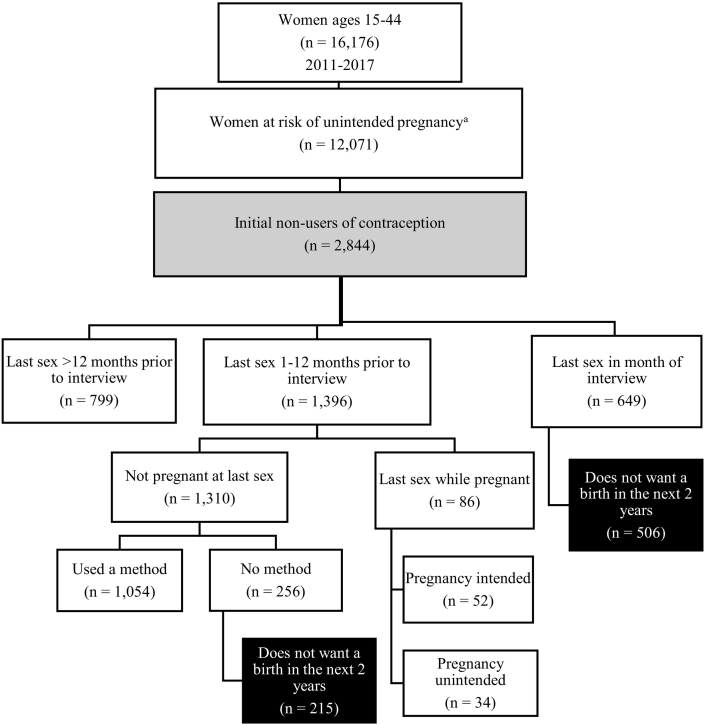
Study design: We used National Survey of Family Growth data from 2011 to 2017 to identify characteristics of contraceptive non-users compared to other women ages 15-44 at risk for unintended pregnancy. We also examined reasons for not using contraception by when non-users expected their next birth. We calculated unadjusted and adjusted prevalence ratios using two definitions of contraceptive non-use: (1) contraceptive non-use during the interview month, and (2) a more refined definition based on contraception use during the most recent month of sexual intercourse and expectation of timing of next birth. We considered p-values < 0.05 statistically significant.
Results: Approximately 20% (n = 2844) of 12,071 women at risk of unintended pregnancy were classified as standard contraceptive non-users. After adjusting for all other variables, non-users were more likely to be low-income, uninsured, never married, expect a birth within 2 years, and have zero or one parity. The top reasons for contraceptive non-use were not minding if they got pregnant (22.6%), worried about contraceptive side effects (21.0%), and not thinking they could get pregnant (17.6%). After applying the more refined non-user definition, we identified 5.7% (n = 721) of women as non-users; expecting a birth within 2-5 years and having a parity of one were associated with non-use after adjustment of all other factors.
Conclusion: Our more refined definition of non-users could be used in future studies examining the causes of unintended pregnancy and to inform programmatic interventions to reduce unintended pregnancy.
Implications: Describing contraceptive non-users and reasons for contraceptive non-use could help us better understand reasons for unintended pregnancy and inform tailored contraceptive access initiatives.
Keywords: Contraceptive access; Contraceptive non-use; National Survey of Family Growth; Unintended pregnancy.
© 2020 The Authors.
Conflict of interest statement
The authors have no conflicts of interest to disclose.
Figures
References
-
- Kost K., Zolna M. Challenging unintended pregnancy as an indicator of reproductive autonomy: a response. Contraception. 2019;100(1):5–9. - PubMed
-
- US Department of Health and Human Services. Healthy People 2020 Objectives: Family Planning. http://www.healthypeople.gov/2020/topicsobjectives2020/overview.aspx?top.... Accessed October 17, 2013.
LinkOut - more resources
Full Text Sources
