. 2020 Sep 14;222(8):1280-1288.
doi: 10.1093/infdis/jiaa467.

Evaluation of Serological Tests for SARS-CoV-2: Implications for Serology Testing in a Low-Prevalence Setting

Affiliations

Evaluation of Serological Tests for SARS-CoV-2: Implications for Serology Testing in a Low-Prevalence Setting

Katherine Bond et al. J Infect Dis. .

Abstract

Background: Robust serological assays are essential for long-term control of the COVID-19 pandemic. Many recently released point-of-care (PoCT) serological assays have been distributed with little premarket validation.

Methods: Performance characteristics for 5 PoCT lateral flow devices approved for use in Australia were compared to a commercial enzyme immunoassay (ELISA) and a recently described novel surrogate virus neutralization test (sVNT).

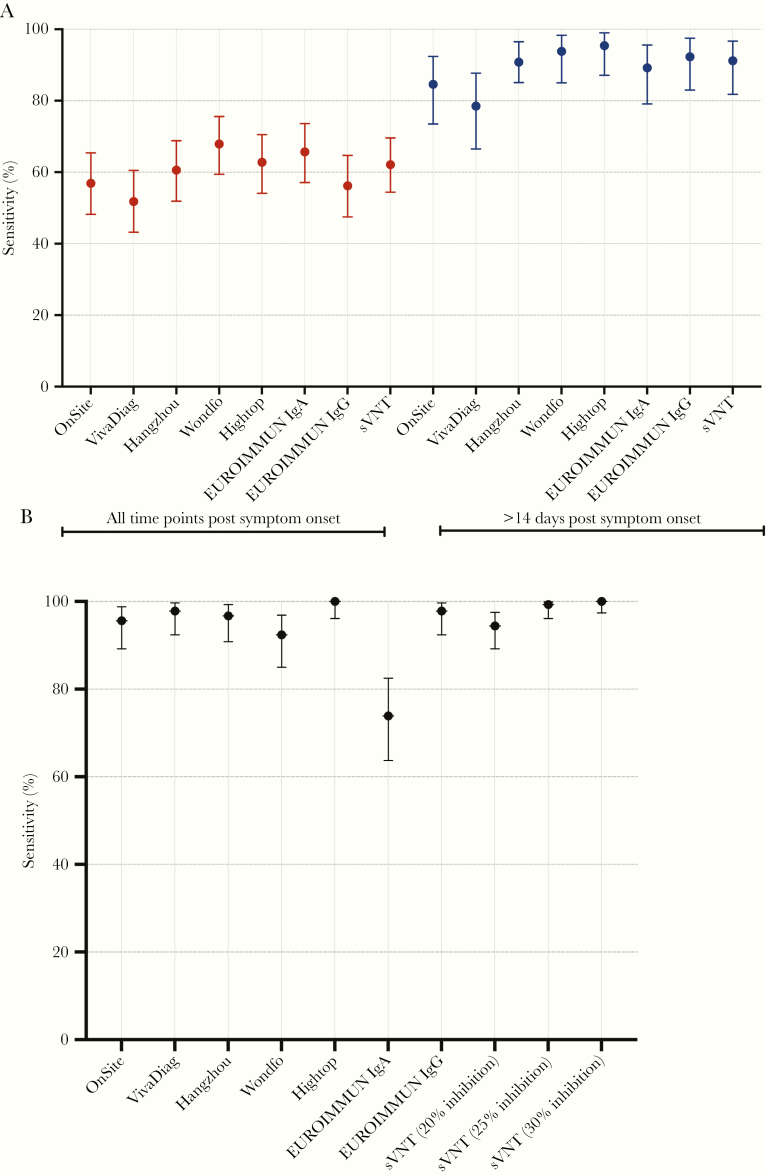
Results: Sensitivities for PoCT ranged from 51.8% (95% confidence interval [CI], 43.1%-60.4%) to 67.9% (95% CI, 59.4%-75.6%), and specificities from 95.6% (95% CI, 89.2%-98.8%) to 100.0% (95% CI, 96.1%-100.0%). ELISA sensitivity for IgA or IgG detection was 67.9% (95% CI, 59.4%-75.6%), increasing to 93.8% (95% CI, 85.0%-98.3%) for samples >14 days post symptom onset. sVNT sensitivity was 60.9% (95% CI, 53.2%-68.4%), rising to 91.2% (95% CI, 81.8%-96.7%) for samples >14 days post symptom onset, with specificity 94.4% (95% CI, 89.2%-97.5%).

Conclusions: Performance characteristics for COVID-19 serological assays were generally lower than those reported by manufacturers. Timing of specimen collection relative to onset of illness or infection is crucial in reporting of performance characteristics for COVID-19 serological assays. The optimal algorithm for implementing serological testing for COVID-19 remains to be determined, particularly in low-prevalence settings.

Keywords: COVID-19; ELISA; lateral flow; neutralization; serology.


Figures

Figure 1.
Figure 1.
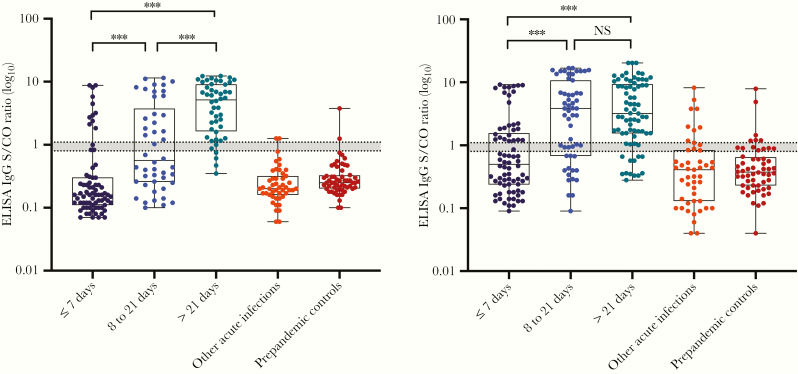
Distribution of signal/cutoff ratios obtained for the EUROIMMUN IgG and IgA ELISA for SARS-CoV-2 cases stratified by time post symptom onset and control sera. Boxes represent median values and interquartile range, and whiskers represent maximum and minimum values. Dotted lines indicate the manufacturer’s cutoff values for interpretation of positive and negative test results, and the shaded grey area represents the range with borderline results. *** P value <.0001. Abbreviations: ELISA, enzyme-linked immunosorbent assay; IgA, immunoglobulin A; IgG, immunoglobulin G; NS, not significant; S/CO, signal/cutoff; SARS-CoV-2, severe acute respiratory syndrome coronavirus 2.
Figure 2.
Figure 2.
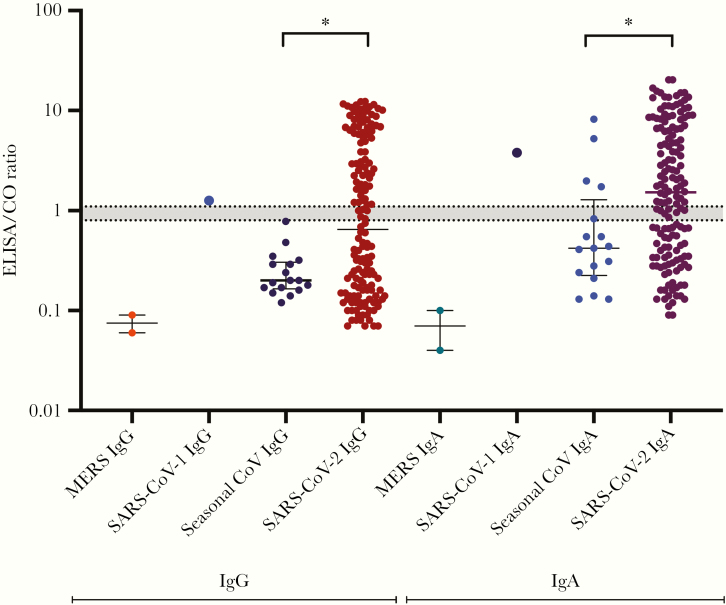
Distribution of signal/cutoff ratios obtained for the EUROIMMUN ELISA for SARS-CoV-2 cases and other human coronavirus infections. Lines represent median values and interquartile ranges. * P value <.01. Abbreviations: ELISA, enzyme-linked immunosorbent assay; IgA, immunoglobulin A; IgG, immunoglobulin G; MERS, Middle East respiratory syndrome; S/CO, signal/cutoff; SARS-CoV-2, severe acute respiratory syndrome coronavirus 2.
Figure 3.
Figure 3.
A, Sensitivity and (B) specificity of 5 different serological point-of-care devices and 1 commercial enzyme immunoassay compared to SARS-CoV-2 RT-PCR. Error bars represent 95% confidence intervals. Abbreviations: IgA, immunoglobulin A; IgG, immunoglobulin G; RT-PCR, reverse transcription polymerase chain reaction; SARS-CoV-2, severe acute respiratory syndrome coronavirus 2; sVNT, virus neutralization test.
Figure 4.
Figure 4.
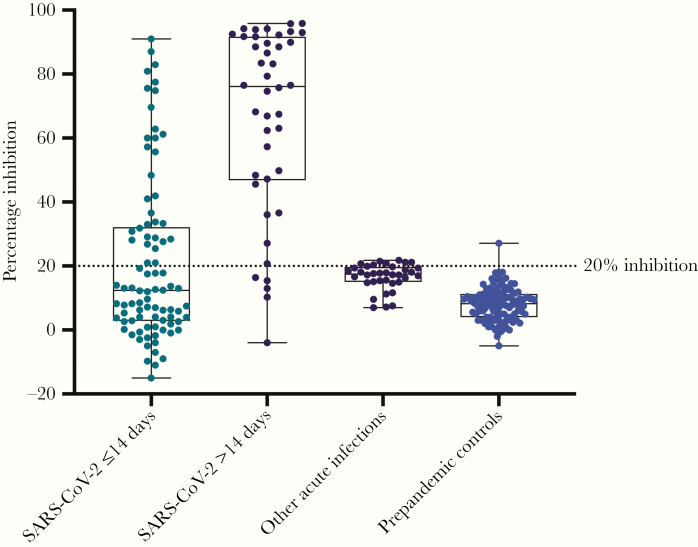
Distribution of surrogate sVNT percentage inhibition for SARS-CoV-2 cases stratified by time post symptom onset and control sera. Boxes represent median values and interquartile range, and whiskers represent maximum and minimum values. *** P value <.0001; *** P value <.01; Abbreviations: SARS-CoV-2, severe acute respiratory syndrome coronavirus 2; sVNT, virus neutralization test.

References

    1. Wu F, Zhao S, Yu B, et al. A new coronavirus associated with human respiratory disease in China. Nature 2020; 579:265–9. - PMC - PubMed
    1. Lu R, Zhao X, Li J, et al. Genomic characterisation and epidemiology of 2019 novel coronavirus: implications for virus origins and receptor binding. Lancet 2020; 395:565–74. - PMC - PubMed
    1. Zhang YZ, Holmes EC. A genomic perspective on the origin and emergence of SARS-CoV-2. Cell 2020; 181:223–7. - PMC - PubMed
    1. Abbasi J. The promise and peril of antibody testing for COVID-19 [published online ahead of print 17 April 2020]. JAMA doi: 10.1001/jama.2020.6170. - DOI - PubMed
    1. Corman VM, Landt O, Kaiser M, et al. Detection of 2019 novel coronavirus (2019-nCoV) by real-time RT-PCR. Euro Surveill 2020; 25:2000045. - PMC - PubMed

Publication types

MeSH terms