


Progression of regional lung strain and heterogeneity in lung injury: assessing the evolution under spontaneous breathing and mechanical ventilation
- PMID: 32761387
- PMCID: PMC7407426
- DOI: 10.1186/s13613-020-00725-0
Progression of regional lung strain and heterogeneity in lung injury: assessing the evolution under spontaneous breathing and mechanical ventilation
Abstract
Background: Protective mechanical ventilation (MV) aims at limiting global lung deformation and has been associated with better clinical outcomes in acute respiratory distress syndrome (ARDS) patients. In ARDS lungs without MV support, the mechanisms and evolution of lung tissue deformation remain understudied. In this work, we quantify the progression and heterogeneity of regional strain in injured lungs under spontaneous breathing and under MV.
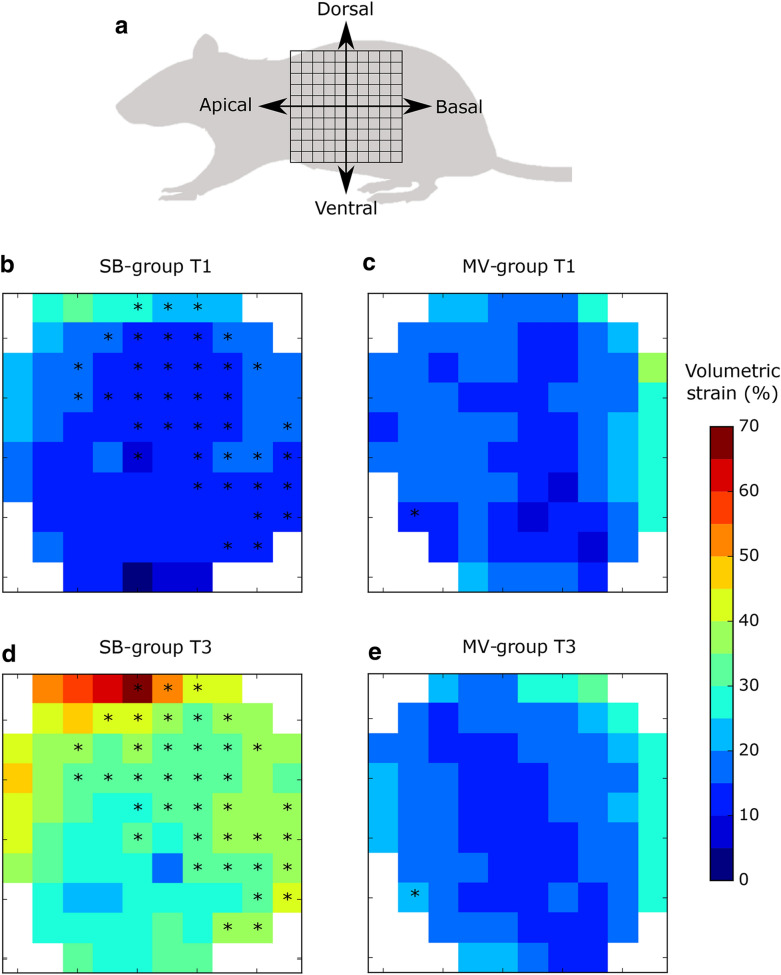
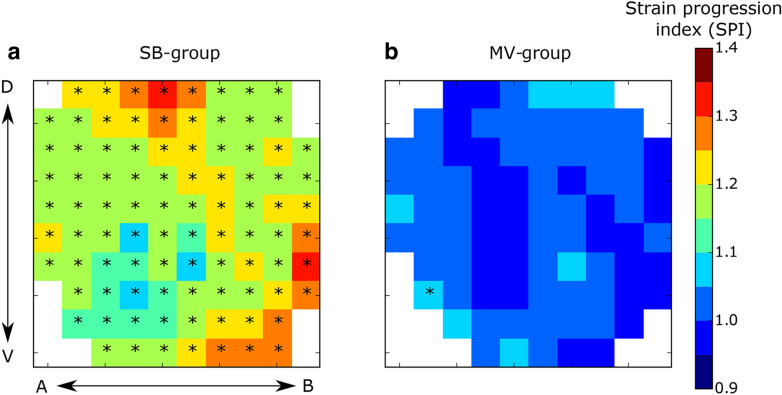
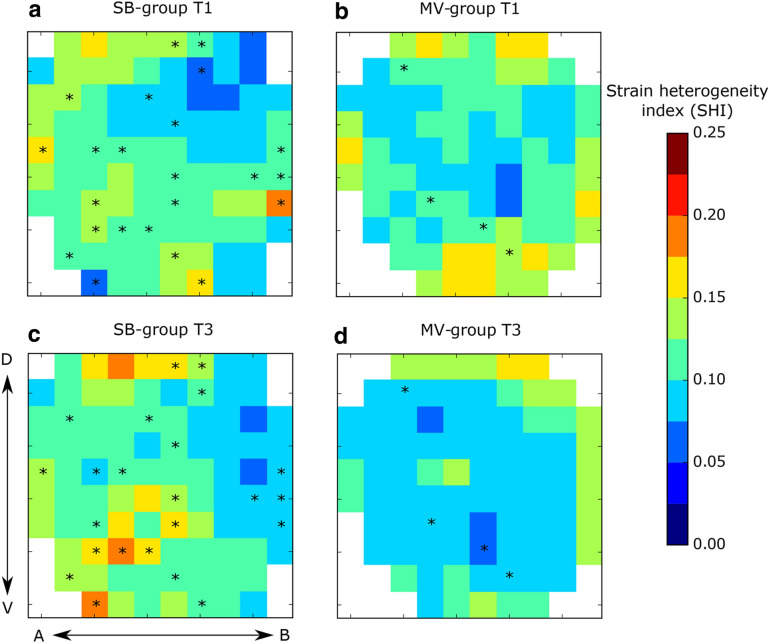
Methods: Lung injury was induced by lung lavage in murine subjects, followed by 3 h of spontaneous breathing (SB-group) or 3 h of low Vt mechanical ventilation (MV-group). Micro-CT images were acquired in all subjects at the beginning and at the end of the ventilation stage following induction of lung injury. Regional strain, strain progression and strain heterogeneity were computed from image-based biomechanical analysis. Three-dimensional regional strain maps were constructed, from which a region-of-interest (ROI) analysis was performed for the regional strain, the strain progression, and the strain heterogeneity.
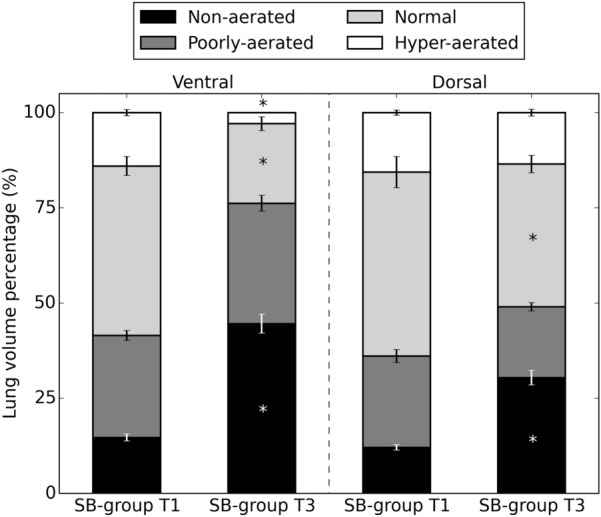
Results: After 3 h of ventilation, regional strain levels were significantly higher in 43.7% of the ROIs in the SB-group. Significant increase in regional strain was found in 1.2% of the ROIs in the MV-group. Progression of regional strain was found in 100% of the ROIs in the SB-group, whereas the MV-group displayed strain progression in 1.2% of the ROIs. Progression in regional strain heterogeneity was found in 23.4% of the ROIs in the SB-group, while the MV-group resulted in 4.7% of the ROIs showing significant changes. Deformation progression is concurrent with an increase of non-aerated compartment in SB-group (from 13.3% ± 1.6% to 37.5% ± 3.1%), being higher in ventral regions of the lung.
Conclusions: Spontaneous breathing in lung injury promotes regional strain and strain heterogeneity progression. In contrast, low Vt MV prevents regional strain and heterogeneity progression in injured lungs.
Keywords: Acute lung injury; Image-based biomechanical analysis; Lung heterogeneity; Lung strain; Mechanical ventilation; Spontaneous breathing.
Conflict of interest statement
The authors declare that they have no competing interests.
Figures
References
-
- Retamal J, Hurtado D, Villarroel N, Bruhn A, Bugedo G, Amato MBP, et al. Does regional lung strain correlate with regional inflammation in acute respiratory distress syndrome during nonprotective ventilation? An experimental porcine study. Crit Care Med. 2018;46:e591–e599. doi: 10.1097/CCM.0000000000003072. - DOI - PubMed
Grants and funding
LinkOut - more resources
Full Text Sources
