


Endothelial Dysfunction and Thrombosis in Patients With COVID-19-Brief Report
- PMID: 32762443
- PMCID: PMC7505138
- DOI: 10.1161/ATVBAHA.120.314860
Endothelial Dysfunction and Thrombosis in Patients With COVID-19-Brief Report
Abstract
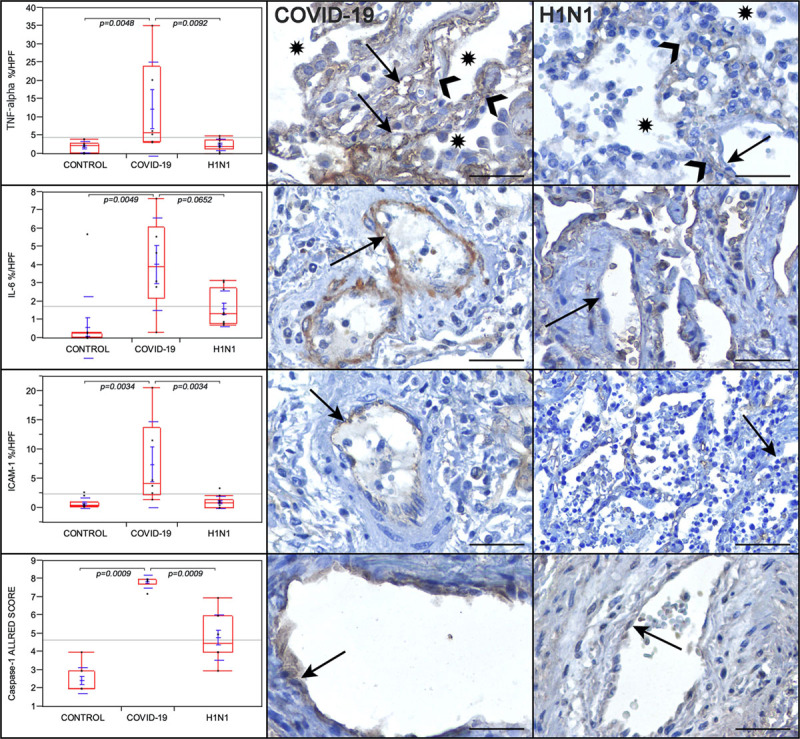
Objective: Alveolar-capillary endothelial cells can be activated by severe acute respiratory syndrome coronavirus 2 infection leading to cytokine release. This could trigger endothelial dysfunction, pyroptosis, and thrombosis, which are the vascular changes, commonly referred to as coronavirus disease 2019 (COVID-19) endotheliopathy. Thus, this study aimed to identify tissue biomarkers associated with endothelial activation/dysfunction and the pyroptosis pathway in the lung samples of patients with COVID-19 and to compare them to pandemic influenza A virus H1N1 subtype 2009 and control cases. Approach and Results: Postmortem lung samples (COVID-19 group =6 cases; H1N1 group =10 cases, and control group =11 cases) were analyzed using immunohistochemistry and the following monoclonal primary antibodies: anti-IL (interleukin)-6, anti-TNF (tumor necrosis factor)-α, anti-ICAM-1 (intercellular adhesion molecule 1), and anticaspase-1. From the result, IL-6, TNF-α, ICAM-1, and caspase-1 showed higher tissue expression in the COVID-19 group than in the H1N1 and control groups.
Conclusions: Our results demonstrated endothelial dysfunction and suggested the participation of the pyroptosis pathway in the pulmonary samples. These conditions might lead to systemic thrombotic events that could impair the clinical staff's efforts to avoid fatal outcomes. One of the health professionals' goals should be to identify the high risk of thrombosis patients early to block endotheliopathy and its consequences.
Keywords: COVID-19; coronavirus; pandemics; pyroptosis; thrombosis.
Conflict of interest statement
None.
Figures
References
-
- Henry BM, Vikse J, Benoit S, Favaloro EJ, Lippi G. Hyperinflammation and derangement of renin-angiotensin-aldosterone system in COVID-19: a novel hypothesis for clinically suspected hypercoagulopathy and microvascular immunothrombosis. Clin Chim Acta. 2020;507:167–173. doi: 10.1016/j.cca.2020.04.027 - PMC - PubMed
-
- Yang M; SSRN Electronic Journal. Cell Pyroptosis, a Potential Pathogenic Mechanism of 2019-nCoV Infection. 2020. https://papers.ssrn.com/sol3/papers.cfm?abstract_id=3527420 Accessed April 10, 2020
-
- Woywodt A, Bahlmann FH, De Groot K, Haller H, Haubitz M. Circulating endothelial cells: life, death, detachment and repair of the endothelial cell layer. Nephrol Dial Transplant. 2002;17:1728–1730. doi: 10.1093/ndt/17.10.1728 - PubMed
MeSH terms
LinkOut - more resources
Full Text Sources
Other Literature Sources
Medical
Miscellaneous
