


Functional deficits in chronic mechanical ankle instability
- PMID: 32762704
- PMCID: PMC7412640
- DOI: 10.1186/s13018-020-01847-8
Functional deficits in chronic mechanical ankle instability
Abstract
Background: The interaction of functional and mechanical deficits in chronic ankle instability remains a major issue in current research. After an index sprain, some patients develop sufficient coping strategies, while others require mechanical support. This study aimed to analyze persisting functional deficits in mechanically unstable ankles requiring operative stabilization.
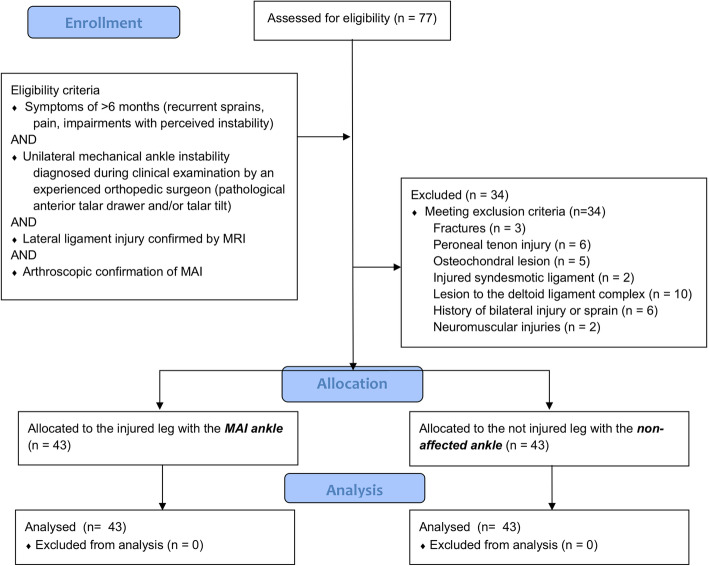
Methods: We retrospectively analyzed the functional testing of 43 patients suffering from chronic, unilateral mechanical ankle instability (MAI) and in which long-term conservative treatment had failed. Manual testing and arthroscopy confirmed mechanical instability. The functional testing included balance test, gait analysis, and concentric-concentric, isokinetic strength measurements and was compared between the non-affected and the MAI ankles.
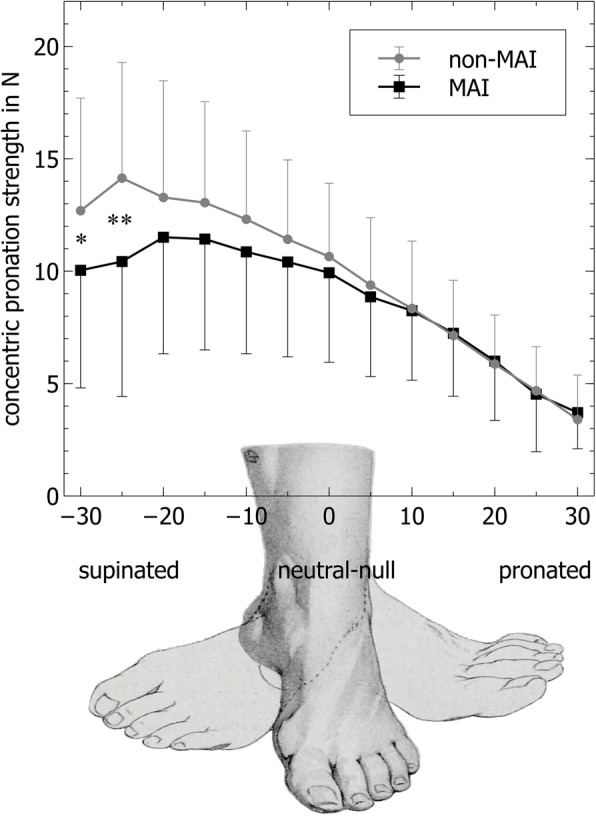
Results: Plantarflexion, supination, and pronation strength was significantly reduced in MAI ankles. A sub-analysis of the strength measurement revealed that in non-MAI ankles, the peak pronation torque was reached earlier during pronation (maximum peak torque angle at 20° vs. 14° of supination, p < 0.001). Furthermore, active range of motion was reduced in dorsiflexion and supination. In balance testing, patients exhibited a significant increased perimeter for the injured ankle (p < 0.02). During gait analysis, we observed an increased external rotation in MAI (8.7 vs. 6.8°, p<0.02).
Conclusions: This study assesses functional deficits existent in a well-defined population of patients suffering from chronic MAI. Impairments of postural sway, gait asymmetries, and asymmetric isokinetic strength can be observed despite long-term functional treatment. The finding that pronation strength is particularly reduced with the foot in a close-to-accident position indicates potential muscular dysfunction in MAI. Possibly, these deficits alongside the underlying mechanical instability characterize patients requiring mechanical stabilization.
Keywords: Mechanical ankle instability; Performance deficits; Peroneal dysfunction.
Conflict of interest statement
No benefits in any form have been received or will be received from a commercial party related directly or indirectly to the subject of this article. The author(s) received no financial support for the research, authorship, and/or publication of this article.
Figures
References
-
- Munn J, Sullivan SJ, Schneiders AG. Evidence of sensorimotor deficits in functional ankle instability: a systematic review with meta-analysis. J Sci Med Sport. 2010;13:2–12. - PubMed
-
- Gehring D, Faschian K, Lauber B, Lohrer H, Nauck T, Gollhofer A. Mechanical instability destabilises the ankle joint directly in the ankle-sprain mechanism. Br J Sports Med. 2014;48:377–382. - PubMed
-
- Lohrer H, Alt W, Gollhofer A. Neuromuscular properties and functional aspects of taped ankles. Am J Sports Med. 1999;27:69–75. - PubMed
Publication types
MeSH terms
LinkOut - more resources
Full Text Sources
Medical
