


Differential and shared effects of psychological skills training and mindfulness training on performance-relevant psychological factors in sport: a randomized controlled trial
- PMID: 32762736
- PMCID: PMC7409666
- DOI: 10.1186/s40359-020-00449-7
Differential and shared effects of psychological skills training and mindfulness training on performance-relevant psychological factors in sport: a randomized controlled trial
Abstract
Background: Mental training intends to support athletes in mastering challenges in sport. The aim of our study was to investigate the differential and shared effects of psychological skills training and mindfulness training on psychological variables relevant to athletic performance (e.g., handling emotions or attention control). We assumed that each approach has its own strengths (e.g., mindfulness has a differential effect on the acceptance of emotions), but for some goals (e.g., attention control), both training forms are expected to be equally successful (i.e., shared effects).
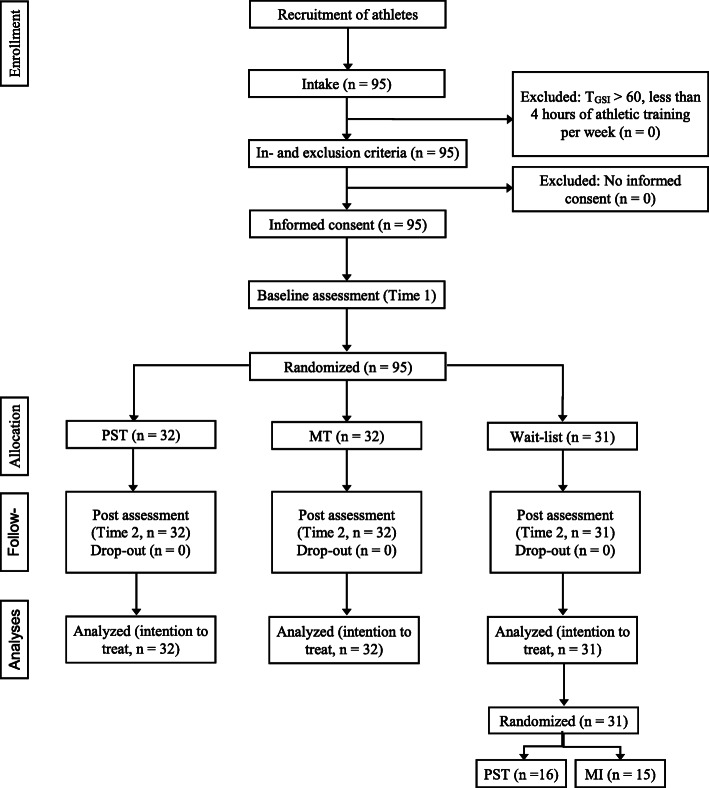
Methods: A total of 95 athletes (Mage = 24.43, SDage = 5.15; 49% female) were randomly assigned into three groups: psychological skills training intervention (PST), mindfulness training intervention (MT), and wait-list control group (WL). Participants completed a questionnaire battery before and after the training (pretest and posttest). We assessed mindfulness, use of mental strategies, handling of emotions, attention in training and competition, as well as the dealing with failure. The two intervention programs each consisted of four 90-min group workshops conducted over a period of 4 weeks.
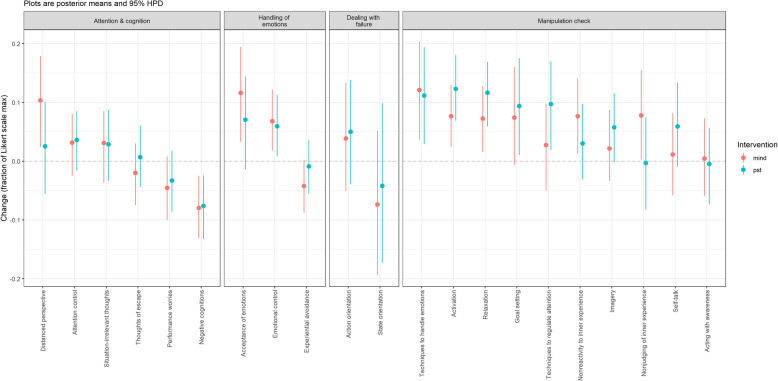
Results: Both interventions passed the manipulation check, that is, PST led to more mental strategies being used (probabilities > 95%), and MT led to an increase in two of three aspects of mindfulness (probabilities > 98%) when compared to WL. Compared to WL, both interventions equally improved in the ability to not let emotions interfere with performance (probabilities > 99%) and in controlling attention in training and competition (probabilities > 89%). To a lesser extend, both interventions showed shared improvements in dealing with failure indicated by more action orientation (probabilities > 82%). We found a differential effect of MT on decreased experiential avoidance: MT decreased compared to WL and PST (probabilities > 92%), whereas PST did not differ from WL.
Conclusion: We conclude that both forms of mental training lead to improvements in performance-relevant psychological factors, especially concerning the handling of emotions and attention control. The results of our study suggest that different paths may lead to the desired outcomes, and accordingly, both forms of mental training seem justified.
Trial registration number: ISRCTN11147748 , date of registration: July 11, 2016.
Keywords: Athletic performance; Bayesian analysis; Competitive sport; Intervention; Mindfulness; Psychological skills training; Randomized controlled trial; Sport psychology.
Conflict of interest statement
The authors declare that they have no competing interests.
Figures
References
-
- Beckmann J. Fragebogen zur Handlungskontrolle im sport (HOSP) München: TUM; 2003.
-
- Beckmann J, Kazén M. Action and state orientation and the performance of the top athletes. In: Kuhl J, Beckmann J, editors. Volition and personality. Action versus state orientation. Göttingen: Hogrefe & Huber Publishers; 1994. pp. 439–451.
-
- Bergman AL, Christopher MS, Bowen S. Changes in facets of mindfulness predict stress and anger outcomes for police officers. Mindfulness. 2016;7(4):851–858. doi: 10.1007/s12671-016-0522-z. - DOI
-
- Berking M, Znoj H. Entwicklung und Validierung eines Fragebogens zur standardisierten Selbsteinschätzung emotionaler Kompetenzen. Z Psychiatr Psychol Psychother. 2008;56:141–152. doi: 10.1024/1661-4747.56.2.141. - DOI
