


Do olfactory and gustatory psychophysical scores have prognostic value in COVID-19 patients? A prospective study of 106 patients
- PMID: 32762737
- PMCID: PMC7406962
- DOI: 10.1186/s40463-020-00449-y
Do olfactory and gustatory psychophysical scores have prognostic value in COVID-19 patients? A prospective study of 106 patients
Abstract
Background: The lack of objective data makes it difficult to establish the prognostic value of chemosensitive disorders in coronavirus disease 2019 (COVID-19) patients. We aimed to prospectively monitor patients diagnosed with COVID-19 to see if the severity of olfactory and gustatory dysfunction associates with subsequent disease severity.
Methods: Multicentre prospective study that recruited 106 COVID-19 subjects at diagnosis. Chemosensitive functions were assessed with psychophysical tests within 4 days of clinical onset, at 10 and 20 days. Daily body temperature and oxygen saturation were recorded as markers of disease severity alongside need for hospitalisation. The correlation between olfactory and gustatory scores and disease severity was assessed with linear regression analysis.
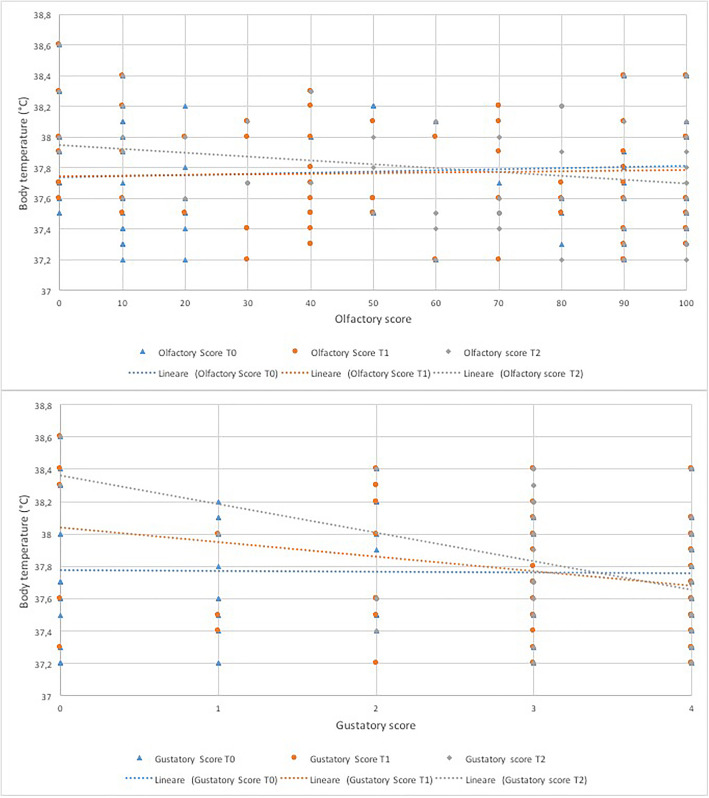
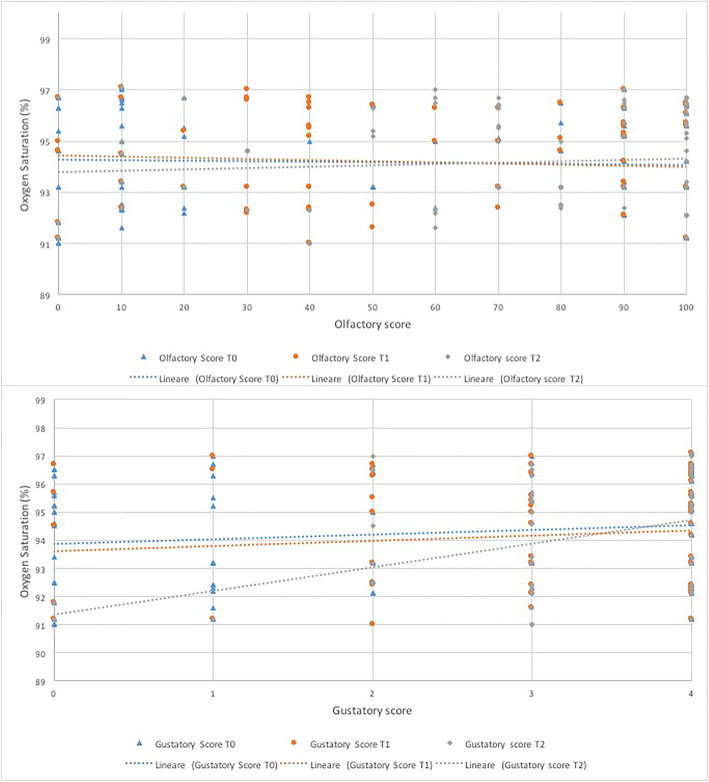
Results: At T0, 71 patients (67%) presented with olfactory dysfunction while gustatory impairment was detected in 76 cases (65.6%). Chemosensitive disorders gradually improved over the observation period. No significant correlations were found between T0 chemosensitive scores and final disease severity. The correlation between olfactory scores and fever proved significant at T2 (p = 0.05), while the relationship with gustatory scores was significant at T1 (p = 0.01) and T2 (p < 0.001), however neither was clinically relevant. The correlation between chemosensitive scores and oxygen saturation was significant only for taste at T2 (p < 0.001). Logistic regression analysis found significant correlations between olfactory impairment severity and need for hospitalization at T2 (OR 3.750, p = 0.005).
Conclusions: Initial objective olfactory and gustatory scores do not seem to have a significant prognostic value in predicting the severity of the COVID-19 course; however, persistence of olfactory dysfunction at 20 days, associated with a more severe course. Unfortunately, olfactory and gustatory dysfunction do not seem to hold prognostic value at the time of initial diagnosis.
Keywords: Ageusia; Anosmia; COVID-19; Gustatory; Olfactory.
Conflict of interest statement
The authors declare that they have no competing interests.
Figures
References
-
- Hopkins C, Surda P, Kumar N. Presentation of new onset anosmia during the COVID-19 pandemic. Rhinology. 2020. 10.4193/Rhin20.116. - PubMed
Publication types
MeSH terms
LinkOut - more resources
Full Text Sources
Medical
