. 2020 Oct;48(10):1273-1275.
doi: 10.1016/j.ajic.2020.07.031. Epub 2020 Aug 4.

Susceptibility of SARS-CoV-2 to UV irradiation

Affiliations

Susceptibility of SARS-CoV-2 to UV irradiation

Christiane Silke Heilingloh et al. Am J Infect Control. 2020 Oct.

Abstract

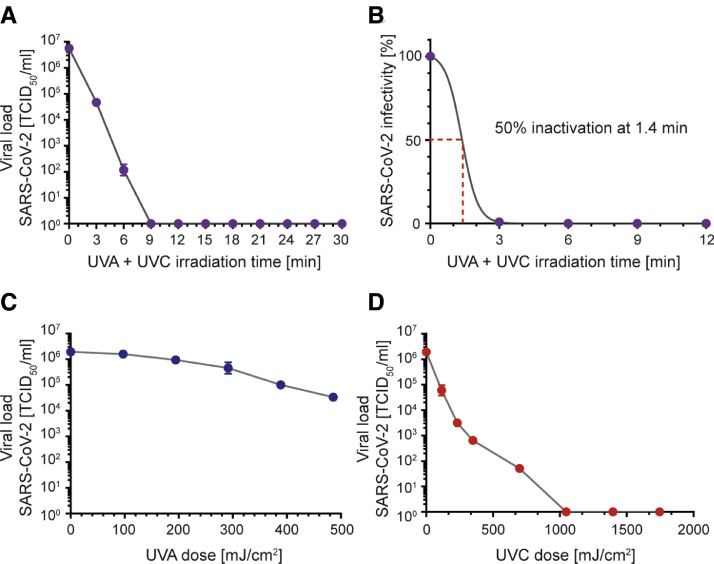
The coronavirus SARS-CoV-2 pandemic became a global health burden. We determined the susceptibility of SARS-CoV-2 to irradiation with ultraviolet light. The virus was highly susceptible to ultraviolet light. A viral stock with a high infectious titer of 5 × 10⁶ TCID50/mL was completely inactivated by UVC irradiation after nine minutes of exposure. The UVC dose required for complete inactivation was 1,048 mJ/cm2. UVA exposure demonstrated only a weak effect on virus inactivation over 15 minutes. Hence, inactivation of SARS-CoV-2 by UVC irradiation constitutes a reliable method for disinfection purposes in health care facilities and for preparing SARS-CoV-2 material for research purpose.

Keywords: COVID-19; Inactivation; Ultraviolet light.


Figures

Fig 1
Fig 1
Inactivation of SARS-CoV-2 by UV irradiation. SARS-CoV-2 at a starting concentration of 5 × 106 TCID50/ml was irradiated with ultraviolet light (UV). UV treatment was performed by irradiation with UVC (254 nm) and/or UVA (365 nm) on 600 µl aliquots of virus in 24-well plates. The UV light source was placed at a distance of 3 cm above the bottom of the plate. Viral loads were determined by end point dilution after (A) combined UVA/UVC exposure at the indicated time points or separate exposure to (C) UVA light after 0, 3, 6, 9, 12, and 15 minutes or (D) UVC light after 0, 1, 2, 3, 6, 9, 12, and 15 minutes. (B) Nonlinear regression was conducted to calculate the duration of combined UVA and UVC irradiation sufficient to inactivate the virus by 50%. The emitted light dose was measured with = 1940 µW/cm2 for UVC (254 nm) and 540 µW/cm2 for UVA (365 nm) at a distance of 3 cm. This corresponds to an applied light dose of 1.94 mJ/cm2 per second for UVC and 0.54 mJ/cm2 per second for UVA (µW = 10−6 J/s). The experiments were performed in triplicates. Error bars represent the standard deviation of the mean.

References

    1. Zhu N, Zhang D, Wang W, et al. A novel coronavirus from patients with pneumonia in China, 2019. N Engl J Med. 2020;382:727–733. - PMC - PubMed
    1. Li R, Pei S, Chen B, et al. Substantial undocumented infection facilitates the rapid dissemination of novel coronavirus (SARS-CoV-2) Science. 2020;368:489–493. - PMC - PubMed
    1. Guan WJ, Ni ZY, Hu Y, et al. Clinical characteristics of coronavirus disease 2019 in China. N Engl J Med. 2020;382:1708–1720. - PMC - PubMed
    1. Casini B, Tuvo B, Cristina ML, et al. Evaluation of an ultraviolet C (UVC) light-emitting device for disinfection of high touch surfaces in hospital critical areas. Int J Environ Res Pub Health. 2019;16 - PMC - PubMed
    1. Darnell ME, Subbarao K, Feinstone SM, Taylor DR. Inactivation of the coronavirus that induces severe acute respiratory syndrome, SARS-CoV. J Virol Methods. 2004;121:85–91. - PMC - PubMed

Publication types