Review
. 2021 Jan 5:401:123415.
doi: 10.1016/j.jhazmat.2020.123415. Epub 2020 Jul 8.

Environmental fate, toxicity and risk management strategies of nanoplastics in the environment: Current status and future perspectives

Affiliations
Review

Environmental fate, toxicity and risk management strategies of nanoplastics in the environment: Current status and future perspectives

Liuwei Wang et al. J Hazard Mater. .

Abstract

Tiny plastic particles considered as emerging contaminants have attracted considerable interest in the last few years. Mechanical abrasion, photochemical oxidation and biological degradation of larger plastic debris result in the formation of microplastics (MPs, 1 μm to 5 mm) and nanoplastics (NPs, 1 nm to 1000 nm). Compared with MPs, the environmental fate, ecosystem toxicity and potential risks associated with NPs have so far been less explored. This review provides a state-of-the-art overview of current research on NPs with focus on currently less-investigated fields, such as the environmental fate in agroecosystems, migration in porous media, weathering, and toxic effects on plants. The co-transport of NPs with organic contaminants and heavy metals threaten human health and ecosystems. Furthermore, NPs may serve as a novel habitat for microbial colonization, and may act as carriers for pathogens (i.e., bacteria and viruses). An integrated framework is proposed to better understand the interrelationships between NPs, ecosystems and the human society. In order to fully understand the sources and sinks of NPs, more studies should focus on the total environment, including freshwater, ocean, groundwater, soil and air, and more attempts should be made to explore the aging and aggregation of NPs in environmentally relevant conditions. Considering the fact that naturally-weathered plastic debris may have distinct physicochemical characteristics, future studies should explore the environmental behavior of naturally-aged NPs rather than synthetic polystyrene nanobeads.

Keywords: Contaminant migration; Environmental remediation; Plastic pollution; Risk management; Terrestrial ecosystem; Virus.


Conflict of interest statement

The authors declare that they have no known competing financial interests or personal relationships that could have appeared to influence the work reported in this paper.

Figures

None
Graphical abstract
Fig. 1
Fig. 1
Schematic illustration of various separation methods for NPs: (a) Differential separation, a typical ultracentrifugation method. Reproduced with permission from (Li et al., 2018). Copyright 2018 Elsevier; (b) Separation of particles using asymmetrical flow field flow fractionation (AF4). Smaller particles possess higher diffusion coefficients, which stabilize further away from the membrane. Thereby, they are subjected to faster steamlines than larger ones, and exit the channel more quickly. Reproduced with permission from (Müller et al., 2015). Copyright 2015 Frontiers Media; (c) Isolation of NPs from facial scrubs using five filtration steps. Reproduced with permission from (Hernandez et al., 2017). Copyright 2017 American Chemical Society.
Fig. 2
Fig. 2
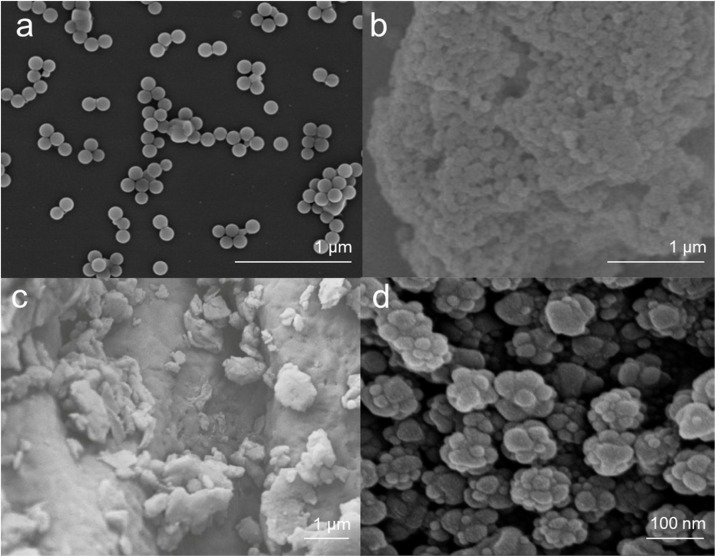
Morphologies of various NPs: (a) commercially available polystyrene (PS) nano-bead particles (Lei et al., 2018); (b) commercially available polytetrafluoroethylene (PTFE) nanoparticles with diameter of 120 nm (Liu et al., 2019b); (c) nano-sized polystyrene (PS) particles attached on surface of polystyrene spherule, which were fragmented from the expanded polystyrene spherules by accelerated mechanical abrasion for a month (Koelmans et al., 2015); (d) synthetic metal-doped polyacrylonitrile (PAN) nanoparticle with a raspberry-like appearance (Mitrano et al., 2019). All images are reproduced with permission.
Fig. 3
Fig. 3
Accumulation of polystyrene NPs in plant tissues: (a) wheat leaves after 10 mg/L NPs treatment (Lian et al., 2020); (b) wheat roots after 10 mg/L NPs treatment (Lian et al., 2020); (c) onion root cell after 100 mg/L NPs treatment, NPs were observed in the cytoplasm. M, mitochondria; N, nucleus (Giorgetti et al., 2020); (d) onion root cell after 1000 mg/L NPs treatment, NPs were observed in the nucleus. CR, chromatin (Giorgetti et al., 2020). All images are reproduced with permission.
Fig. 4
Fig. 4
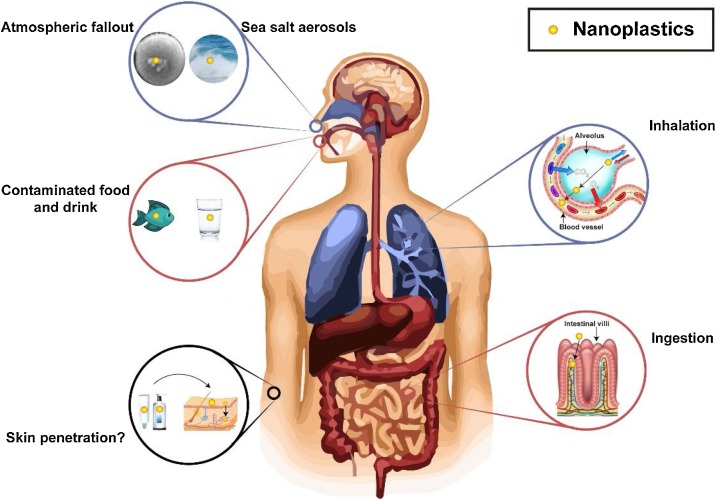
Human exposure pathways of NPs. Blue – inhalation; red – ingestion; black – dermal.
Fig. 5
Fig. 5
Factors determining the toxicity of contaminants attached onto NPs. Organisms may either uptake free-available contaminants directly, or uptake NP-adsorbed contaminants. The sorption coefficient, Kpw, is critical for the understanding of adsorption-desorption. The toxicity of NP-attached contaminants are mainly affected by the size and concentration of NPs, whilst the toxicity is also dependent on the species and the contaminant hydrophobicity/polarity.
Fig. 6
Fig. 6
A DPSIR framework for the risk assessment of NPs. The growing demand of plastic products as a result of the increase in population and economic growth is the driving force. This has led to the release of MPs and NPs from various land-based or sea-based sources of plastic waste input (pressures). After entering the environment, NPs undergo aging, aggregation and migration processes. NPs in the terrestrial ecosystems may end up in soils, and some of them will be bioaccumulated by plants or migrate to the groundwater. A number of plastic particles will enter the aquatic systems and end up in river or lake sediments, or in the ocean (states). The presence of NPs in the environment may pose risks to both terrestrial and aquatic organisms. NPs may also threat the human health through the food chain, or via direct inhalation and dermal exposure (impacts). It is therefore necessary to seek for risk mitigation strategies in response to NP contamination, including the development of novel remediation strategies, the establishment of policies, and the enhancement of environmental education (responses).
Fig. 7
Fig. 7
Technical, legal and social strategies for the remediation and risk containment of NP contamination.

References

    1. Alexy P., Anklam E., Emans T., Furfari A., Galgani F., Hanke G., Koelmans A., Pant R., Saveyn H., Sokull Kluettgen B. Managing the analytical challenges related to micro- and nanoplastics in the environment and food: filling the knowledge gaps. Food Addit. Contam. Part A Chem. Anal. Control Exposure Risk Assess. 2020;37:1–10. - PubMed
    1. Alimi O.S., Farner Budarz J., Hernandez L.M., Tufenkji N. Microplastics and nanoplastics in aquatic environments: aggregation, deposition, and enhanced contaminant transport. Environ. Sci. Technol. 2018;52:1704–1724. - PubMed
    1. Allen S., Allen D., Phoenix V.R., Le Roux G., Durántez Jiménez P., Simonneau A., Binet S., Galop D. Atmospheric transport and deposition of microplastics in a remote mountain catchment. Nat. Geosci. 2019;12:339–344.
    1. Amaral-Zettler L.A., Zettler E.R., Mincer T.J. Ecology of the plastisphere. Nat. Rev. Microbiol. 2020;18:139–151. - PubMed
    1. Andrady A.L. Microplastics in the marine environment. Mar. Pollut. Bull. 2011;62:1596–1605. - PubMed

Publication types

LinkOut - more resources