


Clinical evaluation of five different automated SARS-CoV-2 serology assays in a cohort of hospitalized COVID-19 patients
- PMID: 32763809
- PMCID: PMC7367003
- DOI: 10.1016/j.jcv.2020.104549
Clinical evaluation of five different automated SARS-CoV-2 serology assays in a cohort of hospitalized COVID-19 patients
Abstract
Background: The global market for SARS-CoV-2-immunoassays is becoming ever more crowded with antibody-tests of various formats, targets and technologies, careful evaluation is crucial for understanding the implications of individual test results. Here, we evaluate the clinical performance of five automated immunoassays on a set of clinical samples.
Methods: Serum/plasma samples of 75 confirmed COVID-19 patients and 320 pre-pandemic serum samples of healthy blood donors were subjected to two IgG and three total antibody SARS-CoV-2-immunoassays. All test setups were automated workflows.
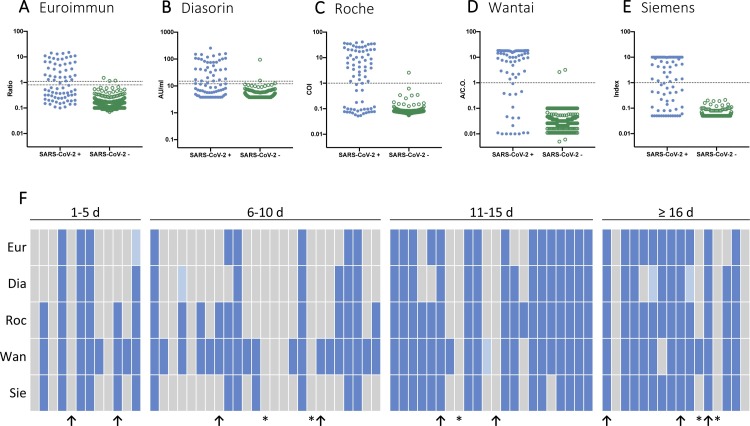
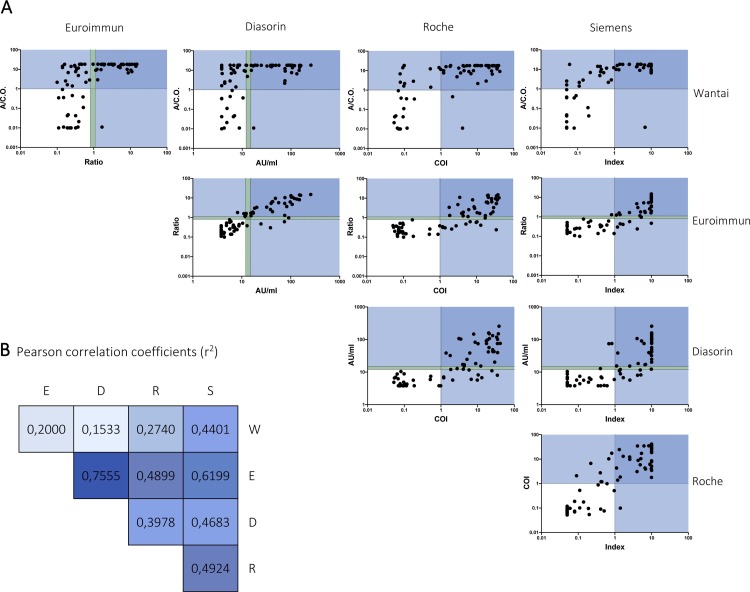
Results: Positivity of assays (onset of symptoms > 10 days) ranged between 68.4 % and 81.6 % (Diasorin 68.4 %, Euroimmun 70.3 %, Siemens 73.7 %, Roche 79.0 % and Wantai 81.6 %). All examined assays demonstrated high specificity of >99 % (Euroimmun, Diasorin: 99.1 %, Wantai: 99.4 %) but only two reached levels above 99.5 % (Roche: 99.7 %, Siemens 100 %). Interestingly, there was no overlap in false positive results between the assays. The strongest correlation of quantitative results was observed between the Diasorin and Euroimmun IgG tests (r2 = 0.76). Overall, we observed no difference in the distribution of test results between female and male patients (p-values: 0.18-0.87). A significant difference between severely versus critically ill patients was demonstrated for the Euroimmun, Diasorin, Wantai and Siemens assays (p-values:0.041).
Conclusion: All assays showed good clinical performance. Our data confirm that orthogonal test strategies as recommended by the CDC can enhance clinical specificity. However, the suboptimal rates of test positivity found at time of hospitalization in this cohort underline the importance of molecular diagnostics to rule out/confirm active infection with SARS-CoV-2.
Keywords: COVID-19; SARS-CoV-2; Serology.
Copyright © 2020 Elsevier B.V. All rights reserved.
Conflict of interest statement
Marc Lütgehetmann has received travel expenses and speakers’ honoraria (Roche Diagnostics, Diasorin, Biomerieux). The other authors declare that they have no conflict of interest.
Figures
References
-
- Bryant J.E., Azman A.S., Ferrari M.J., Arnold B.F., Boni M.F., Boum Y. Serology for SARS-CoV-2: apprehensions, opportunities, and the path forward. Sci. Immunol. 2020;5(47) - PubMed
-
- FDA . US Food & Drug Administration Website; 2020. EUA Authorized Serology Test Performance.
-
- Lassaunière R., Frische A., Harboe Z.B., Nielsen A.C., Fomsgaard A., Krogfelt K.A. Evaluation of nine commercial SARS-CoV-2 immunoassays. medRxiv. 2020;2020 04.09.20056325.
Publication types
MeSH terms
Substances
LinkOut - more resources
Full Text Sources
Miscellaneous
