


COVID-19 and Parent-Child Psychological Well-being
- PMID: 32764151
- PMCID: PMC7546085
- DOI: 10.1542/peds.2020-007294
COVID-19 and Parent-Child Psychological Well-being
Abstract
Background and objectives: The outbreak of coronavirus disease 2019 has changed American society in ways that are difficult to capture in a timely manner. With this study, we take advantage of daily survey data collected before and after the crisis started to investigate the hypothesis that the crisis has worsened parents' and children's psychological well-being. We also examine the extent of crisis-related hardships and evaluate the hypothesis that the accumulation of hardships will be associated with parent and child psychological well-being.
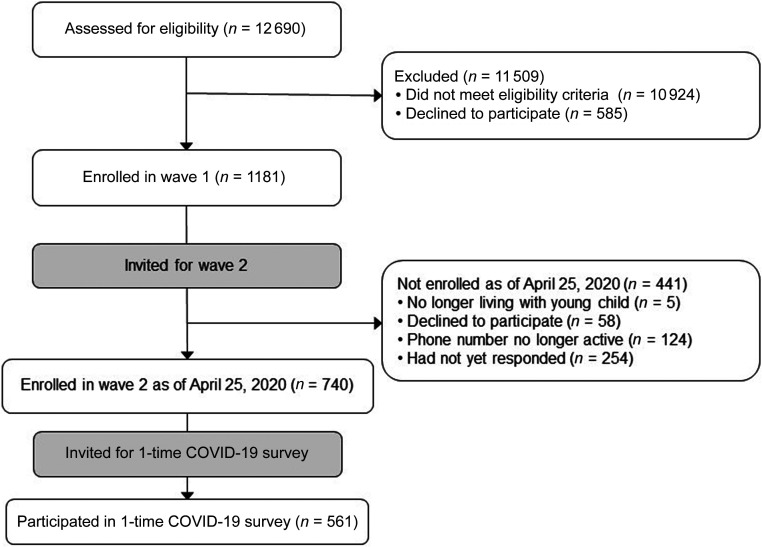
Methods: Daily survey data were collected between February 20 and April 27, 2020, from hourly service workers with a young child (aged 2-7) in a large US city (N = 8222 person-days from 645 individuals). A subsample completed a one-time survey about the effects of the crisis fielded between March 23 and April 26 (subsample n = 561).
Results: Ordered probit models revealed that the frequency of parent-reported daily negative mood increased significantly since the start of the crisis. Many families have experienced hardships during the crisis, including job loss, income loss, caregiving burden, and illness. Both parents' and children's well-being in the postcrisis period was strongly associated with the number of crisis-related hardships that the family experienced.
Conclusions: Consistent with our hypotheses, in families that have experienced multiple hardships related to the coronavirus disease 2019 crisis, both parents' and children's mental health is worse. As the crisis continues to unfold, pediatricians should screen for mental health, with particular attention to children whose families are especially vulnerable to economic and disease aspects of the crisis.
Copyright © 2020 by the American Academy of Pediatrics.
Conflict of interest statement
POTENTIAL CONFLICT OF INTEREST: The authors have indicated they have no potential conflicts of interest to disclose.
References
-
- National Academy for State Health Policy Chart: each state’s COVID-19 reopening and reclosing plans and mask requirements. 2020. Available at: https://www.nashp.org/governors-prioritize-health-for-all/. Accessed July 27, 2020
-
- Bureau of Labor Statistics Unemployment insurance weekly claims. 2020. Available at: https://www.dol.gov/ui/data.pdf. Accessed July 10, 2020
-
- Johns Hopkins University Center for Systems Science and Engineering COVID-19 dashboard by the Center for Systems Science and Engineering (CSSE) at Johns Hopkins University. 2020. Available at: https://gisanddata.maps.arcgis.com/apps/opsdashboard/index.html#/bda7594.... Accessed July 27, 2020
-
- McKee-Ryan F, Song Z, Wanberg CR, Kinicki AJ. Psychological and physical well-being during unemployment: a meta-analytic study. J Appl Psychol. 2005;90(1):53–76 - PubMed
-
- Gassman-Pines A, Schenck-Fontaine A. Economic Strain and Job Loss In: Fiese BH, ed.. APA Handbook of Contemporary Family Psychology. Washington, DC: American Psychological Association; 2018:457–470
Publication types
MeSH terms
Grants and funding
LinkOut - more resources
Full Text Sources
Medical
Research Materials
Miscellaneous
